
Politics · taz · · 3h
NSU murder in Hamburg: The Federal Prosecutor General is hindering the investigation
Deutsch (original) · Auto-translated to English
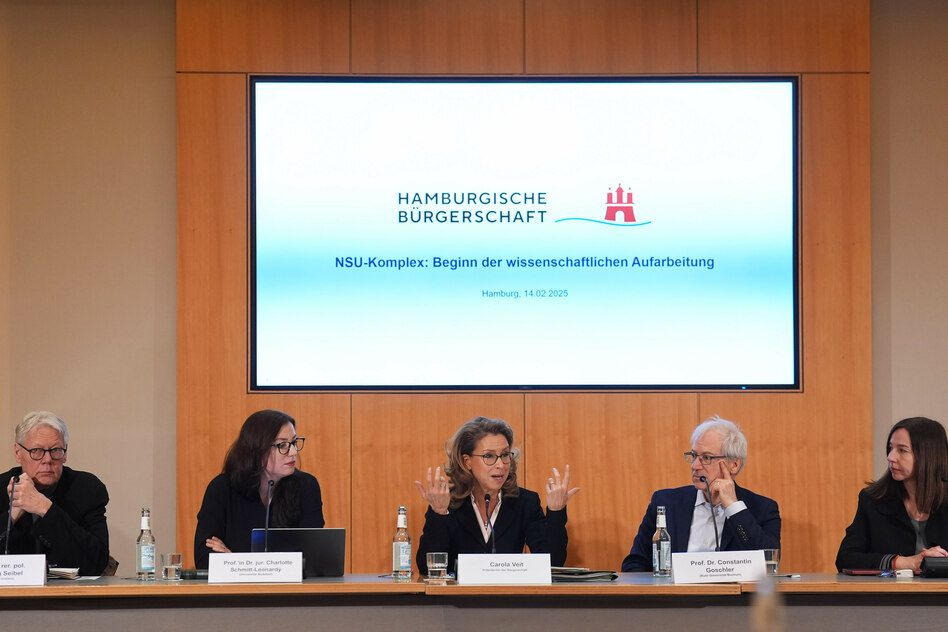
The interdisciplinary research team investigating the murder of Süleyman Taşköprü in Hamburg on behalf of the Hamburg citizens has already looked through around 8,000 pages of files. Terrorists from the Nazi group National Socialist Underground (NSU) shot Taşköprü in his vegetable shop in 2001. Unlike in many federal states, Hamburg's citizens decided against an investigative committee and instead decided on a scientific examination of the question of why the security authorities did not investigate right-wing terrorism for a long time.
The first media analyzes have already been carried out. However, it could be that the scientific work-up is not completed. The Federal Prosecutor General in Karlsruhe still does not want to release the files of the State Criminal Police Office in Hamburg. The researchers therefore contacted the responsible Karlsruhe Higher Regional Court.
The legal dispute not only costs time, it also ties up “significant legal resources,” said Charlotte Schmitt-Leonardy, a legal scholar at Bielefeld University, in Hall 151 of Hamburg City Hall, where the team recently presented the status of its research. Its head, Konstantin Goschler, contemporary historian at the Ruhr University Bochum, pointed out that the scientists could not assess the exchange between the State Criminal Police Office (LKA), specifically the State Security, and the State Office for the Protection of the Constitution (LfV) as long as the LKA files were not accessible.
Team member Ivo Komljen specified that the available sources from the state security agency partially showed that there was a “knowledge asymmetry” between the LfV and the LKA and a “dysfunctional friction process” that led to the persistent assumption that the murder was motivated by criminal motives - and to the exclusion of right-wing extremist motives. However, this can only be understood more precisely with the LKA files. This is the only way to reach a conclusion with recommendations.
Since January 12th of this year, the Karlsruhe Higher Administrative Court has had an application from the research group and the Hamburg citizens for a court decision regarding access to these files. The court should oblige the Federal Prosecutor General to grant the research team's request for access to files dated October 4, 2025. By refusing to inspect the files, the Federal Prosecutor General has now hindered scientific work for twelve months.
The scientific work-up is actually scheduled for the end of 2027. Schmitt-Leonardy didn't want to talk about a plan B if that wasn't enough. She hopes that the Federal Prosecutor General will give up his total blockade attitude, because in “times like these” state institutions also know that they have to open up to the public. The research team has signaled that it will be completely open about the “how” of accessing the files: they are also prepared to view the files in secure rooms at the Federal Prosecutor General's office and to accommodate him in terms of data protection.
However, team leader Goschler did not want to rule out the possibility of considering extending the research contract. But he could also imagine a change in the order. However, a shift in focus away from the LKA would hardly correspond to the original mandate. In the presentation of the research project on the citizen's website, five of the six questions are explicitly aimed at police investigations. Without the LKA files, research would reach its limits here.
The researchers admitted that Süleyman Taşköprü's relatives were disappointed with their work. The family sees the research project as a “consolation prize” anyway; they would have wanted a parliamentary committee of inquiry – and are still calling for one to this day. The research team has inherited a legacy, said Goschler.
In addition, they only tried to contact the family after studying the files - as is consistent with scientific standards. It came too late for the family. The team still hopes to talk to the relatives. You definitely want to take the perspective of those affected into account.
Read the full story at the source
Source: taz