
Politics · taz · · 1h
Non-voters in Berlin: You have no choice
Deutsch (original) · Auto-translated to English
A ysel Kılıç's* eyes light up as she shows a photo of the baby on her cell phone. Her first grandchild was born a few weeks ago. She raised three children in Berlin. Two daughters and a son, all three have completed their studies and all have German citizenship, she says. The Turkish citizen and her husband applied for naturalization last year. It worked for him straight away. “But my application hasn’t been processed yet,” she says. Kılıç is therefore not allowed to vote in the elections for the Berlin House of Representatives and the district councils on Sunday.
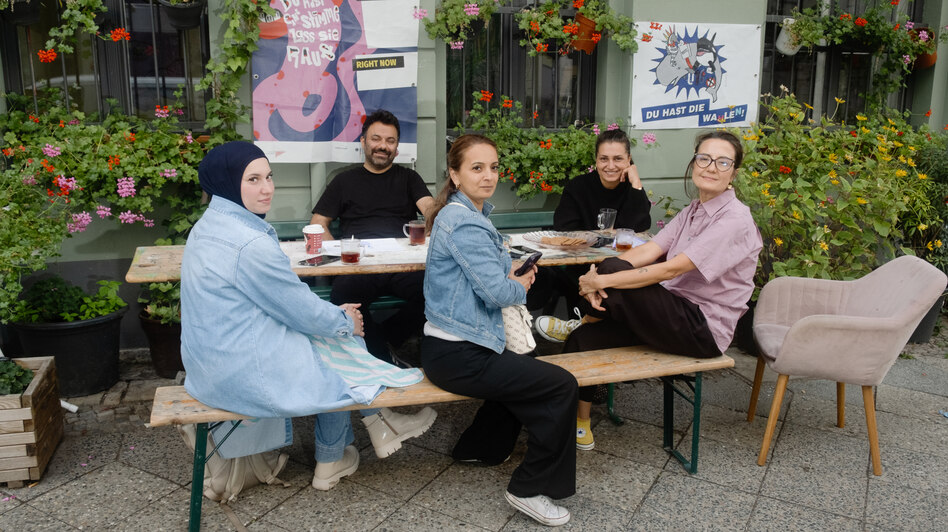
Aysel Kılıç was 15 years old when she came to Berlin in 1979, she said on the Wednesday before the election at the women's breakfast of Aufbruch Neukölln, an association that campaigns against violence and for political participation. A dozen women, most of them around 50 years old or older, sit around tables pushed together in a room where seminars usually take place. Kılıç is the only one with a coffee mug in front of her, the others drink Turkish tea.
“My father went to Germany to work and then brought us over,” says Kılıç, who gradually begins to tell the story. When she started school in Turkey, she first had to learn Turkish because they spoke Kurdish at home. With the move to Germany came a new language.
Yes, she would like to vote, says Kılıç. "I probably can't change much. But it might be important for the children's future," she says vaguely. At least symbolically, she is allowed to fill out two ballot papers this morning: in the past few weeks, several initiatives have held symbolic elections in Spätis, in neighborhood centers or even at stands in the park. Never before have so many Berliners been excluded from the elections: 864,145 residents of voting age are not allowed to vote in the state parliament, the integration media service has calculated, that is 25.7 percent of registered Berliners who are older than 16 years. For comparison: In Mecklenburg-Western Pomerania around 7.2 percent are not eligible to vote.
This includes refugees and people who have lived here for decades without a German passport, but also expats who primarily come to Berlin temporarily to work. EU citizens are entitled to vote in local elections for district councils, but not in elections for state parliament.
The Mitte district has been holding its own symbolic elections for several years. More than 40 percent of the participants chose the Left, while all other parties were less than 20 percent. However, the evaluation only lists around 350 votes cast. The aim of such campaigns is - in addition to building a mood among those who are excluded from the right to vote - to also create a low-threshold offer to talk to people who are not entitled to vote, inform them about their rights and answer questions about naturalization and participation.
“We see that this is important for many people in order to feel part of society,” says Bahar Özkaraca, who leads a political education project at Aufbruch Neukölln and advises people on naturalization. The AfD's election successes are causing many in their groups great fear and concern. This has also motivated some people to apply for naturalization, she says.
Especially among the people who immigrated to Germany from Turkey, many decided against naturalization for a long time. Because to do this they would have had to give up their Turkish citizenship. With the reform of citizenship law in 2024, naturalization is now possible after just five years and it is allowed to retain your previous citizenship. That was also the deciding factor for Aysel Kılıç.
Joanna Bronowicka is someone who aims to improve the political participation of people without German citizenship. She is Polish and has lived in Berlin for 12 years. As an EU citizen, she is allowed to vote at district level, but does not have a vote in the state parliament election. Bronowicka thinks: Participation starts much earlier, when people want to change something in their environment for the better.
She shows what that could look like in concrete terms on a warm September afternoon in a square at the end of her street in Schöneberg. Greenery grows out of cracks in the stones and rubbish lies in several corners. Many house entrances are barricaded with plywood boards. There is also trash at the entrance to the fenced-in sports field at the back of the field.
“The place has so much potential as a meeting place,” says Bronowicka. The neighborhood is ready to get involved here. “But for this we need approval from the district and contact persons,” she says. “It takes time.”
It took five years just for them to get the public toilet block, which was currently unusable, to be dismantled. “We think: If more people stay here, it can become a place where the neighborhood likes to come together.” They have a street festival in mind, maybe even a café. In the neighborhood and youth center Treff 62 on her street, Bronowicka met many who had lived in Berlin for a long time but were not allowed to sign for the request.
On this September afternoon, children are playing with a bouncy ball on the sidewalk in front of the Kieztreff. A mother comes to pick up her daughter. “Of course I choose Elif,” she says. The Elif - one of us, that resonates in her enthusiasm for the left-wing top candidate with a Turkish family history.
Another group of non-voters: the so-called expats, whose numbers are increasing not least due to the reform of the immigration law and various agreements. The IamExpat Germany portal estimates that there are well over 150,000 skilled workers from all over the world, well-educated, with above-average income and with no intention of becoming naturalized.
Most of them are privileged anyway due to their origins in EU countries, Great Britain or the USA, which means that they can move around the world more easily because of favorable visa regulations. Or they have a secure residence status thanks to their training, such as the around 43,000 Indian citizens who worked in Berlin at the end of 2025, primarily in the IT and tech sector.
Linda Smith* is also one of the “privileged foreigners,” as she puts it herself. She has a university degree, a managerial job and earns enough money not to have to worry. Because she works in an exposed position, she doesn't want to read her real name in the newspaper. Unlike the classic expats, whose stay usually doesn't exceed three years, Linda has lived here for many years and speaks perfect German. "I came here because I love the country, its culture and its people. And I am proud to have created this life for myself," says Linda.
She also does not have German citizenship. At first it didn't work because she would have had to give up her passport from her country of origin. “My father advised me to do this,” she says. "But my origins are a part of my identity. The fate of most foreigners is that we have a life here and a family somewhere else." During the Corona pandemic, for example, she would no longer have been able to easily travel to her father without the passport.
Since the reform of citizenship law, she could now have both nationalities. But she still hesitates. The situation in Germany is making her increasingly afraid. "In the last few years I have seen how the country is not moving to the right, but is actually falling. I am shocked at how uninformed people here are in some cases when they vote. And how superficially Germany has dealt with its history despite everything, and how racist it still is in many places."
She came to Berlin for the first time as a young woman in 1997 - and immediately fell in love with the city. Today she finds it "tragic that the fate of this country is so important to me. And that I cannot support it with my vote" - because the right to vote is linked to the decision for German citizenship.
“I only noticed how many people here don’t have German citizenship when I wanted to stand for the election,” says Joanna Bronowicka. She needed 185 signatures from people who are registered in the district and are also eligible to vote there. She had herself put on the “Foreigners in” list on the ballot paper for the district council meeting in Tempelhof-Schöneberg.
The list, which is also running in Neukölln, demands the right to vote for everyone, initially at the local level. It should be enough, says Bronowicka, that she is an EU citizen: “I don’t want to be naturalized.” And it should be the same for all other nationalities, demands Bronowicka. “We need political representation of people with a migration background.” Their perspectives were missing in politics. “German citizenship should not be a prerequisite for being able to have a democratic say at the local level,” says Bronowicka.
The CDU sees it differently. "The Basic Law does not allow people without citizenship to vote here. I stick to that too," says Gerrit Kringel from the CDU. Kringel is the deputy district mayor of Neukölln and, as a city councilor, is also responsible for the area of order. His party also nominated him as a candidate for mayor in the current election.
“The path to voting rights is naturalization,” he says. “Easier and faster naturalization is also what we want – for people who meet the requirements,” he says. It is important, for example, that those wishing to become naturalized accept and live the equality of men and women. The right to vote for EU citizens at local level is regulated in Article 40 of the Charter of Fundamental Rights of the European Union. “It’s mutual,” says Kringel. He therefore believes it is wrong to extend this regulation to people from other countries of origin.
Linda, on the other hand, would welcome that: She cannot confirm the cliché that foreign specialists are not interested in German domestic politics: “Our lives also depend on whether a xenophobic party governs,” she says, referring to the AfD.
The fact that the right-wing extremists in Berlin have no prospect of government responsibility hardly consoles them. "The entire discourse has moved to the right due to the rise of the AfD. And it has also become more violent." This development has politicized them. And she also observes this in those around her. Then she says decisively, even if the political chances are not good for expats: “I want to vote in the next federal elections.”
Aysel Kılıç also hopes so, after all, her naturalization application is already underway. At the Aufbruch Neukölln women's breakfast, Kılıç's neighbor is happy that she has now voted in Germany for the first time; she has recently become a naturalized citizen. Above all, she wants to influence what happens in the district – such as the garbage problem. The neighbor's adult daughter, who was born and raised in Berlin, does not receive citizenship. “I have a chronic illness and therefore cannot work full-time,” says the daughter. "That's why my income isn't enough for naturalization. My husband doesn't earn enough for both of us either."
Aysel Kılıç shakes his head. And she says: "I always wanted to study. My teacher at school in Turkey also encouraged me to do so," she says. "But my parents didn't allow it. My mother said it would be enough if I could write letters for my husband later." Kılıç raises her chin defiantly. “I have never written a single letter for my husband in my entire life,” she says.
Instead, she first worked in a cake factory in Berlin, then as a cleaner, and later for eleven years at the biscuit manufacturer Bahlsen. It was hard work. With the German passport she could travel more easily: “I would really like to go to London,” she says. Her daughter lived there for a while. And she could spend more than six months in a row in Turkey without losing her residence status here. She shakes her head again. "I was Kurdish and that didn't help me. I was Turkish and that didn't help me. And then as a German? Let's see."
* Name changed, the real name is known to the editors
Read the full story at the source
Source: taz