
Germany taz
New elections in Serbia: They scare Vučić
In Serbia, Aleksandar Vučić wants to become prime minister. But a student movement could pose a threat to him - even though it runs without students. more...
Deutsch (original) ·Auto-translated to English
The young people arrive in the city full of energy and hoping for political change. Thousands of Belgrade residents greet them. Fireworks rise into the night sky, drums and brass players provide music. The crowd dances and sings songs calling for Vuči��'s defeat. “Victory, victory!” echoes through the streets.
The mood is exuberant. But the uncertainty remains: What will happen on election night? Will the regime provoke violence?
“We’ve gotten used to all sorts of provocations over the past two years,” says Tara. She is doing her master's degree at the Faculty of Political Sciences at the University of Belgrade. She has been active in the student movement since the mass protests began. “We know where the dangers come from and how we can avoid violent conflicts.”
Like the other young people you talk to, she is also convinced that the student list will win. But what if Vučić claims victory? Tara just smiles.
Serbia's strong man also tours the country tirelessly. The cameras of the television stations connected to the same network are always there. Since the beginning of the year he has appeared on TV almost 600 times. His central message: The students are disguised terrorists who want to destroy Serbia. Under no circumstances would the land be left to them; their only goal is to ruin the state. “We will defeat them,” he shouts at rallies every day.
Parliament should not have been re-elected until the end of 2027. But after almost two years of mass student protests, Vučić called early elections for October 25th. Officially, they are supposed to end the political crisis and clarify which course the country should take. However, critics suspect that Vučić wants to regain the initiative and consolidate his power after months of protests.
Vučić also has another goal: he wants to move from the presidency to the head of the government. His second term in office would have ended in the spring; a third term as president is constitutionally ruled out. He resigned at the end of September. His Serbian Progressive Party (SNS) has now nominated him as a candidate for prime minister.
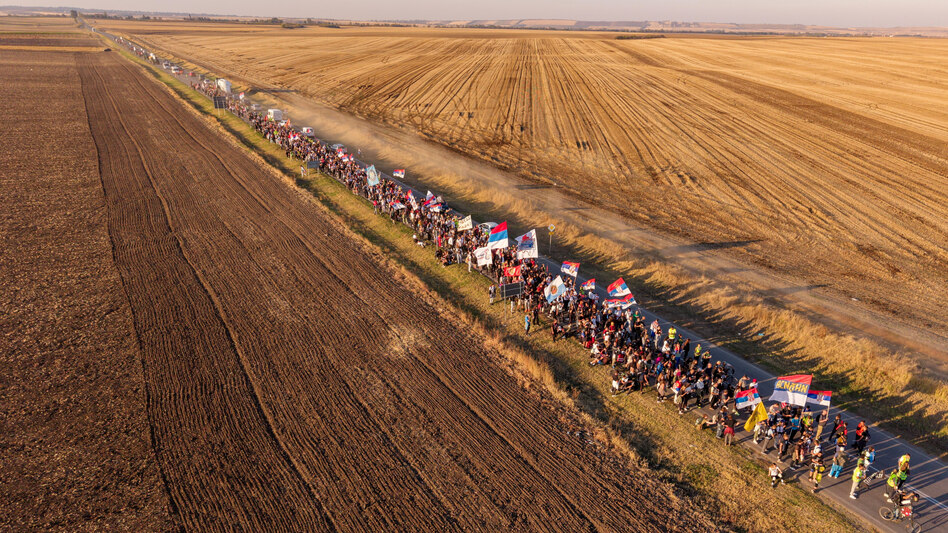
While Vučić wants to consolidate his power after months of protests, the student movement is building on its previous successes. The marches at the end of the election campaign are intended to awaken memories of the previous year among voters. At that time, columns of students marched through the country and met with great response in many places. They were greeted with enthusiasm by people, especially in rural regions where Vučić's party is traditionally strong. Many felt pressured by local officials from the ruling Serbian Progressive Party. After years of intimidation, they were confronted with an unfamiliar sight: young people who appeared openly, laughed and resisted political pressure.
The people provided the students with roast meat and cake on their marches and offered them accommodation. They were moving scenes. In Serbia there was talk of a youth that appeared out of nowhere and brought hope.
When the students arrived in Belgrade on Wednesday evening, the hope from back then returned. The last big rally before the elections was planned for the following day. It took place in the central Slavija Square. There, on March 15, 2025, hundreds of thousands followed the students' call and took to the streets against the government. It was one of the largest demonstrations in Serbia's history.
An opponent from an autocrat's nightmare
Serbian President Aleksandar Vučić, who has ruled the country with a hard hand for years, has so far had an easy time with the chronically divided civil opposition. He seemed untouchable.
For more than a decade he has kept the country in a constant election campaign and has repeatedly placed it in a political state of emergency. This gives him a lasting advantage: since 2012, Serbs have elected a new parliament six times and a president three times. There are also numerous local elections.
Then on November 1, 2024, the canopy of the train station in Novi Sad collapsed, killing 16 people. The students asked a simple question: Who is responsible? When they didn't get satisfactory answers, they decided to put pressure on themselves.
Vučić has not yet had to deal with an opponent like the student movement. It has no publicly visible leaders whom he could specifically put pressure on or win over to his side. According to its own information, the movement brings together more than 200,000 young activists. They organize themselves decentrally, have not yet allowed themselves to be intimidated and are carrying out their political battle with an energy that is sometimes reminiscent of a festival.
When the student movement finally registered for the election, it became apparent that its activities over the past almost two years had long since taken on the character of an election campaign. Now all she had to do was turn this into a formal election campaign.
Financially, the student list is far inferior to the electoral alliance United Serbia led by Vučić. She compensates for this with an intensive foot campaign. Their main goal: convince non-voters to go to the polls on October 25th.
Maja and Andrej, both students in Belgrade, walk through a multi-story building in Block 22 in the Novi Beograd district. They press the buttons on the intercom one by one until someone opens the door. After months of campaigning, they know exactly what they are doing.
A couple in bathrobes opens the door; it is Sunday morning. The man actually wants to hear what the students have to say, but they ask the questions: “What do you think is the biggest local problem?” And then: “What do you see as the biggest problem in the country?” The couple responds in unison: “The corruption!”
Andrej later explains that this is by far the most common answer. At the next door, on the floor below, a woman says the same thing. In the next apartment: same thing. It is no coincidence that the slogan of the student list is: “Either Serbia or the Mafia.”
Numerous student teams visit thousands of households in Belgrade's apartment blocks alone. Around 150 students manage to visit more than 7,000 apartments every week. This number increases as the elections get closer.
Something else could decide the outcome of the election: no Serbian opposition party has ever provided as many trained election observers as the student list. They cover almost all 8,392 polling stations in the country. In Serbia, over 6.4 million people are eligible to vote.
These early parliamentary elections, taking place in a tense, divided society, are being monitored by international bodies such as the OSCE Parliamentary Assembly and the domestic observer mission CRTA. Groups from Russia, the USA and Azerbaijan are also represented.
The name “Student List – Students Win” is misleading because there is not a single student among the candidates for the 250 parliamentary seats. They are people with successful professional careers, most of whom are unknown to the public. There is no professional politician among them. Another criterion: They have made a name for themselves through civic engagement in their place of residence. The list was created through a long, complicated process in which student representatives had veto rights.
One of those selected is Slobodan Bubnjević, physicist, writer and science journalist. “It is of course a great honor to be part of such a historic list, but like most candidates, politics fills me with disgust and I would like to complete the task for which the students have nominated me as quickly as possible and return to the book I am working on and my normal life,” he says.
He now feels an obligation to the young people who trust him: "Our country is occupied by an illegal regime that a free citizen simply has to resist. And I'm there precisely because the task is so difficult," he says.
What he doesn't say: The Student List is an organization without visible leaders in which adults are accountable to students. It is a new, politically daring experiment.
Many political observers in Serbia assume that there could be outbreaks of violence on election night. “If only this goes well,” you hear worried people saying these days wherever you go.
Regime representatives describe the student list as a terrorist organization financed by hostile foreign countries that does not want to accept Vučić's victory. They call them “traitors,” “rapists,” “anti-Serbs.”
On the other hand, it is believed that Vučić will not accept defeat under any circumstances. Since he came to power, he has manipulated elections, brought the media into line, and misused public resources and state institutions for party purposes. The police and security services do not protect law and order, but rather the regime.
Journalists are advised to get protective helmets and gas masks before the parliamentary elections. As if we were going to the front on Sunday.