
Germany taz
Excess profits tax: Oil companies can give something away
The International Tax Observatory is calling for a new excess profits tax on oil profits. Germany alone would bring in three billion euros annually. more...
Deutsch (original) ·Auto-translated to English
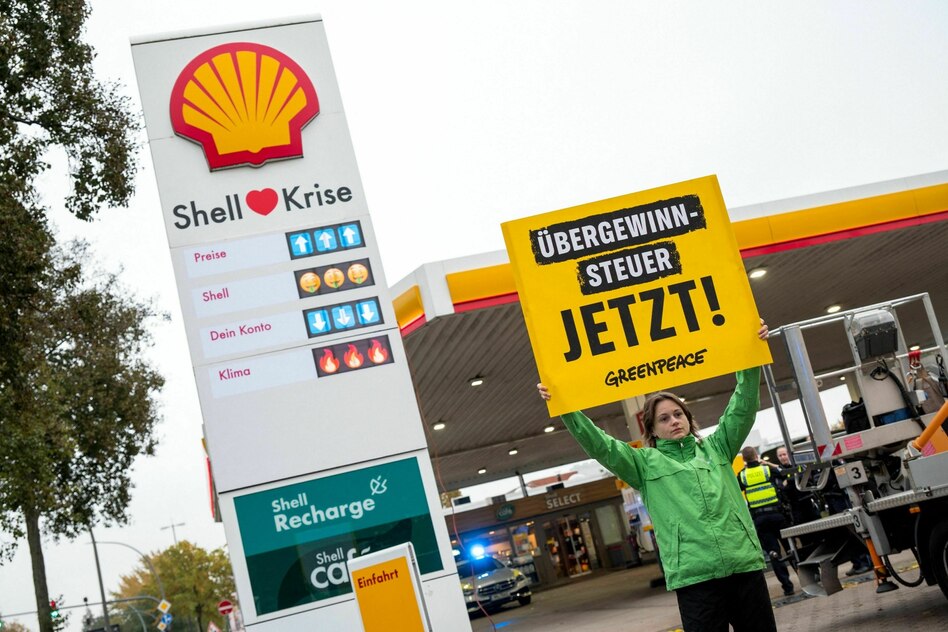
As oil prices rise on the world market, the profits of oil companies also increase. Economists are now responding to this with a new proposal for an excess profits tax to skim off some of the profits and funnel them into the coffers of consumers and governments. The European Union could earn 18 billion euros this year, of which Germany could receive 3 billion euros.
The profits that oil companies reported for the third quarter of 2026 alone are impressive. At the British company Shell, earnings roughly doubled compared to the previous quarter to 10.9 billion euros. The relative scarcity caused by the Iran war makes this possible. The French group TotalEnergies also doubled its profits to a good 7 billion euros. Repsol in Spain earned almost 600 million euros more and reached 2.8 billion euros in the third quarter.
The second quarter of this year wasn't bad either. The world's eight largest oil companies doubled their net profits compared to the same period last year to almost 80 billion euros, writes the International Tax Observatory (ITO) in Paris. The partly EU-funded research institute works with, among others, the renowned French economist Thomas Piketty and the German Institute for Economic Research.
The researchers are taking the situation as an opportunity to publish the concept for an excess profits tax that is intended to circumvent the problems of the similar EU tax that already existed in 2022 and 2023. At that time, the tax only applied once because of the Russian attack on Ukraine, and the burden was relatively low. Lawsuits by companies against the former tax are still pending before the European Court of Justice.
The ITO now recommends setting up a permanent mechanism so that old discussions do not start again every time the oil price rises. Taxation would then be activated automatically when certain thresholds are exceeded.
For example, all profits that exceed a profit margin of 10 percent could be subject to the levy. The institute advises using the global profits of corporations as a basis and then calculating the share that they record in Europe. This can prevent them from shifting profits abroad and hiding them from taxes.
With a 50 percent tax on profits above 10 percent - various models have been tried out - the EU would receive around 18 billion euros in 2026, according to the ITO calculations. As the largest European economy, Germany would receive a good 3 billion euros, France 2.2 billion, Spain 1.9 billion, Poland 1.7 billion and Italy 1.6 billion euros.
These funds could be used, for example, to pay energy money to private households that are particularly suffering from high fuel prices. Another variant would be to use a few billion euros in the federal budget to accelerate the transition to renewable energies and move away from expensive oil and gas.
Why doesn't this happen? Central actors are at odds, so there is a lack of political will. Federal Finance Minister Lars Klingbeil (SPD) is pushing for a new attempt at excess profits tax at the European level; Portugal, Spain, Austria and Italy support him. But Economics Minister Katherina Reiche (CDU) is slowing down. EU Economic Commissioner Valdis Dombrovskis also cannot bring himself to do so. Meanwhile, Poland recently implemented a national version of the tax.