
Germany taz
New LNG terminal in Stade: More dependence on gas
Economics Minister Reiche hopes for more security of supply for natural gas. Environmentalists are critical of the new LNG terminal in Stade. more...
Deutsch (original) ·Auto-translated to English
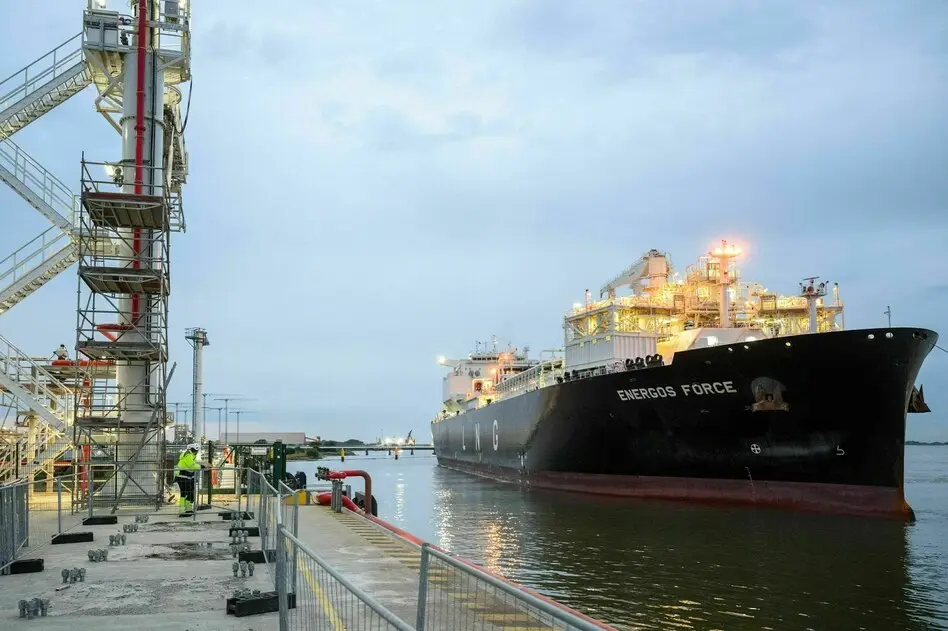
The fifth floating terminal for liquefied natural gas (LNG) in Germany went into operation on Monday in Stade an der Elbe. In Stade it will become “visible what security of supply means in practice,” said Federal Minister of Economics Katherina Reiche (CDU), who gave the starting signal for feeding LNG into the gas network. Reiche likes to cite the LNG terminals as a reason why the currently relatively low gas storage levels do not pose a threat, even in a cold winter.
The terminal in Stade is expected to achieve an injection capacity of up to 3.2 billion cubic meters of natural gas in 2027. In 2025, LNG accounted for around 10 percent of German gas imports. Stade can increase this share by around a quarter. Germany imports significantly more gas via pipelines, from which regasified LNG also comes, for example from the Netherlands or Belgium.
Environmentalists are critical of the project. While the climate conference in Turkey is discussing how to deal with the climate catastrophe, “Katherina Reiche is pushing our gas dependence further,” criticized the Federal Managing Director of German Environmental Aid (DUH), Sascha Müller-Kraenner. “In view of rising gas prices and unreliable partner countries, the LNG expansion is more than questionable,” said Müller-Kraenner. The energy system is only sustainable with cheap renewables and electrification. The DUH also warned of Germany's increasing dependence on US fracking gas, which is particularly harmful to the environment.
A model calculation by Greenpeace shows how lengthy it is to reduce Germany's dependence on fossils. According to this, the heat pumps sold in this country between 2021 and 2025 will replace almost three percent of the gas requirements for heating and hot water every year.
According to the calculation, with one million new heat pumps every year, an amount of gas could be saved in 2035 that would correspond to around a third of Germany's storage capacity. In fact, around 354,000 heat pumps were installed in Germany between July 2025 and June 2026.