
Germany taz
New album from non-Seattle: They never grow thick skin
Today a revolution, tomorrow a country trip: Nichtseattle's new album “Große Liebe” is about pop, nature and one's own socialization in East Germany. more...
Deutsch (original) ·Auto-translated to English
Can't shoo away a fly that's crawling on your arm? Would you rather see what crawling feels like? “And even if it tickles, you let them / It’s like someone is touching you,” sings Katharina Kollmann over a reserved groove in “Housefly”. At the same time there is a latent nervous drive.
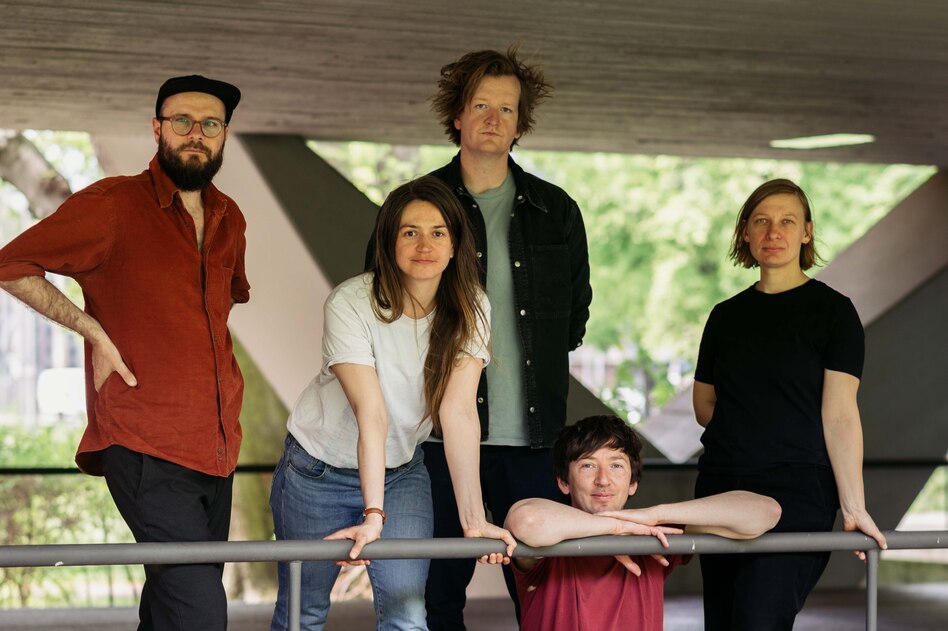
No, the song is not a weird mindfulness exercise. More of an invitation to approach everyday life with freshly balanced sensory skills - and the willingness to allow for ambivalence. Such offers can be found on “Große Liebe”, the fourth album by Nichtseattle, the now quintet project of the Berlin artist Katharina Kollmann. And this despite the fact that the album title describes a feeling that celebrates clarity and not ambivalence.
“Because my parents separated, the Berlin Wall collapsed,” writes Kollmann at the start of a funny and clever essay that accompanies the album release. In these liner notes, Kollmann traces the changes in her ideas about love - in such an entertaining way that you wish she could write a book.
Non-Seattle: “Great Love” (State Act/Bertus/Zebralution).
Tour: November 3rd Hansa48, Kiel; 4. 11. Knust, Hamburg; 5. 11. Kleine Freiheit, Osnabrück, continues.
Her great love still came to her back then, thanks to pop songs and Hollywood cinema: “It should now be open to us, the whole free world that was previously closed to our parents, and with it all the great feelings that our adults didn’t seem to know yet.” However, the reality turned out to be much more complicated. And at some point Kollmann simply stopped, “exactly where I found myself,” instead of pursuing romantic fulfillment.
Over time, other people and even a few animals joined her. Kollmann invited them to stay, “even though I was actually a little afraid of them.” And experienced the unexpected, sometimes even luck. In the song “Wildeste Nacht” in more classical territory. But also in the group therapy circle or in her house project in the country, where she lives temporarily: “Whether with children or old people / I like to sit in a circle now” is what the song “Dallas” says.
While on the previous album "Haus" (2024) she vomited in frustration in the song "Beluga (Condominium)" - "Now I should also say something about the concept of 'love'", the context was a date with an annoyingly self-satisfied rooster - on the new album she does exactly that, as complex as it is precise. The song lyrics seem like poems: they sound associative and dense, surreal, but grounded in social realism.
The song “River Cola” – the discounter soda also adorns the album cover as a colored pencil drawing – turns out to be a precise study of a milieu in which love is rather difficult. She rhymes “semi-conscious desire for destruction” with “bare male breasts”. And “Overlooked bodies wear neon dresses / To pleading gray gaze.” In addition, the realization that with greater social distance Kollmann would look more calmly at the imbalances outlined in the song. “If you weren’t one of them / Then / You would have stayed calm.”
As is often the case in non-Seattle texts, gender issues and Eastern socialization are included, in a pleasantly discourse-free manner. “It’s not about me making statements about the East,” explains the 41-year-old in an interview. “I would rather explore my environment.” Her generation is more concerned with this topic in the media and artistically - something that older people are often surprised about. “For my parents’ generation it was still about not being left out. The attitude was: ‘It’s good that it’s over.’ But it’s not over – at least not for everyone.”
But what exactly is not over in their estimation? Kollmann attests that East Germany has “quite a crisis in self-esteem”. On the one hand, because of the feeling that "with reunification in 1990, we had to completely abandon everything that came from the GDR. But a lot more came into play, a wide variety of experiences: for example in connection with the crèches." During the GDR era, small children were brought there as early as infancy on Monday mornings and were not picked up again until the weekend - so that single mothers and shift workers could also work. “That left traumatic marks.”
Our conversation takes place in the KulturMarktHalle, a former department store in the not yet fully gentrified east of Prenzlauer Berg in Berlin. A classic so-called third place: low-threshold, without pressure to consume. There is karaoke here as well as social advice and a repair café.
And of course the department store choir that Kollmann leads and which makes her rave: “It’s great what can happen when people who don’t come from the same bubble come together.” In addition, the choir, in which men and women from 30 to 80 sing along, took away her fear of getting old.
Kollmann, born in 1985, grew up in Berlin-Karlshorst, on the other side of the S-Bahn ring. The first music project she went public with was called Lake Felix. She played bass to introspective texts in English. In 2019, as a non-Seattle, she released German-language music for the first time with the rather sparse guitar album “Wendekid”, which was self-published at the time. The successor “Kommunistenlibido” (2022) was released on the Staatsakt label and made quite a few waves, as did “Haus” (2024). The theme of this concept album was a wide variety of spaces - and the people who set up in them.
Even though her fellow musicians were already there on the previous album, only now “Große Liebe” really sounds like the band and the work. More opulent and impasto, warmly instrumented - and sometimes the sound actually sounds a bit like Seattle, if this city stands for grungy lo-fi guitar pop. And sometimes anarchic humor even shines through, for example when the band comments on Kollmann's meandering stream of consciousness from offstage in the love song "I with Glasses".
Katharina Kollmann still composes the songs alone. "When I have the core of the song - it can be a sentence or just a few words to which I play the guitar - it's like a door opens. A lot of associations come through. Once the framework is in place, we can then work on it in the rehearsal room."
But back to the entertaining liner notes: What motivated the 41-year-old to stop pursuing love? “Exhaustion certainly played a role,” she explains. "If, for various reasons, it is difficult with the ideal you have, you have to see how things are still going. And appreciate what is already there - knowing that you have to live love, no matter how. Simply to stay healthy."
Is it a woman thing to define yourself by romantic relationships in such a way that when it doesn't work out it automatically becomes a problem? Although, at least according to social research, men benefit more emotionally from committed relationships than women. At least that's what an academic meta-study from 2025 suggests, in which over 50 studies from western industrialized countries were evaluated. “Perhaps,” Kollmann suspects, “women are more behind because they don’t find love so easily.”
At the same time, they are more socially integrated and are less psychologically dependent on the relationship. Appropriately, the album also includes the anthemic “My Ladies”. In this song, the celebration of female solidarity seems a little too intentional and didactic, but at the same time heartwarming. In the video clip, a colorful gang of women from Kollmann's environment stream through the Mecklenburg countryside - from the band, their house project and the choir.
And for once, Kollmann can praise a love free of ambivalence: “I believe in us.” She lists some good reasons for this - perhaps the best one in these hardened times: “Because we never grow thick skin.”