
Politics · taz · · 2h
New state parliament in Saxony-Anhalt: election of the first AfD parliamentary president is imminent
Deutsch (original) · Auto-translated to English
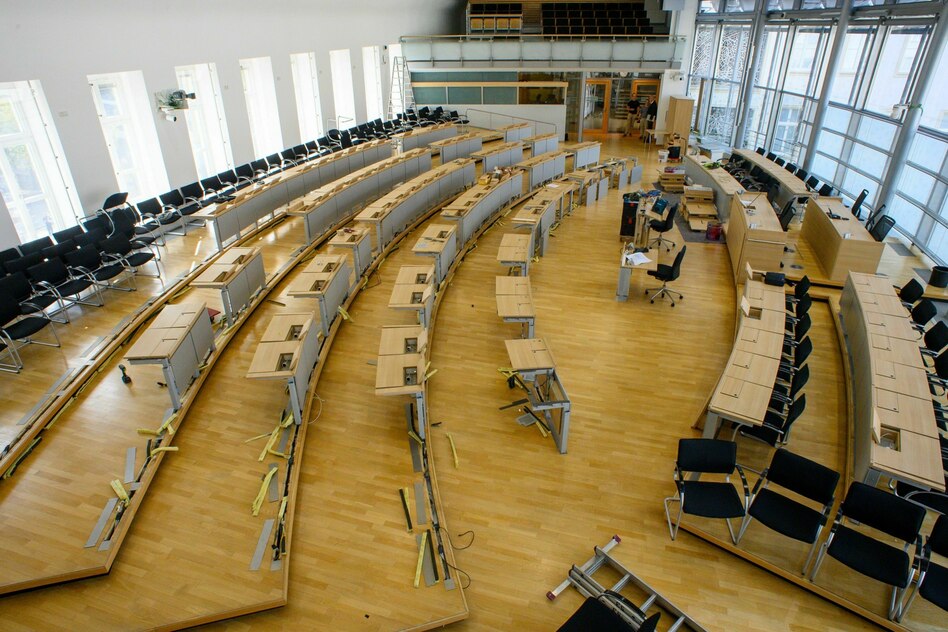
After the state elections in Saxony-Anhalt, the 83 elected representatives will meet this Tuesday for their first joint, constitutive meeting. The meeting in the plenary hall will be opened at 11 a.m. by senior president Eva von Angern from the Left Party. She has announced that in her opening speech she will talk, among other things, about women's rights and cooperation in parliament and its role model effect.
Then a new president of the state parliament is elected. The AfD parliamentary group, the strongest force in parliament with 39 members, has proposed its parliamentary manager Tobias Rausch as a candidate.
Armin Willingmann (SPD), Hans-Thomas Tillschneider (AfD) and Carsten Borchert (CDU) want to run as vice presidents.
From 11 a.m., Parliament will livestream the meeting. You can follow the events of the day here, the taz is there. (efi)
11:00 a.m.: Eva von Angern, the longest-serving member of Parliament, begins the session right on time. The first thing she asks is whether anyone other than her has been a member of the state parliament for longer. She has been a member of parliament in Magdeburg without interruption since 2002. Tobias Rausch, the AfD candidate for state parliament president, looks at his cell phone. (efi/dmn)
10:50 a.m.: The state chairman of the SPD, Andreas Schmidt, is on his way to the plenary hall with an empty coffee cup. Unlike usual, he wears jeans and is unshaven. When asked about this, he explains that political clothing is not permitted in the plenary hall. But his outfit is a statement. "This is not a solemn day, on which I don't dress festively. I'm coming, but I'm not celebrating the day with festive clothes. Not when a Tobias Rausch is elected President of the State Parliament." Then he shuffles along with his coffee cup. A gong sounds. It starts in ten minutes. (dmn)
10:15 a.m.: The AfD retreats to a room to discuss strategy. In the hallway you can hear several times the MPs drumming, shouting and chanting, which is more reminiscent of an ultra-block than a state parliamentary group's dominance behavior. (gjo)
9:36 a.m.: A large part of the AfD faction has now appeared in front of the state parliament. Accompanied by police officers, they film the rally. After brief boos, the Basic Law continues to be read out. The current issue is the article that regulates party bans. The participants in the rally cheer briefly, then continue their reading. Meanwhile, Ulrich Siegmund is talking to the streamer Hannes Kreschel, right-wing streamers accompany him every step of the way. Tillschneider doesn't want to talk to the taz. (dmn/gjo)
9:19 a.m.: Around 300 people read out the first 20 articles of the Basic Law on Cathedral Square. Behind them is the Adenauer bus from the Center for Political Beauty. Its loud speakers set the pace. Among the participants are several MPs from the Left and the Greens. The senior president Eva von Angern, who will soon open the state parliament, also prays the text of the law. While she is looking at a cell phone, others have opened small constitutional law books with the national anthem written on the back. The police set up barriers between the rally and the state parliament. (dmn)
8:55 a.m.: After the election of the state parliament president, the election of the vice presidents will also take place this Tuesday. Three men are running: Carsten Borchert (CDU), Armin Willingmann (SPD) and Hans-Thomas Tillschneider (AfD). Regarding their election, the BSW parliamentary group declared on Monday evening that only Borchert would receive votes from them.
Tillschneider is a “bosom friend of the German arms industry” and “the opposite of a balancing and presidential personality,” explained Claudia Wittig, the deputy parliamentary group leader of the BSW in Saxony-Anhalt. “The BSW does not give the AfD a blank check for its candidate proposals,” Wittig continued. Rausch assesses her differently than Tillschneider, who was responsible for the AfD election program.
The BSW criticizes the SPD candidate Willingmann for his acting role as science minister in Saxony-Anhalt. He will remain in office until the change of government. “It is not appropriate to occupy a prominent position in the executive branch and at the same time run for one of the most important positions in the legislature,” says the BSW parliamentary group.
It remains to be seen whether the two candidates will still receive enough votes. According to the rules of procedure, it is sufficient for the first state parliament session if a deputy person is elected president. (dmn)
8:31 a.m.: The AfD candidate Rausch will not get any votes from his group, said Sven Schulze, leader of the CDU group, on Monday. However, the Union MPs would not vote against Rausch either. The group agreed to abstain. Due to his previous calls for order and his role in the nepotism affair, Rausch is not a candidate that the CDU would put forward. But there was a discussion about whether it was right to reject the candidate from such a large group. In addition, the AfD does not need votes from the CDU for a majority; the BSW is already voting for Rausch. (dmn)
8:13 a.m.: In the election on September 9th, the AfD received the highest share of the vote: around 44 percent. This makes it the largest parliamentary group in the state parliament of Saxony-Anhalt, comprising 39 of the 83 representatives, including two women. The rules of procedure of the state parliament of Saxony-Anhalt allow the party to make the first proposal for the office of state parliament president. The group unanimously agreed on Tobias Rausch as the candidate.
The CDU has 15 representatives (including two women), the Greens, SPD and Left have eight seats each and the BSW has five. Shortly after the election, the AfD and BSW began discussions about “joint projects”. However, the BSW parliamentary group emphasizes that it neither wants a government coalition with the AfD nor will it vote for an AfD prime minister. Tobias Rausch would still choose the BSW. According to BSW, his role in the AfD's nepotism affair plays no role for the office, which is worth 18,000 euros. After all, he has parliamentary experience and it is good parliamentary practice to elect the candidate of the largest parliamentary group.
A not so good parliamentary custom, however, seems to be the seating arrangement. At least BSW and AfD have changed this in the Saxony-Anhalt state parliament. While the parliamentary groups were previously arranged from left to right based on political orientation, as in all German parliaments, the AfD and BSW MPs now sit in the middle. To do this, the Greens have to move to the far right. When asked about this, BSW parliamentary group leader Thomas Schulze explained: He didn't know where the order came from. But he thinks the Greens on the right are amusing. (dmn)
Read the full story at the source
Source: taz