
Politics · taz · · 2h
New state parliament in Saxony-Anhalt: Rausch elected as the first AfD parliamentary president
Deutsch (original) · Auto-translated to English
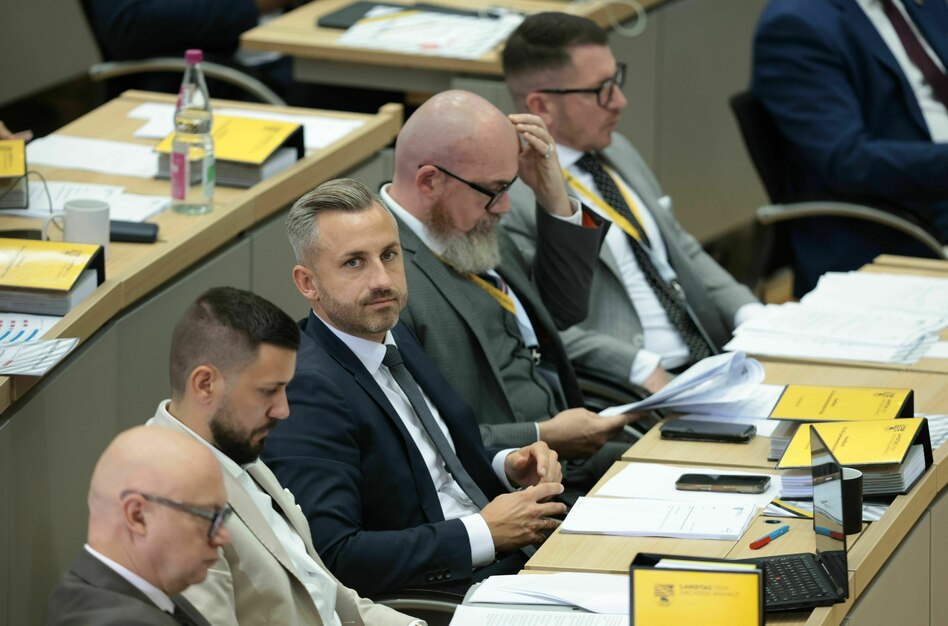
After the state elections in Saxony-Anhalt, the 83 elected representatives will meet this Tuesday for their first joint, constitutive meeting. The meeting in the plenary hall was opened at 11 a.m. by senior president Eva von Angern from the Left Party. In her opening speech, she spoke, among other things, about women's rights and cooperation in parliament and its role model effect.
Then a new president of the state parliament was elected. The AfD parliamentary group, the strongest force in parliament with 39 members, sent its parliamentary manager Tobias Rausch as a candidate. He was elected with 48 of 82 votes. In addition to the votes from AfD (39 MPs) and BSW (five MPs), he must have received at least four votes from the CDU, SPD, Greens or Left. The CDU (15 MPs) had announced in advance that it would abstain. But there were only five abstentions. 29 MPs voted no.
Armin Willingmann (SPD), Hans-Thomas Tillschneider (AfD) and Carsten Borchert (CDU) want to run as vice presidents.
Parliament has been livestreaming the session since 11 a.m. You can follow the events of the day here, the taz is there. (efi)
1:39 p.m.: Addendum while the Council of Elders is meeting: By the way, the SPD presented the newly elected AfD state parliament president with the Basic Law and a white rose. White was probably also the chalk that Tobias Rausch ate before his inaugural speech: In his speech, the newly elected AfD state parliament president clearly focused on normalization instead of riot. The first right-wing extremist state parliament president since 1945 emphasized that he wanted to be the state parliament president of the entire parliament. He read his inaugural speech word for word, said that his door was open to everyone and praised parliamentary rules. Of course, they were rewritten precisely because his group had used so much tax money in nepotism and the pockets of relatives. Rausch said he wanted to act in a non-partisan manner and respect the rights of the opposition, although the AfD had tried to increase the number of committee seats in order to have a quorum on its own - contrary to all democratic principles. And non-partisanship does not become any more credible because he also wants to remain general secretary of his party in addition to his new position. Rausch says: “The days of political firewalls should be a thing of the past.” In the end, no one clapped except the AfD and the BSW. Putin likes this. (gjo)
1:10 p.m.: The meeting was adjourned. The Council of Elders meets in the meantime to discuss how to proceed with the election of the vice presidents. The AfD wants to change the rules of procedure so that an AfD vice-president can also be elected in addition to the AfD state parliament president. It continues again at 3 p.m. (efi)
1:10 p.m.: The AfD had already received more votes than it had representatives in elections for deputy state parliament presidents in the last legislature - even when the BSW was not yet in the state parliament. In Saxony-Anhalt there have long been voices in the CDU calling for cooperation with the AfD - which is why there has always been speculation that the additional votes would have to come from the Union. It won't be possible to fully clarify this because the election is secret. However, the number 48 is extremely interesting: within the AfD, the number is also considered a test balloon for Ulrich Siegmund's prime ministerial election in December to see whether a majority could also be achieved for him. The AfD keeps saying that there are discussions with individual MPs. Were they the ones who voted for Rausch today? You will probably never find out. (gjo)
1:02 p.m.: While Rausch is speaking, Sven Schulze, the CDU parliamentary group leader, looks at his cell phone. He doesn't look satisfied. The new state parliament president Rausch received more votes than there are AfD and BSW members in the state parliament. Apparently the CDU did not vote unanimously. The 15 CDU/CSU MPs had announced in advance that they would abstain. But in the end there were only 5 abstentions. Two CDU members had previously announced to the taz that they would vote against Rausch. Apparently there were more parliamentarians who decided to do so. At the same time, four of them probably voted for the AfD candidate. (dmi)
12:51 p.m.: Tobias Rausch takes a seat at the executive committee table, drinks a sip of water and begins with a short speech. He will hold the office of President of the entire state parliament, not as that of a faction, Rausch reads. “Parliamentary rules should not be based on who they currently benefit.” He would like to see a state parliament in which there are arguments, but factual politics take precedence over party politics. “The days of political firewalls should be a thing of the past.” As President of the State Parliament, he will make decisions that not everyone will like. But he promises that the same rules apply to all factions. He wants to make decisions transparently. He gets applause from the AfD and the BSW. (dmn)
12:50 p.m.: Susan Sziborra-Seidlitz (Greens) now takes the podium. As parliamentary group leader, she is always allowed to speak in the state parliament. She reminds us that the President of the State Parliament must protect the dignity and rights of all representatives. The AfD has placed itself in the middle, but it is therefore not in the “center of society”. An election result does not result in a claim to subordination. The Greens had received a voter mandate and they wanted to fulfill it. “Democratic institutions do not protect themselves,” says Sziborra-Seidlitz. If the President of the State Parliament does not respect the rights in Parliament, the Greens want to draw legal consequences. “Saxony-Anhalt needs people to come here.” Exclusion should not become the flagship of the country and parliament. Finally, she looks again into the five rows of the AfD faction directly in front of her. “Let’s put this group in a tight spot with regard to the seating arrangement,” says Sziborra-Seidlitz. Laughter from the AfD. Ulrich Siegmund slouches in his seat. There is applause from the Greens. (dmn)
12:39 p.m.: The ballots are counted. Von Angern read out the result: 82 votes were cast, 0 of which were invalid.
AfD candidate Tobias Rausch received 48 yes votes and 29 MPs voted against him. There were five abstentions. Rausch was elected and became the AfD's first state parliament president. “I congratulate you on this,” says von Angern. There is a standing ovation from his group. The BSW also claps. Otherwise there is peace. Rausch received four more votes than the AfD and BSW have MPs. This means that parliamentarians from the ranks of the CDU, SPD, Greens and Left also spoke for him.
When asked whether he accepted the election, Rausch replied: “Yes, I accept the election.” (efi/dmn)
12:36 p.m.: The newly elected secretaries gather around a table next to the government bench, empty the urn and sort the papers. Rausch comes back and sits in the front row of the AfD faction again. Hans-Thomas Tillschneider stands next to him and looks at the counting. One of the Matthias Büttners (Staßfurt) appears with a bouquet of flowers and places it on the table in front of the parliamentary group leader Siegmund, next to Rausch. (dmn)
12:32 p.m.: The roll call of the MPs has ended. Von Angern asks one last time if anyone hasn't cast their vote yet. Since this is not the case, the vote is over. The meeting is interrupted for the votes to be counted, the representatives are supposed to remain in the plenary hall, but Tobias Rausch leaves the room briefly. (efi/dmn)
12:17 p.m.: One MP after another is called, makes their way to a wooden voting booth, disappears briefly and then throws a folded piece of paper into the ballot box. Two factions had previously announced that they would elect Tobias Rausch: his AfD and the BSW. Together they get 44 votes and would therefore have a majority, Rausch would be elected.
The Greens, SPD and Left had spoken out against Rausch. On the one hand, it would be a turning point: Rusch would be the first state parliament president of a right-wing extremist party in the history of the Federal Republic. He also played a central role in the AfD's nepotism affair. In the last legislative period he received several calls to order. The three parties have therefore expressed concern that the Saxony-Anhalt state parliament could become harsher under his leadership.
The CDU parliamentary group, however, has decided to abstain. However, two CDU politicians indicated to the taz that they would still vote no. (dmn)
12:05 p.m.: The central agenda item 8 is now on: the election of the state parliament president. According to the state constitution, the strongest faction submits a proposal. Von Angern accordingly reads out the AfD's proposal, which, as announced, is sending Tobias Rausch into the race. The person who receives the majority of the votes cast is elected as President of Parliament. Abstentions count as votes not cast. There will be no discussion about the election results. Voting is carried out secretly with a ballot paper in the voting booth. Secretary Katharina Kohl (SPD) turns the ballot box towards the plenary session and confirms: “The ballot box is empty.” Then it starts. (efi/dmn)
11:58 a.m.: The election of the secretaries is coming up. They are proposed by the parties. Their job is, among other things, to distribute the ballot papers and then count the votes. There are suggestions from all groups. In the case of the AfD, only the new left-wing MP Mustafa Groener voted against it. A little later he himself was elected secretary with votes from all factions. (efi/dmn)
11:49 a.m.: There is confusion about the agenda: When will the rules of procedure be debated - before or after the election of the state parliament president? That's why there is a short meeting between the parliamentary managers in front of the presidential desk. The result: The AfD's motion for rules of procedure is referred to the Council of Elders, and the meeting is therefore interrupted after the election of the vice president. The state parliament has meanwhile adopted the previous rules of procedure in order to proceed further. (gjo/dmn)
11:38 a.m.: All MPs are present, with one exception. Von Angern thereby establishes the quorum of Parliament. The missing MP is Frank Bommersbach from the CDU. (efi/dmn)
11:31 a.m.: All members of the state parliament are now read out in alphabetical order by the youngest member of parliament, John Lucas Dittrich (BSW), and their attendance is checked. In the AfD parliamentary group there are more MPs with the first name Matthias than women. When the two AfD MPs named Matthias Büttner are called, this is particularly noticeable. (efi/dmn)
11:29 a.m.: “Saxony-Anhalt is still a colorful, diverse, tolerant society,” says von Angern. In a long list she names people of different genders, different origins, with different experiences in war, studying and family. “We are all Saxony-Anhalt,” the Left ended her speech. There is applause from all factions except the AfD. Then it subsides with the BSW, followed by the CDU, the SPD, the Greens and finally the Left. Von Angern takes a breath and continues with the agenda. (dmn)
11:17 a.m.: Von Angern quotes the “Antifa clause”, Article 37a of the state constitution of Saxony-Anhalt. “Not allowing the revival or spread of National Socialist ideas, the glorification of the National Socialist system of rule, or racist and anti-Semitic activities is the obligation of all state authorities and the responsibility of every individual.” Knocks from almost all factions, in the AfD faction only Christian Hecht makes an effort to drum on his table. The others don't move. (dmn)
11:07 a.m.: Von Angern reports in her speech that so far only a few women have been senior presidents in Germany. There are also few women represented in the state parliament: just under 22 percent of representatives are female. Nevertheless, they would represent the interests of women and girls, promises von Angern. Almost all parties tap their tables in agreement. The 39 members of the AfD parliamentary group, right in the middle of the plenary hall, show no movement. (dmn)
11:01 a.m.: AfD top candidate Ulrich Siegmund appeared at the meeting with a cup with the imprint “Left Tears”. The saying “left-wing tears” is common in conservative and right-wing circles. This mockingly makes the alleged nostalgia of the political opponent from the left spectrum an issue. The cup also features the intertwined letters U and S - presumably Siegmund's initials. (dpa)
11:00 a.m.: Eva von Angern, the longest-serving member of Parliament, begins the session right on time. The first thing she asks is whether anyone other than her has been a member of the state parliament for longer. She has been a member of parliament in Magdeburg without interruption since 2002. Tobias Rausch, the AfD candidate for state parliament president, looks at his cell phone. (efi/dmn)
10:50 a.m.: The state chairman of the SPD, Andreas Schmidt, is on his way to the plenary hall with an empty coffee cup. Unlike usual, he wears jeans and is unshaven. When asked about this, he explains that political clothing is not permitted in the plenary hall. But his outfit is a statement. "This is not a solemn day, on which I don't dress festively. I'm coming, but I'm not celebrating the day with festive clothes. Not when a Tobias Rausch is elected President of the State Parliament." Then he shuffles along with his coffee cup. A gong sounds. It starts in ten minutes. (dmn)
10:15 a.m.: The AfD retreats to a room to discuss strategy. In the hallway you can hear several times the MPs drumming, shouting and chanting, which is more reminiscent of an ultra-block than a state parliamentary group's dominance behavior. (gjo)
9:36 a.m.: A large part of the AfD faction has now appeared in front of the state parliament. Accompanied by police officers, they film the rally. After brief boos, the Basic Law continues to be read out. The current issue is the article that regulates party bans. The participants in the rally cheer briefly, then continue their reading. Meanwhile, Ulrich Siegmund is talking to the streamer Hannes Kreschel, right-wing streamers accompany him every step of the way. Tillschneider doesn't want to talk to the taz. (dmn/gjo)
9:19 a.m.: Around 300 people read out the first 20 articles of the Basic Law on Cathedral Square. Behind them is the Adenauer bus from the Center for Political Beauty. Its loud speakers set the pace. Among the participants are several MPs from the Left and the Greens. The senior president Eva von Angern, who will soon open the state parliament, also prays the text of the law. While she is looking at a cell phone, others have opened small constitutional law books with the national anthem written on the back. The police set up barriers between the rally and the state parliament. (dmn)
8:55 a.m.: After the election of the state parliament president, the election of the vice presidents will also take place this Tuesday. Three men are running: Carsten Borchert (CDU), Armin Willingmann (SPD) and Hans-Thomas Tillschneider (AfD). Regarding their election, the BSW parliamentary group declared on Monday evening that only Borchert would receive votes from them.
Tillschneider is a “bosom friend of the German arms industry” and “the opposite of a balancing and presidential personality,” explained Claudia Wittig, the deputy parliamentary group leader of the BSW in Saxony-Anhalt. “The BSW does not give the AfD a blank check for its candidate proposals,” Wittig continued. Rausch assesses her differently than Tillschneider, who was responsible for the AfD election program.
The BSW criticizes the SPD candidate Willingmann for his acting role as science minister in Saxony-Anhalt. He will remain in office until the change of government. “It is not appropriate to occupy a prominent position in the executive branch and at the same time run for one of the most important positions in the legislature,” says the BSW parliamentary group.
It remains to be seen whether the two candidates will still receive enough votes. According to the rules of procedure, it is sufficient for the first state parliament session if a deputy person is elected president. (dmn)
8:31 a.m.: The AfD candidate Rausch will not get any votes from his group, said Sven Schulze, leader of the CDU group, on Monday. However, the Union MPs would not vote against Rausch either. The group agreed to abstain. Due to his previous calls for order and his role in the nepotism affair, Rausch is not a candidate that the CDU would put forward. But there was a discussion about whether it was right to reject the candidate from such a large group. In addition, the AfD does not need votes from the CDU for a majority; the BSW is already voting for Rausch. (dmn)
8:13 a.m.: In the election on September 9th, the AfD received the highest share of the vote: around 44 percent. This makes it the largest parliamentary group in the state parliament of Saxony-Anhalt, comprising 39 of the 83 representatives, including two women. The rules of procedure of the state parliament of Saxony-Anhalt allow the party to make the first proposal for the office of state parliament president. The group unanimously agreed on Tobias Rausch as the candidate.
The CDU has 15 representatives (including two women), the Greens, SPD and Left have eight seats each and the BSW has five. Shortly after the election, the AfD and BSW began discussions about “joint projects”. However, the BSW parliamentary group emphasizes that it neither wants a government coalition with the AfD nor will it vote for an AfD prime minister. Tobias Rausch would still choose the BSW. According to BSW, his role in the AfD's nepotism affair plays no role for the office, which is worth 18,000 euros. After all, he has parliamentary experience and it is good parliamentary practice to elect the candidate of the largest parliamentary group.
A not so good parliamentary custom, however, seems to be the seating arrangement. At least BSW and AfD have changed this in the Saxony-Anhalt state parliament. While the parliamentary groups were previously arranged from left to right based on political orientation, as in all German parliaments, the AfD and BSW MPs now sit in the middle. To do this, the Greens have to move to the far right. When asked about this, BSW parliamentary group leader Thomas Schulze explained: He didn't know where the order came from. But he thinks the Greens on the right are amusing. (dmn)
Read the full story at the source
Source: taz