
World taz
New general strike in France: class struggle and Kufija
France's youth continue to protest against poor schools and expensive lives. Through Palestine solidarity, Jean-Luc Mélenchon's left connects with the youth movement. more...
Deutsch (original) ·Auto-translated to English
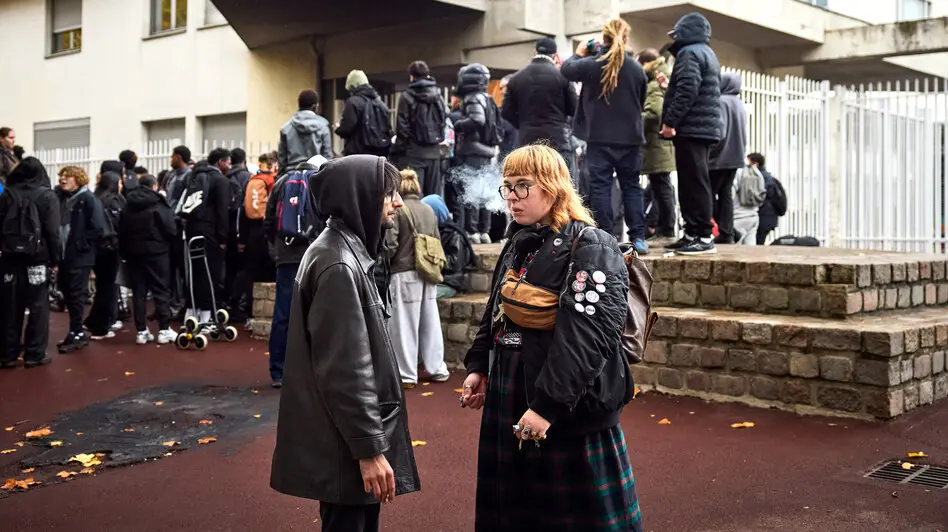
There is a scuffle at the main entrance to the Université Paris 8 in Saint-Denis on this Monday evening. Shortly after 7 p.m., security personnel stopped allowing students into the Bauhaus-style building in the northern Paris suburb. A few minutes ago, the students voted in a general assembly to occupy the university again now, after the autumn break.
“Due to a currently ongoing blockade, the campus is not accessible today,” the university management announced on its social media channels. “We will keep you updated as the situation develops.” She has been posting these sentences again and again since October 1st.
If the students have their way, it will stay that way for now. The majority demands that the protests for better and fairer educational conditions continue. Many plan to spend the night in the university building, including Marius and Pablo. Both are 20 years old, in their third year of study and would like to remain anonymous. Marius is studying literature and English, Pablo is studying computer science.
The two share not only their friendship, but also their shared commitment to the strike movement. This started at high schools at the end of September and quickly spread to universities. The first of these universities was Paris 8. Its students had already moved to the nearby Lycée Paul Éluard on October 1st to support the students in their blockade.
In the Café de la Mairie, with a view of the famous Saint-Denis cathedral and the historic town hall, the two report on the weeks of protests. "It was so obvious how shitty the education system is and how unfair enrollment is. A small push was enough for this outbreak." Pablo reads a message on his cell phone and is disappointed. "Nothing came of the occupation. There weren't enough people left inside. We'll try again in the morning."
The government had hoped that the protests would subside after the autumn holidays. But the unions have announced a general strike for Thursday. The Interior Ministry reported on Tuesday that 48 of the approximately 3,700 high schools and 51 of the 184 universities were blocked. Pupil and student organizations speak of 500 schools and disruptions at around every second university.
“After every year of study, I ask myself whether I can still afford it or whether I have to drop out,” says Pablo, who lives in a shared apartment in Paris. On average, a shared room there costs between 750 and 800 euros per month. Marius, who moved from a small town to Paris to study, was able to get one of the few places in a dormitory.
Saint-Denis is a center of recent protests. There were early clashes with the police here. A picture went around the world: Mayor Bally Bagayoko had positioned himself protectively between the security forces and the students. Bagayoko, whose family comes from Mali, has been the first black mayor of the second largest city in the Paris area since March. Since taking office, he has been exposed to violent racist hostility. His approachable nature is well received in Saint-Denis – 150,000 residents with roots from over 140 countries and one of the poorest communities in France. Bagayoko is a member of Jean-Luc Mélenchon's left-wing party La France insoumise (LFI, Indomitable France).
Criticism of the central university admissions system Parcoursup, which Macron introduced, is particularly loud in Saint-Denis. Pupils and students consider it to be non-transparent and disadvantageous, especially for young people from poorer backgrounds. They are calling for its abolition, 250,000 additional study places, more teachers with permanent contracts, renovated schools and smaller classes. Access to master's courses should also be made easier and the Abitur should be reformed. The costs: 10 billion euros annually.
The government has offered to raise around half the sum, create 15,000 university places, hire 500 teachers and reverse 800 job cuts. She wants to gradually reduce the class size to 28 and replace the Parcoursup admission system with a new system by 2028. The student union Union Étudiante calls the offer “completely inadequate”.
But the demands of young people are not limited to the education sector.
What connects Pablo and Marius is also an issue that has been as visible in all youth protests in recent years as the climate crisis: Palestine. The two are part of the Comité Palestine Paris 8, one of many solidarity groups at French universities. Some of these committees have existed since the student movement of 1968 and have been sometimes more, sometimes less active over the years. Others only joined after October 7, 2023.
“When the war in Gaza started, we were still students,” says Marius. The images of the “unbelievable massacres, of dead people, of torn bodies, were present everywhere.” It was “the first genocide filmed live,” adds Pablo. That “shaped an entire generation.” Pablo himself lived in Jerusalem for a few years as a child, but today he would not travel to Israel.
With their colleagues from the committee, they organize cinema evenings, information events, help Palestinian fellow students with language courses, distribute flyers, argue, and mobilize. “You shouldn’t become sad about the situation, because then you’ll become apathetic,” says Marius. “I don’t feel sadness, I feel insane anger and that’s my fuel to keep fighting.”
They report that they are in contact with other Palestine committees. The movement is particularly popular at the Sorbonne University, and also at Sciences Po, the country's most renowned political college. The Sciences Po branches in Strasbourg and Bordeaux have terminated or suspended their relationships with the respective Israeli partner universities under pressure from students.
But in view of the major social issues that are driving people onto the streets, the issue of Palestine has just faded into the background. Even all the flags, watermelon pins and stickers at the demos can't hide this.
Pablo and Marius regret that foreign policy is being forgotten now, when the election campaign for the presidential election next April is underway. For example, the fact that France continues to supply components for Israeli weapons and ammunition and thus “remains an accomplice in the genocide of the Palestinians,” says Marius.
The party that protests against this most vocally is the LFI. Among other things, Mélenchon refused to classify Hamas as terrorist even after the attack on October 7, 2023. He said he did not accept this designation for an “organization that is involved in a war of this kind with a colonial state.” In doing so, Mélenchon made himself impossible for the political establishment - but many young people, on the other hand, find themselves mirroring her stance on the Middle East conflict.
“At least we see LFI as legitimate discussion partners on the topic,” says Pablo. Personally, he says, he comes from an anarchist milieu in which people “distrust parties anyway.” “As far as the French left is concerned, it has been known at least since François Hollande that the socialists have completely betrayed us.” He followed the Left party conference in Berlin last weekend. “I’m wondering: who will betray us next?” He would see “betrayal,” for example, in “giving in during expropriation.”
At some point the two friends disappear into the night. It would be good to eat something, get some sleep, gather strength.
According to a poll published on October 15, 49 percent of 18- to 24-year-olds would vote for Mélenchon in the first round. “When we go to high school, it’s a home game for us today,” says Hadrien Clouet. The 35-year-old MP from Toulouse is, along with Mélenchon, one of the three authors of LFI's new election program, which the party plans to present on Saturday in an exhibition hall in Paris. They called the little booklet “The Common Future”. Clouet expects 15,000 supporters at the event.
On Wednesday, Clouet, who received his doctorate in Germany, stands in the entrance to the magnificent Palais Bourbon on the banks of the Seine, which houses the French National Assembly. He welcomes an economics professor who his group has invited as an advisor for the budget debate. He jokes with waiting TV reporters in the hallways, then stops in front of a relief. It shows a key scene of the French Revolution: the deputy Mirabeau confronts the royal envoy Dreux-Brézé and defies the order to dissolve the National Assembly. “We are here by the will of the people, and we will leave this place only by the force of bayonets.”
Clouet knows the sentence by heart. He speaks it as if it were appropriate now: On one side is Macron, who appears increasingly authoritarian and wants to push protesting youth off the streets. On the other side is LFI, which sees itself as the parliamentary voice of young people.
Because LFI had “instrumentalized” the student protests and “called on the youth to revolt,” Bruno Retailleau, the head of the conservative Républicains, called for LFI to be dissolved. His party colleague, Senate President Gérard Larcher, considered a ban.
For Clouet, the two are no longer serious competition. The Républicains are far behind in the polls, Macron's renaissance movement is "finished," says Clouet. The opponent is Marine Le Pen and her Rassemblement National (RN).
On his cell phone he enjoys showing the social media channels of the right-wing extremist politician and Mélenchon: On Tiktok he has 1.6 million more followers than Le Pen, and one million more on Twitter. But the polls show a different picture: While Le Pen has 33 percent, Mélenchon only has 19 percent. The greater reach on social media has not yet been reflected in comparable survey results. “RN targets the old and the police, we target the young,” says Clouet.
During his visits to high schools, he heard from students whose math teacher was away due to pregnancy and was not being replaced. “They don’t know how they’re going to pass their high school diploma,” he says. Because there are too few school buses, they have to drive long routes; some students in rural areas are on the road from 5 a.m. to 7 p.m. It is constantly said that there is a lack of money for better education. The French energy company Total alone doubled its profit to almost 7.5 billion euros in the third quarter. “We could use that to buy 22,000 electric school buses,” says Clouet.
There are “millions of students in the country who are afraid of what will happen in the coming year.” The Macronists have made access to universities more and more difficult. In contrast to previous protests, students in better areas also joined in. “They understand that the misery also affects them,” says Clouet.
Fueled by social media, the protests then spread from schools and universities to other parts of society, says Clouet. “The new, common motto was the fight for affordability of life.”
The number of poor people in France has grown from 8 to almost 10 million under Macron. On average, a family of four lost a total of 1,200 euros in purchasing power in 2024 and 2025. “This is a de facto expropriation,” says Clouet. “People may be able to postpone their vacation for now, but that’s not possible when it comes to dinner.”
So the unions finally joined the protests. Clouet thinks it goes well together. "If there are not enough well-trained university graduates, even the large industrial companies will not be able to get out of the crisis. Anyone who lowers the level of education will harm the entire country. Everyone understands that."
Macron tried to split this alliance when he announced in a speech on October 22nd that he would initially ban all demonstrations except those of the trade unions. Afterwards, the trade union demonstration was banished from the center of Paris to the outer motorway ring. Both have never existed before. The unions are now even more upset, says Clouet.
By mid-October, police had taken 8,000 people into custody during student protests, most of them minors. Official figures have been missing since then. Clouet estimates that number has now risen to around 12,000. A police officer fired a tear gas canister at close range into the face of 14-year-old Eden from Saint-Ouen-l'Aumône, north of Paris, destroying his jaw. Up to four young people's eyes were mutilated by rubber and tear gas bullets, and the hands of three protesters were torn off.
Normally the police weigh things down in such cases. “This time, however, there were video recordings of many of the incidents that clearly showed who the aggression came from,” says Clouet. There has not been as much repression in France as in the past few weeks since the Second World War. He calls Macron's administration a “Western European Putinism”. This first brought parents and then other parts of the population onto the streets.
This also applies to the Palestinian question. Clouet calls it a “fundamental reference” to the protests. France supplies components to manufacturers of Israeli tanks, drones and ammunition. Although Macron criticized Netanyahu, he allowed him to cross French airspace nine times after the arrest warrant from the International Criminal Court. “Macron should have forced the plane to land and extradited him to The Hague,” says Clouet. Macron's government is arming Israel "contrary to all the conventions that France has signed," says Clouet. To young people, this appears to be a “negation of all the moral values that one is trying to teach them”.
He does not accept the accusation that Israel is being criticized obsessively during the protests while suffering in other countries such as Sudan or Ukraine is ignored. “It’s not the same because France doesn’t support the wars there.”
LFI works closely with Sudanese exile organizations, one center being Saint-Denis. “That’s why there’s a Sudan flag hanging in Bally Bagayoko’s office,” says Clouet. This is a “normal form of solidarity” with the war victims, just as justified as the Ukrainian flags at other town halls. “But they leave them hanging while the prefects take down the Palestine flags.”
From Bally Bagayoko's office in Saint-Denis it is just a few minutes walk to the University of Paris 8, where students stand in front of closed doors on Tuesday mornings. Most of them didn't even set off because of the blockade. Pablo and Marius are also the other way round. The rest move on to the Lycée Paul Éluard, where several dozen protesters wait in a good mood in the drizzle. For the first time since the protests began, the police remained invisible that day. Helpers serve coffee and tea at a makeshift table.
A Palestine activist who calls herself Nana has mingled with the young people. “I am a Parisian, a Muslim of Algerian descent,” says the 32-year-old. “I know well what racial profiling and police violence mean.” She is here to support the young people. Nana believes in the possibility of the different activists coming together because “all issues belong together,” as she says: climate protection, criticism of capitalism, social justice, police violence, the rights of Palestinians. Then she stands back in front of the school gate with her red keffiyeh.
Because the school director allowed a police operation on the school grounds before the holidays, the teachers are now also on strike. They are demanding the resignation of the school principal. Together they observe a minute's silence for the victims of the racist attack in the community of Trappes that shocked the country ten days earlier, in which an assassin named Kevin T. targeted people of Arab and African descent. One person was killed and several others were injured. The perpetrator apparently wanted to avenge the looting of stores on October 17th. Here at the school too, many people are black, Muslim and of Arab origin.
“Let’s expand the strike” is the motto for Thursday’s protests. Pupils, students and trade unions have called for this. As of Wednesday morning, the police had not yet decided whether to allow the planned route.