
Germany taz
New concentration camp memorial in Oranienburg: When the neighbors suddenly became perpetrators
Only one wall remains from the first Oranienburg concentration camp. An open-air exhibition commemorates the site of terror in the middle of the city. more...
Deutsch (original) ·Auto-translated to English
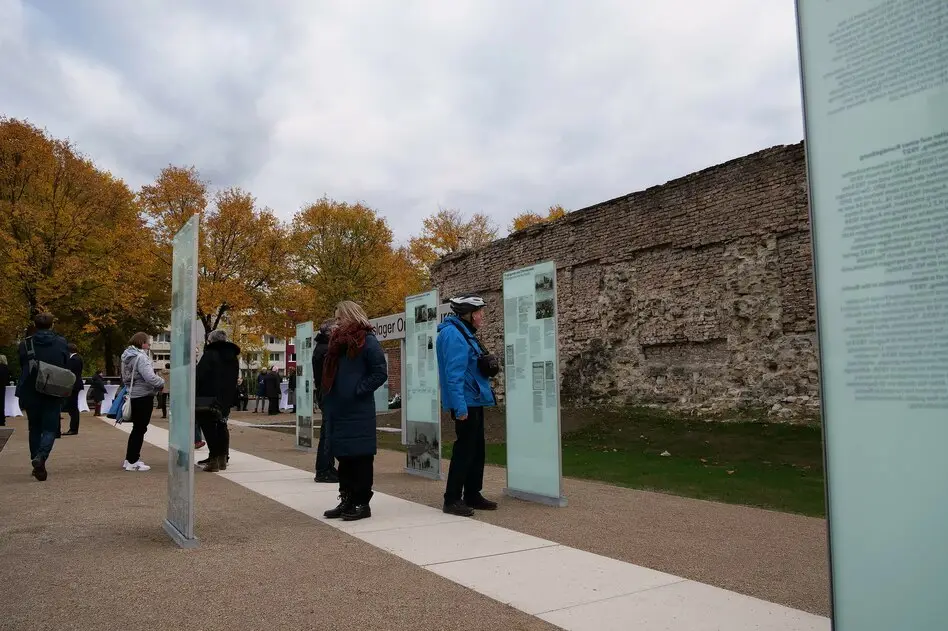
Rüdiger Köhn goes from stele to stele, carefully reading a few texts and looking with interest at the accompanying black and white photos. He didn't have to go far. The 88-year-old lives across from the newly opened memorial in “one of these blocks,” he says, referring to the other side of Berliner Strasse. The memorial site for the former Oranienburg concentration camp was inaugurated on November 2nd. “Finally,” says Köhn.
The new memorial is located in the middle of the city. The castle and castle park are just a few minutes walk down Berliner Straße. The place of remembrance marks an empty space: a historical, approximately 60 meter long remnant of the wall has become a place of remembrance and discussion of the history of National Socialism.
As early as 1933, the year the Nazis came to power, the Oranienburg concentration camp was set up as the first concentration camp in Prussia. The Sachsenhausen concentration camp on the outskirts of the city, which is so well known today, was not the first in the city. All of this can be experienced in words and pictures in German and English in an impressive open-air exhibition.
The dimensions of the site and the outlines of the buildings that no longer exist are cleverly made visible through different soil conditions. The still delicate lawn shimmers light green, here and there the pattern of the rake can be seen. The topography of the former concentration camp in the middle of Oranienburg is made visible - a successful concept. The place of remembrance was designed by Martin Bennis (architecture), Weidner Händle Atelier (graphics) and Ralph Gabriel (research and texts). Agnes Ohm from the Sachsenhausen Memorial and Museum was in charge of scientific management.
On the site of a former brewery, political opponents of the Nazi regime, especially communists and social democrats, but also Jewish prisoners were imprisoned - around 3,000 people in total. At least 16 prisoners died. Some of them have names and faces on the information boards, and their lives and sufferings can be understood.
In the wake of the Röhm Putsch and the disempowerment of the SA, which had operated this early concentration camp, the SS took over command and closed the camp in July 1934. The prisoners were transferred to the Lichtenburg concentration camp. Two years later, the SS opened the Sachsenhausen concentration camp on the outskirts of Oranienburg. It was built by prisoners for more than 200,000 prisoners and is located less than two kilometers from the new memorial site in the middle of the city.
This first concentration camp in Oranienburg was remembered back in GDR times - but only in a very inconspicuous manner. There is a memorial plaque on the historic remnant of the wall, on its narrow edge there is a white rose and small stones that commemorate the dead in Jewish tradition. A few meters further there is a memorial stone with an inscription that is difficult to read. The stone, erected in 1974, commemorates Erich Mühsam, the anarchist writer and activist who was murdered by guards in the Oranienburg concentration camp on July 10, 1934. There is a fresh wreath and bouquet of flowers and candles under the memorial stone.
Representatives from the federal and state governments took part in the memorial’s inauguration ceremony. The mayor of Oranienburg, Jennifer Collin-Feeder (SPD), expressed her joy that with the inauguration “a long journey would come to an important conclusion”: “At the same time, the history of this place as a place of remembrance begins anew.” He remembers the people who were persecuted, disenfranchised and murdered here, and makes it clear that “coming to terms with our history remains an ongoing responsibility.”
In her speech, the mayor also thanked the “long-term commitment of many Oranienburgers”, without whom this new memorial would not exist. Part of the civil society initiative was her party colleague, state parliament member Björn Lüttmann, who has his constituency office in Oranienburg and also sits on the city council. Lüttmann is the initiator of the working group “Memorial of the former Oranienburg concentration camp”.
“It took more than six years from the first idea to the inauguration,” Lüttmann tells taz. The square on Berliner Strasse was not a worthy place of remembrance at the time. The old brewery had long since been demolished except for the wall that still stands today. In the empty square, in addition to the two memorial stones from GDR times, there was only a concrete area, a bench, a flower pot and trash cans. “It doesn’t work that way,” they would have thought, Lüttmann remembers an on-site appointment in November 2019. “Unworthy,” “shabby” and “sad,” was the tenor at the time, “when you think about what kind of history this place has, what happened there.”
In January 2020, a cross-party initiative introduced the first draft resolution for a new memorial to the city council, according to Lüttmann - "initiated by the SPD and the Left and supported by the Greens, the FDP, the Free Voters and the Pirates." The AfD was against it, the CDU abstained.
There was a citizen survey, discussions about money, a working group. “It dragged on,” Lüttmann looks back, “there were frustrating times. We had to keep putting pressure on regularly.” A second resolution will follow in 2022 to confirm the project. This year, an audio walk was developed to the former concentration camp - “an interim success”, the audio walk can still be accessed on site today via a QR code.
Things started to move in 2024: The project was subsidized with around 283,000 euros by the Federal Ministry of Housing, Urban Development and Construction as part of the “Promotion of investments in national urban development projects” program. Oranienburg beat out more than 100 applications in the 2024 project call and was selected as one of 17 cities across Germany for funding. According to the city, the total budget for the new memorial is around 425,000 euros.
The aim of Lüttmann and his colleagues was to “make the historically significant place in the cityscape tangible, to promote engagement with the city’s history and to make visible the fates of the people who were persecuted and murdered under National Socialism”.
Well, that was a success, the money was well spent, you could say. Lüttmann also thinks so: “It was worth it.” The result is a joint project between the city, state and federal government that shows “what civic engagement can achieve”. He would like “Oranienburgers, school classes and guests from all over the world to discover this place in a completely new way.”
That should work. “The decisive strength of the place is that it is located in the middle of the city,” says Axel Drecoll, head of the Brandenburg Memorials Foundation, to taz. Anyone who visits the place of remembrance will learn impressively that the violence of the Nazi regime took place under the eyes of the city's population - and some of them even contributed to it. The prisoners had to do forced labor, for example in road construction. “The horror was visible to everyone,” says Drecoll. “The concentration camp guards – around 170 SA men – came from the region.”
“Here neighbors were terrorizing neighbors,” says Drecoll. “What makes this place so important is the realization that within just a few weeks all mechanisms of the rule of law and human dignity were thrown overboard and turned into their opposite.” The early concentration camps would show “that from the very beginning these Nazi detention centers were lawless spaces for uninhibited terror, violence and murder.” “What began here ended in Sachsenhausen and Auschwitz.”
Back to Rüdiger Köhn. He has lived in Oranienburg for 51 years and came after the Second World War as a resettler “from what is now Poland, from Pomerania”. And because he lives across the street, he knows what it used to look like here, when the brewery and the old police building still stood. He reports that he observed the work on the new memorial “for months.”
And the supermarket right behind the wall, whose construction caused a lot of discussion in 1993? “It doesn’t bother me,” says Köhn. “That’s part of the times we live in.”
Opposite the memorial, where the old police building was, a new U-shaped building has long been standing. It is the new dormitory for the police school of the state of Brandenburg, as Rüdiger Köhn explains. It opened in March of this year and can accommodate 400 people. The pensioner thinks it's a great thing: "The aspiring police officers are looking at the new memorial."
Why remembrance is important for everyone in his eyes: “Even if the saying isn’t mine: it’s time for us to remember again.”