
Politics taz
After the parliamentary election in Serbia: Dangerous vacuum in Belgrade
It may take a while for a government to be formed in Serbia. The election loser Vučić and his followers could try to use this time for themselves. more...
Deutsch (original) ·Auto-translated to English
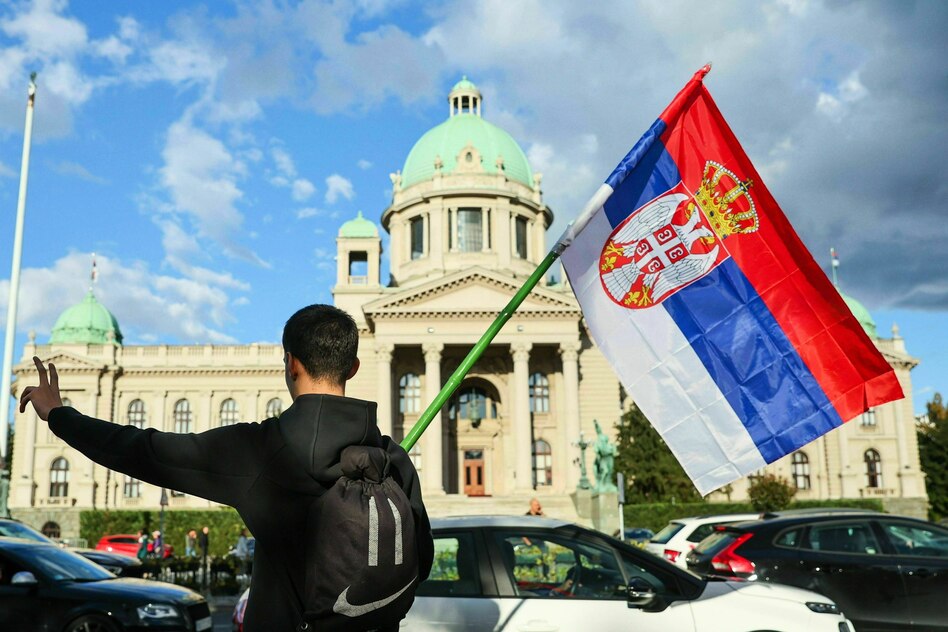
When the results of the parliamentary elections were announced on the evening of October 25th, there was boundless jubilation in Serbia. The student list had achieved a landslide victory, and the autocrat Aleksandar Vučić had conceded defeat. There was a celebration all night long, even on Monday. But sobriety returned on Tuesday.
The winners may have the political triumph in their pockets, but not even the electoral process is formally over. The defeated regime could delay the constitution of parliament and the formation of a government and use this transition vacuum to fish in troubled waters. The electoral commission has the final say and so far it has been a toy in the hands of Vučić.
If it accepts objections, the elections will have to be repeated in individual polling stations, even if this has no influence on the final result. Only when all objections have been dealt with will the electoral process be declared over and the newly elected representatives can take their oath. There is no legally prescribed deadline for this. After the 2022 parliamentary election, the election was repeated several times in a single polling station in southern Serbia, which lasted three months.
After the initial shock, Vučić appeared combative. He said he would not flee, but would lead the opposition and fight back if his supporters were attacked. Over 1.6 million voters voted for his Serbian Progressive Party (SNS). It boasts of having over 700,000 members.
In addition, the student list is now at the top of the state pyramid, which was concocted from corruption, crime and lawlessness. An entire army of the former president's followers lurks in the substructure. In 14 years, the SNS has managed to penetrate every pore of society, to fill all state institutions with party comrades loyal to Vučić and to take them over - in short, to build a real rogue state.
This primarily applies to the judiciary, the police, the secret services and finance. “After a systematic destruction of democratic institutions and the principles of the rule of law, after years of languishing in the state of a hijacked state, Serbia will have to restart the entire democratic government apparatus of the country,” says Srđan Majstorović, Chairman of the Board of the Center for European Politics (CEP) and member of the Public Policy Advisory Group “Balkans in Europe” (BiEPAG).
For the older citizens of Serbia, everything that is happening now is déjà vu under different historical circumstances. In 2000, when the then ruler of Serbia, Slobodan Milošević, refused to accept an election defeat, he was forced to resign in a popular uprising.
The victorious opposition had a solid majority in parliament and formed a government. But then, as now, all state institutions were occupied by the previously ruling party. With little understanding of the fragile democracy, the West put enormous pressure on reformist Prime Minister Zoran Đinđić to immediately demonstrate his pro-Western policies and transfer all Serbs accused of war crimes to the UN war crimes tribunal.
Three years later, Đinđić was murdered; the executioners were active members of the special police units. Nine years later, after many crises, the same anti-Western warmongers came to power, and Aleksandar Vučić was able to begin to dismantle the democracy that had just been established.
"The scale of crucial structural reforms at the time, combined with the EU's excessive expectations, led to the collapse of the dream of an entire generation, which came to a cruel end with the murder of Zoran Đinđić. Lessons must be learned from this experience," says Majstorović.
Instead of putting pressure on the new Serbian government, for example to immediately impose sanctions on Russia, which would drive up prices in the country dependent on Russian gas and oil, the EU should unconditionally support Belgrade in first rebuilding a functional democracy.
Majstorović urges the EU to have “realistic expectations and strategic patience” given the scale and complexity of the tasks facing the new authorities in Serbia. “After all, over the past 14 years the EU has shown an unreasonable amount of patience towards the authoritarian regime and the dismantling of democratic institutions,” he explains. “In doing so, she sacrificed her own credibility among the citizens of Serbia, who had previously viewed Brussels as a benchmark for democracy.”