
Germany · taz · · 2h
Musical forest walk: The sound of the green finger
Deutsch (original) · Auto-translated to English
It's beautiful up here, so beautiful, as if all the landscape painters of the 19th century had come together to create a romantic ideal image of Osnabrück's Schinkelberg. Only the five nasty rodents baring their teeth menacingly on a blood-red cartoon sign from the city administration are a bit disturbing: “No rubbish – no rats!”
On the program here today is the perception workshop “Listening Hiking”: two hours of contemplative, collective silence while listening under wind-swept beech and chestnut trees, on valley paths and meadow hilltops, along blackberry thickets and beautifully draped boulders, through mossy roots and the remains of old ravines. “Breathe into the landscape!” says curator Dirk Manzke, professor of urban and open space planning at Osnabrück University, at the beginning. “Let’s see what happens!”
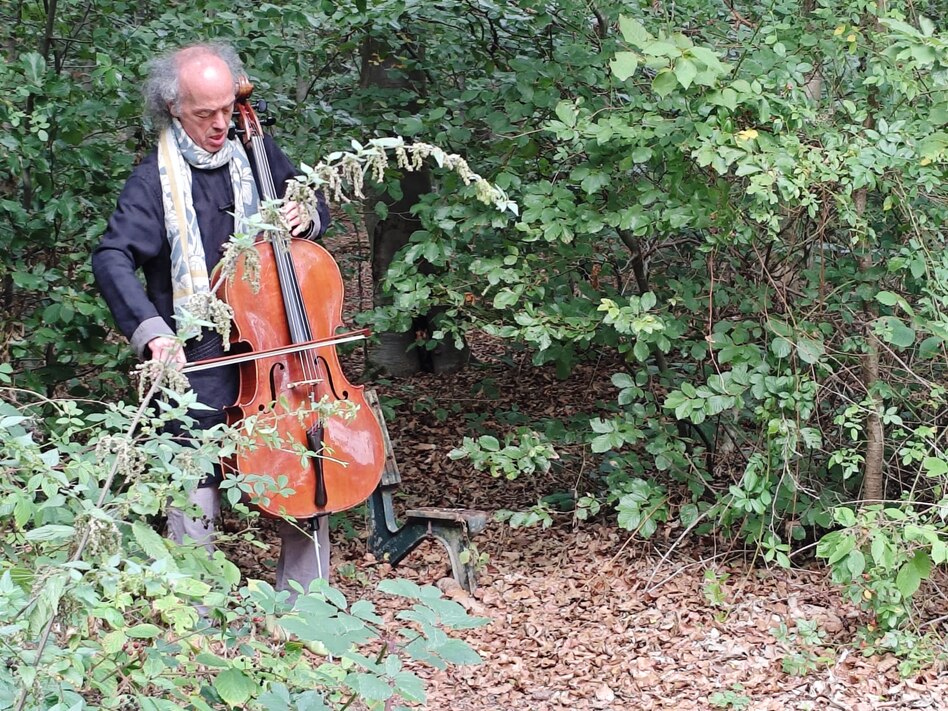
He then hands over the leadership to Willem Schulz. The experimental cellist lures the 30 participants into nature. At his side are Johanna Geith, Susanne Schulz and Hartmut Koehler, viola and violin. What they play, sometimes alone and sometimes together, sometimes planned and sometimes spontaneous, is subtle and hypnotic. Sometimes their play imitates the calls of birds, sometimes the creaking of tree trunks.
That's nice. But if you hope for an idyll, you're wrong. The Schinkelberg is one of Osnabrück's “Green Fingers”, natural open spaces that connect the interior of the city with the surrounding area in a star shape. But the district it towers over is a testament to industrialization. It is located next to residential and commercial buildings - between the railway and motorway - and that is unmistakable. In addition, open spaces arouse desire, from the influx of cold air to biodiversity. Manzke, who is here today for the Osnabrück Building Culture Association, is concerned with protecting them.
The musicians stride, chant, circle each other, hide in the branches, separate, play in the distance half alone, stand on hills in front of dramatic skies, make bushes their stage. If they stop at crossroads and surround the participants, this signals: Look around! The magic that surrounds you is great!
The afternoon also has bizarre moments - not all of them are necessarily intentional. We pass official fire bowls and barbecue ash disposal stations, right next to them there are also official warnings: campfires prohibited! Grilling forbidden! How fire can happen without fire, grilling without grilling? A mystery. This too becomes a stage, rats included.
The blue-silver slip in the undergrowth at the foot of the telecommunications tower is extremely strange. Although it is Osnabrück's tallest building, it is hardly noticeable from a forest perspective. It is not known whether the musicians noticed the item of clothing as they lined up in front of the tower gate.
The question also remains open as to why someone would come up with the idea of disposing of shopping bags on the side of the road in the parking lot - just three steps from an absurdly gigantic trash can - from Action to Kaufland, with rotten apples in them.
But the rest has magic. Schulz dances with his cello, reverently, playing it almost overhead, his long hair blowing theatrically in the wind. And although the city noise around us hasn't really gone away, from the roar of motorcycles to the sirens, it does disappear. The rustling of the leaves under our feet emerges, the cracking of the branches, the whisper of the wind in the grass.
Some of those listening sit on the floor, look up at the sky, close their eyes and hug each other. You lean dreamily against trees, feeling the drops of rain that fall almost imperceptibly. You listen – even to the silence. Because of the slowness in which we move, the natural space around us, although not large, appears infinite.
Read the full story at the source
Source: taz