
Germany · taz · · 51m
Fashion photography from the GDR: When pictures speak loudly
Deutsch (original) · Auto-translated to English
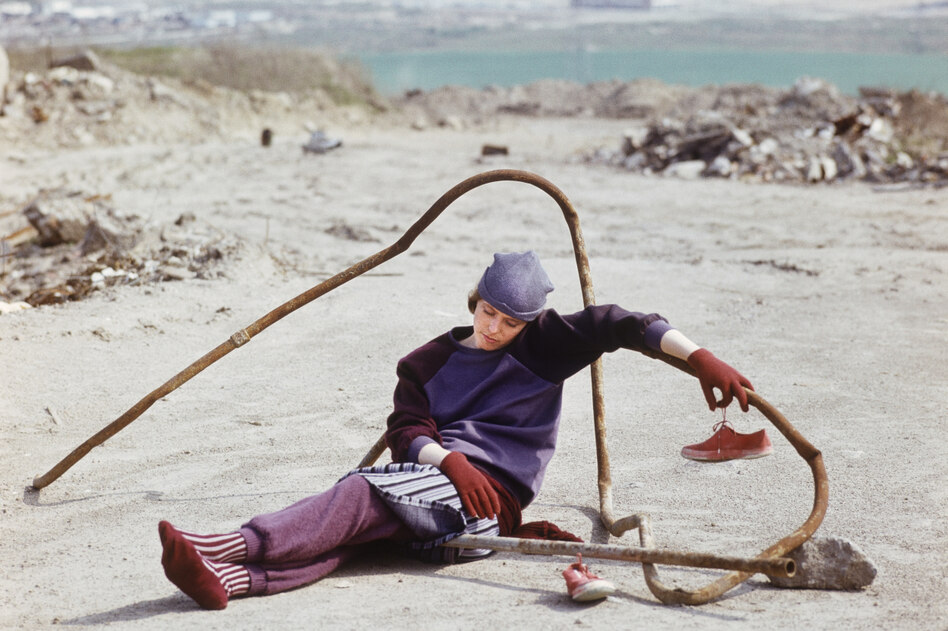
Fashion photography usually has a clear mission: to put the clothes in the foreground and, in the best way, to encourage viewers to buy them. The photographer Ute Mahler approached it differently. The focus is not on the clothes, but on the models who wear them. Since 1975, she has photographed countless women and their clothes for the GDR fashion magazine Sibylle, and after reunification she also worked for Stern. Her pictures will be exhibited in the Pankow Gallery until November under the title “The Same Sky – Fashion Photography”.
Mahler does not photograph perfect surfaces. Her pictures convey the mood of the women photographed. They look impressively past the camera, sometimes seemingly directly into Mahler's eyes. They look pinched, annoyed, melancholic, bored, flirtatious or challenging; their personalities take up most of the space.
In this way, Mahler contrasts not only the expectations of fashion photography, but also the image of a GDR woman. Her works show the models as clear individuals; they do not correspond to the socialist image of women that the fashion magazine Sibylle also published. Mahler's work thus created a bubble of resistance within the Sibyl.
“There is no distance from the camera,” said Mahler in a taz interview. In her work, Mahler attaches particular importance to the relationship between herself as a photographer and her models. The women seem to feel comfortable with Mahler, and their photos also radiate familiarity. Last but not least, the title of the photographs plays a role; almost every one of them only has the first name in the caption, supplemented by the location and year. “The women allow the photographer to see a personal, private side of them,” said Mahler.
The background also plays an important role in Mahler. There are hardly any studio photos hanging in the gallery; Mahler prefers to photograph her models outside. Photographs from East Berlin are particularly impressive; The picture “Julia, Berlin Bebelplatz, 1981” shows the pregnant model Julia in black and white like so many of Mahler's photographs. Julia wears light, flowing clothing, her hair is down and frames her face. Her gaze turns to the side, she appears exhausted and has rested her arms on her lap.
Mahler took the photo on Bebelplatz in 1981. In the background you can see stands showing members of the GDR Politburo. When it was published in the fashion magazine Sibylle, the members' heads were cut off; the photograph can be seen in its entirety in the Pankow Gallery.
Photographs were also taken outside of Berlin. Mahler made many of them in Brandenburg and the surrounding area; Lehnitz and Bad Freienwalde, for example, become the setting; lakes, prefabricated buildings and fields determine the background. A photograph from 1983 shows the model Martina in Velten. She leans casually on a bridge and looks into the distance through her black, wide sunglasses. The image is in color; the model's red pants pop in the lower part of the image and are complemented by the long black top, the bright blue of the sky completes the photograph. In the background, right next to the model's head, three helicopters are flying. The photography is very impressive; Martina seems unimpressed and powerful at the same time.
Mahler often works with everyday situations. People walk past or cars or bicycles drive by. The model stands, runs, sits or lies in the foreground like an incision in the everyday routine that takes place in the background. Everyday life and modeling take place at the same time, but do not seem to notice each other. The photograph “Edda, Berlin Prenzlauer Berg, 1979” shows the model Edda crossing a street.
She pushes a stroller in front of her, the child, chubby and warmly dressed, looks behind her. Edda almost seems to collide with three children playing, who don't even look at the model and run after two balls in their childlike playfulness. Edda isn't interested in the children either; her gaze goes directly to the camera. She looks interested, it seems as if Mahler pulled the trigger a second before the model smiled knowingly. A long dress flatters the model's tall, slim figure.
Mahler also traveled to other countries for her photographs. Photographs from Minsk and Havana hang in the gallery, and photographs from later years were also taken in Lanzarote and the USA. Mahler's work always remains the same: her models are in the foreground, they are self-confident, idiosyncratic individuals who seem to communicate with Mahler through the camera.
The title of the exhibition and the book published with the exhibition by Hartmann Books fits well: they all share the same sky, no matter where and when Mahler photographs them.
Read the full story at the source
Source: taz