
War & Militarism taz
Military strategies of the USA and Iran: How old myths legitimize new wars
From ancient Persia to Karbala, Washington and Tehran use historical narratives to demonize opponents and mobilize support. more...
Deutsch (original) ·Auto-translated to English
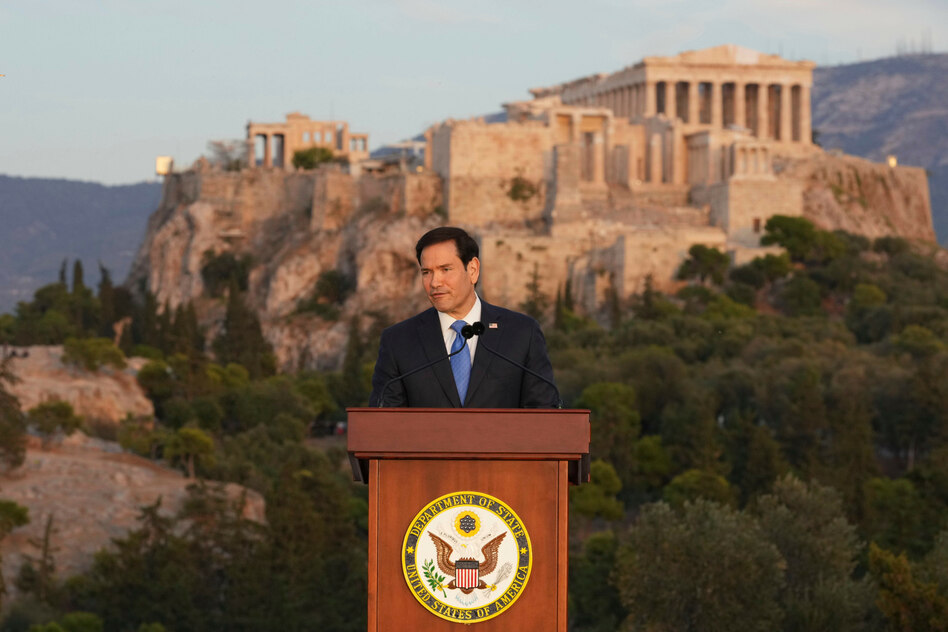
Since the beginning of the conflict between the United States and Iran, policymakers in both countries have repeatedly turned to history and mythology to support their respective narratives. An example of this is the speech by US Secretary of State Marco Rubio in Greece. But Iranian government officials also rely on historical stories of resistance and the religious traditions of the Shiite community.
Both sides draw on collective memories and historical myths in order to generate emotional identification and legitimize their political and military goals. The narratives not only serve to justify one's own actions, but also to portray the opponent as a threat.
is an investigative journalist, documentary filmmaker and author. Since 2005 he has been reporting on political developments, human rights and civil society in Iran and the Middle East. He has worked with Iran Journal, Radio Free Europe/Radio Liberty and Deutsche Welle, among others.
At the beginning of October, against the backdrop of the Acropolis in Athens, US Secretary of State Marco Rubio recalled the campaign of the Persian King Xerxes in 480 BC. BC and the subsequent burning of the Acropolis by the Persian army. At the same time, the US Secretary of State warned of a “decline of Western civilization” and appealed to European states to return to the “values of ancient Greece” and stand with the USA.
Donald Trump and other White House officials had previously targeted “Iranian civilization” and portrayed it as an uncivilized antithesis to the Western world. This narrative is in stark contrast to the narrative before the outbreak of war, when the US claimed to support Iranian protesters in the fight against the regime's dictatorship.
The taz is an independent, left-wing and opinionated daily newspaper. We have been arguing in our comments, essays and debate texts since the taz was founded in 1979. We often cannot and do not want to agree on an opinion. That's why you'll find some completely opposing positions here - all part of the very broad left-wing spectrum of opinions.
At that time, the USA, together with Israel, planned an attack on Iran, which then took place. But with the closure of the Strait of Hormuz and the activation of Iranian proxy forces, a shift in US strategy took place: the military threat and the mobilization of international support became more prominent in public rhetoric, while human rights violations and the suppression of protests became less important.
In this scenario, much like the script of a Hollywood blockbuster, Western audiences are presented with a lingering mythical threat from a distant land, the elimination of which requires the emergence of a new Alexander to once again subjugate Iran.
The allusion to Alexander the Great, who conquered the Achaemenid Empire, gives this story a historical dimension: today's conflict appears to be a continuation of an age-old antagonism between Greece or the West and Persia or Iran. Two historically completely different political orders are linked together.
A comparison with George W. Bush's rhetoric during the invasions of Iraq and Afghanistan illustrates this transformation: While after September 11, 2001, Bush explicitly used the term "Crusades" to highlight the contrast between Christianity and Islam, the Trump administration can no longer use this term today in order not to offend its Arab allies. Iran must therefore be rhetorically isolated and separated from the rest of the Arab-Islamic world.
In contrast to the US narrative, the Iranian regime uses its own overarching narrative, aimed at both the domestic population and the region's societies: the story of Imam Hussein, the third Imam of the Shiites, who fell in the Battle of Karbala against the forces of the Umayyad Caliph Yazid I in 680 AD.
Hussein resisted Yazid's rule and was killed along with some of his relatives and companions. In Shiite tradition, his death is considered martyrdom. It became an important symbol of resistance against unjust rule and of sticking to one's own convictions even in great danger. The regime has used this religious memory for decades to portray defeats as moral victories and sacrifices as signs of historical fortitude.
Since the beginning of the war launched by the United States and Israel, Iranian officials and military officials have continually invoked this “Hussein Movement.” This narrative allows the regime to reframe military and political setbacks as temporary and ultimately victories - even the targeted killings of senior leaders like Ali Khamenei, who plays the role of martyr in this narrative.
In this logic, not only the West and Israel are considered enemies, but also the Sunni Arab Gulf states - in accordance with the religious affiliation of the caliphs who are held responsible for Hussein's death.
Attacks on these states are legitimized by their own supporters as part of a “holy war”. At the same time, the regime does not see itself as having any duty to protect the civilian population from US attacks; Rather, killed citizens are presented as symbols of suffering and resistance in order to mobilize collective emotions. Even the US economic and military siege is compared to the historic closure of access to water for Hussein and his companions in Karbala.
However, this overarching narrative is not only directed against external enemies. Despite the bloody suppression of the protests in January 2026, the regime continues to see a significant threat from its own population. Therefore, rallies are organized by regime supporters under the motto “Voluntary self-sacrifice” in order to turn public space into a stage for declarations of war against government critics.
This pattern of thinking has now gone so far that numerous Iranian demonstrators have reported being called “infidels” or “killers of the imam” by interrogators while in custody.
With this narrative strategy, the Iranian regime reinterprets military defeats, economic pressure, social discontent and strategic wrong decisions. In this way, it can mobilize its supporters, ideologically strengthen its proxy militias abroad and present the repression of domestic political opponents as part of a broader struggle.