
Germany · taz · · 3h
Military money for Bremerhaven: changing times bring money
Deutsch (original) · Auto-translated to English
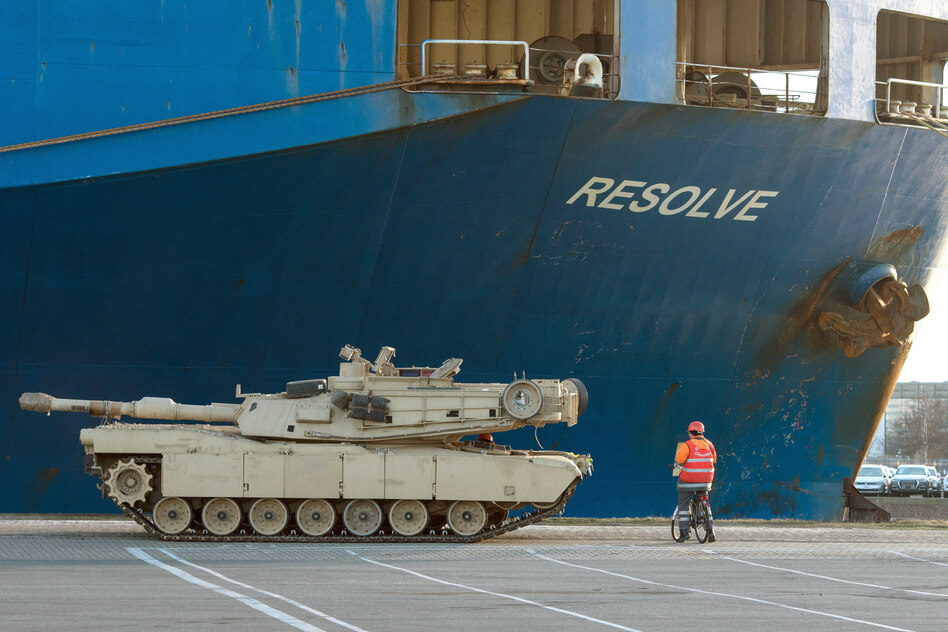
Now it's through: A whopping 1.3 billion euros will be put into Bremen's ports between 2026 and 2031. The majority of the money comes from the Bundeswehr. People don't like to hear the word "military port", which was still circulating last fall; the Bremen Senate prefers to talk about a "deployment hub": In the future, the overseas port in Bremerhaven should be suitable for shipping personnel and material for the Bundeswehr and NATO partners in the event of a defense, i.e. soldiers, tanks and other military equipment.
In Bremerhaven alone, one billion euros will be invested over the next five years. This is an incredible sum for the city; it roughly corresponds to the entire annual budget. It has actually been known for a long time that the money would come - but recently it was questioned again.
The Bundeswehr demanded that the state add its own resources. Finally, improving the port for military purposes also benefits civilian uses: a reinforced bridge can transport not only tanks but also trucks, and a deeper harbor basin serves not only frigates but also container ships. Bremen wants to be able to use these opportunities.
The various sides calculated for all 42 measures who would benefit and how big they would be - and who should therefore invest how much. The result was a figure of 202 million euros, which the state and city were supposed to contribute themselves. The state of Bremen had already budgeted for its share of this in the budget, 169 million euros from the special port fund.
What was still missing was a mere 33 million euros - that should come from the city of Bremerhaven itself. But this money was missing from the budget of the notoriously cash-strapped city, which was only able to present a budget for the year in June with great difficulty.
A failure of the billion-dollar investment was of course not an option for the state. The Senate delivered last week and has now taken over the municipal contribution itself; The money comes from Bremen's state share of the special fund for infrastructure and climate protection.
Bremen and Bremerhaven seem to be doing well with their own contribution. Some of the projects that are now being implemented with federal money should have come anyway: For example, it was already clear beforehand that the Stromkaje, i.e. the jetty on the banks of the Outer Weser, had to be renovated. The federal government could have waited and saved its money, but then the renovation would probably have taken much longer. But NATO wants to see the first results as early as 2027. So the country now gets a large part of the costs for free.
The federal government will be fine. It is factored into the military billions that civilian actors also benefit. The so-called dual use is intended to make the population more receptive to the high expenditure.
In Bremerhaven, it's not just the port industry that benefits: Since the access routes also have to be used for the delivery of heavy military equipment, there is also 259 million euros for roads and bridges in the city: Among other things, Barkhausenstrasse is being renovated and a bridge is apparently being rebuilt over Stresemannstrasse.
The rest of the money, around 160 million euros, goes to Bremen Airport. More logistics space is to be created there, and the runways are also to be reinforced. The cash-strapped airport can certainly use investments - but the money won't change the structural deficit; There could be a threat of insolvency again as early as 2027, Radio Bremen's regional magazine “Buten un binnen” reported just last week.
The generous funding was received with ambivalence in the German port industry in the winter. The seaports had previously called for more federal commitment to German ports. According to the Central Association of German Seaport Companies (ZDS), the investment backlog is around 15 billion euros; The federal government currently only contributes 38.8 million euros annually. The ZDS demands more almost every month. After all, the argument goes, the entire republic depends on it: without functioning ports, there will be no exports.
The industry welcomed the federal government's billion-dollar funding in November 2025 - but it also caused envy. Hamburg in particular, as the location of Germany's largest seaport, is said not to have been happy that another port was being considered. Mayor Peter Tschentscher (SPD) then criticized the federal government's maritime coordinator, Christoph Ploß, who comes from Hamburg, for his “night and fog campaign”.
Bremen's mayor Andreas Bovenschulte (SPD), on the other hand, praised not only Bremen's own Bundestag member when presenting the billion-dollar package, but also his CDU counterpart Thomas Röwekamp.
The decision as to where the Bundeswehr's planned new naval port will go has not yet been made. At the beginning of August it was said that the decision had been made against Bremerhaven and for Emden. However, the Bundeswehr has not yet confirmed this.
Even without a naval port, the “deployment hub” has its price: If you take the military threat seriously - and you do with the investment - then Bremerhaven and Bremen Airport will become an important target.
Bremen's left-wing economic and port senator Kristina Vogt has now paved the way for this militarization of the port; The left continues to be critical of increasing spending on military purposes.
Just a year and a half ago, Vogt herself had also taken a position against militarization: In March 2025, she decided not to sign a defense policy position paper from the North German economics and transport ministers because it also called for easing of restrictions on arms exports.
Read the full story at the source →
Source: taz