
World · taz · · 49m
Rent protests in Spain: Unbearable housing situation
Deutsch (original) · Auto-translated to English
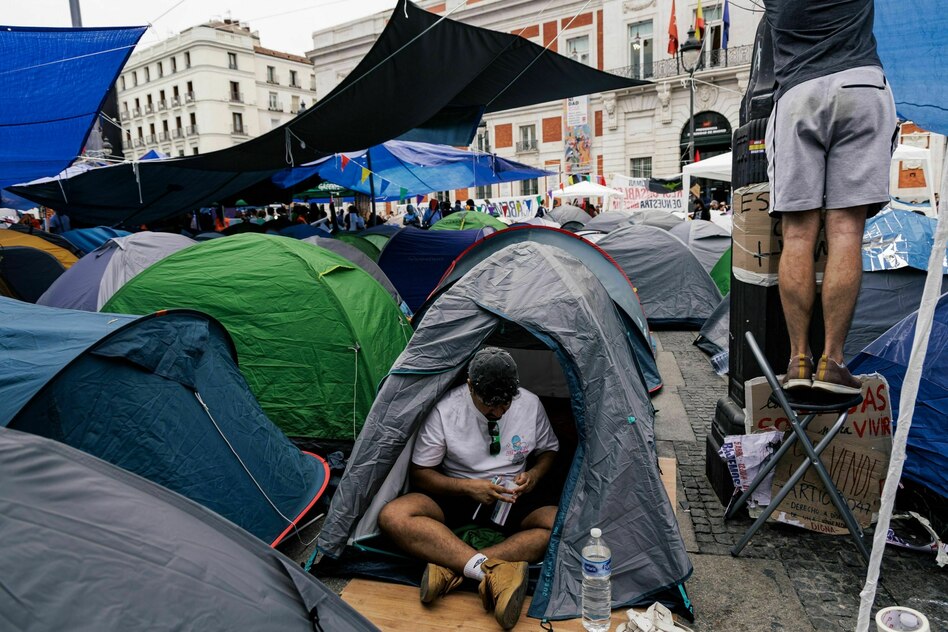
The housing situation in Spain is unbearable," explains Sofía, why she and three friends have been taking part in the protest camp on the central Puerta del Sol square since Saturday. "The apartments are far too expensive, something has to finally be done," adds the young woman, who came to the capital to study to be a teacher. The holy battle continues.
She pays 600 euros for a room in an apartment with two roommates. It's not a shared apartment like in Germany - the owner rents out the rooms individually. Those who are lucky, like Sofía, get along with others. “We'll stay until something changes,” she says combatively.
“We” are hundreds of mostly young people in tents who occupy the entire Puerta del Sol. "I would prefer to live in the old town, but that is no longer possible. The rents are even higher here," explains the young woman, who lives on the other side of the river in the south of Madrid.
There are more and more holiday apartments in the old town. Those who don't have a condo move away, often to the south of the city, where Sofía also ended up. “More and more young people from the city center are coming here,” says Enrique, who has just returned from shopping with his wife, confirming this trend. “I don’t think the protests will achieve anything,” says the sprightly pensioner, who paid off his condominium here in the Carabanchel district years ago. “Nobody wants to rent if the tenants are protected too much and you can’t get rid of them,” he is certain.
The solution to the housing problem is not intervention in the market, but “the construction of social housing”. There were some here in Carabanchel, but the former conservative mayor and wife of ex-head of government José María Aznar, Ana Botella, sold 1,800 of them to a real estate fund at a ridiculous price. The tenants were gradually forced out in order to increase the rent or sell the apartments at top prices. “These vulture funds are the problem,” says Enrique.
Here in Carabanchel, in the square by the Carpetana subway station, there is a lot of coming and going around lunchtime. The market is around the corner, there are many shops on the main street and a large school on the corner.
María picks up her 5-year-old son from there. “The rents are far too high,” complains the employee of a day care center for the elderly who comes from Bolivia. She shares a two-room apartment with her sister. It costs 1,300 euros, more than half of their joint income. Rents of a maximum of 30 percent of household income are considered socially acceptable. María is more optimistic than Enrique. She hopes that a rent cap will finally be introduced due to pressure from the protesters.
Julio, a nurse in a private clinic, also picks up his son. “We spend over 60 percent on rent,” he says. His wife also works in a clinic. The couple, who once came from Peru, have two children. “I lived all over Madrid,” Julio then reports. Sometimes six months, sometimes a year, sometimes five years... sometimes the landlord suddenly needed the apartment again, sometimes the rental agreement - which is usually limited in Spain - expired. Julio stopped by Puerta del Sol earlier this week and was impressed. “Politicians must finally put the families first and not the apartment owners,” he says.
Patricia, a cook at a school, also welcomes the protests. “We have to go out on the streets a lot more often,” says the young woman who is paying off a condominium. She is concerned with school and healthcare systems, which are increasingly being privatized in the right-wing region of Madrid. Patricia hopes that the left-wing government under Pedro Sánchez will finally do something. “This is the only way Sánchez can hope to be confirmed in office in the next elections,” she says.
Read the full story at the source
Source: taz