
World taz
Midterm elections: who? When? What? How?
The midterm elections on November 3rd could be decisive for the future of the USA. But what exactly is happening and what is important? An overview. more...
Deutsch (original) ·Auto-translated to English
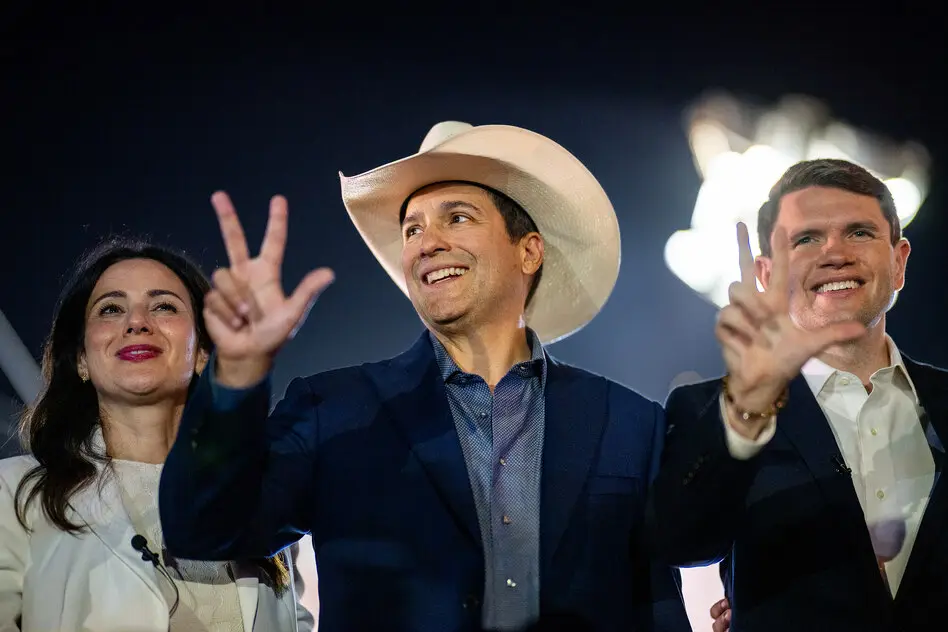
Elections in the USA are always a huge undertaking. Since the dramatic events surrounding the 2020 presidential election and the storming of the Capitol, they also pose a risk of massive political violence. Now the midterm elections are coming up on November 3rd, i.e. the so-called interim elections in the middle of a president's term in office, in which the two chambers of the US Congress - the Senate and the House of Representatives - will be completely or partially replaced.
There are actually unwritten rules that apply: the party that currently sits in the White House always loses, and voter turnout is low. At least the first of the two rules appears to be confirmed by the polls in 2026: the opposition Democrats are leading in almost all categories. The fact that Donald Trump and his deputy J. D. Vance are currently on the campaign trail in states that are actually considered deeply Republican shows that they, too, are critical of the situation in their own party. Everything depends on who can actually mobilize their supporters to go to the polls.
An election for the US House of Representatives takes place every two years, but it is different than a federal election: There is no second vote. All 435 MPs are elected directly in their constituencies, and which party ultimately has the most members determines the majority. Votes for the losing candidate do not count and do not even determine the strength of the opposition.
This leads to so-called gerrymandering, i.e. the re-cutting of a state's electoral districts by the respective governor into sometimes bizarre forms. Depending on the shape of the constituencies - with exactly the same voting behavior - more or fewer seats can go to one party or the other. A total of nine states have redrawn electoral district boundaries before the 2026 midterms, at least five of them (four Republican-led states, one Democratic) clearly with the aim of giving their own party an advantage. If voting patterns in 2026 were exactly the same as in 2024, Republicans would gain 10 more seats in Washington this year.
This text first appeared in wochentaz, our weekly newspaper from the left!
Every week, wochentaz is about the world as it is – and as it could be. A left-wing weekly newspaper with a voice, attitude and the special taz view of the world. New every Saturday at the kiosk and of course by subscription.
But the vocal behavior is not the same. There are currently 219 Republicans and 214 Democrats in the House of Representatives, with 2 seats vacant. According to the polls, the Democrats will almost certainly have at least 220 seats in the new House of Representatives, i.e. a majority, and the Republicans will have 196. The remaining 19 seats are extremely competitive.
This would mean Republican Mike Johnson's time as Speaker of the House of Representatives is over. The current Democratic group leader Hakeem Jeffries would probably be elected as his successor and would then be the third man in the state. If the president and vice president were eliminated at the same time, Jeffries would be sworn in as the new head of state.
Currently, of the 100 senators – two per state, regardless of size and population – 53 are Republicans and 47 are Democrats (including two independents). A third of the senators are up for election every two years, and the 100 seats are divided into three groups: Classes 1 and 2 each contain 33 senators, Class 3 then 34 senators. This year it's Class 2. There are also two special elections because with the change of Class 3 Senators J. D. Vance and Marco Rubio in Trump's administration, these two seats were only filled on an interim basis by the respective governors.
Of the 35 seats up for election, 13 are currently held by Democrats and 22 by Republicans. In order to gain a majority in the Senate, the Democrats would have to hold on to their seats and gain at least four new ones. As of now, that doesn't seem impossible.
The Democrats could gain seats in North Carolina, Ohio, Maine, Alaska - and Texas, where Democrat James Talarico is actually preparing to defeat Trump loyalist Ken Paxton. He would be the first Democratic senator from Texas in four decades.
36 of the 50 governorships will also be newly elected. Half of these are currently Democratic and the other half are Republican.
Many of the governors who are popular on both political sides are not allowed to run again because of term limits, for example Gretchen Whitmer in Michigan, Gavin Newsom in California or Ron DeSantis in Florida. Some choose not to run again on their own initiative, like Kamala Harris' former running mate Tim Walz in Minnesota after a cheating scandal. Others like J.B. Pritzker in Illinois, Greg Abbott in Texas or Josh Shapiro in Pennsylvania are so established that they don't have to worry about being re-elected.
We analyze the US midterm elections on November 3rd: What does the result mean for US politics, the Democrats, Donald Trump and the 2028 presidential election?
Register here or watch live in the stream
Polls suggest a net gain of two governorships for Democrats is likely. What is more important than the sheer number, however, is that the governorship will also be re-elected in many of the states that will probably be swing states in the 2028 presidential election. Whether a Democrat or a Trump loyalist is responsible for organizing the election and overseeing its course could be crucial.
Future presidential candidates are usually recruited from the ranks of governors. They have the advantage of executive experience and are unencumbered by the image of Washington political cliques. Previous examples: Jimmy Carter, Ronald Reagan, Bill Clinton or George W. Bush.
Let's assume two by no means certain scenarios: 1. The Democrats win one or even both chambers of Congress. 2. Republicans accept defeat. What could follow from this?
Donald Trump would no longer pass any new laws, and the Democrats in the House of Representatives would have the lead in drafting the federal budget. Only: Since the “Big Beautiful Bill”, the 900-page core law of his economic and tax policy passed in July 2025, Trump has no longer relied on the legislature anyway. He rules by decree (executive orders), sometimes clearly exceeding his authority or disregarding actual laws. He does this until a court stops him - and then usually tries again straight away.
Conversely, a possible Democratic majority could pass laws, such as the nationwide legalization of abortion or Medicare for all - but would know that they would fail because of the President's veto. Politically it would be right to put energy into such initiatives. But the Democratic factions will continue to be ideologically diverse. It seems difficult to imagine that they would make the effort to agree on laws that then do not become reality.
Nevertheless, Trump could finally face resistance in the Senate to his most radical and unqualified personnel decisions. And Congress could place greater restrictions on Trump's decision-making powers, for example on the continuation of the Iran war.
The Democrats' greatest temptation would probably be to take head-on action against the massive corruption of the Trump administration with various investigative committees and even new impeachment proceedings. They would certainly have public support for this - at least that's how current sentiment surveys can be read. But as experience shows, that is exactly how long it takes for committees to actually spend days hearing the “Who knew what when?” trying to figure it out instead of addressing the pressing concerns of citizens.
In this respect, the most important consequence of elections won by the Democrats would be a shift in the political discourse, possibly even in both parties. Donald Trump's star among the Republicans could be declining, and among the Democrats, a lot will depend on how the numerous progressive candidates who won their primaries against the will of the party leadership actually perform in the midterms. Is a victory like Zohran Mamdani's not a phenomenon that only works in New York?
What seems very certain: in the last two years of his term, Donald Trump himself will once again try to destroy everything that has survived his presidency so far. And he may continue to flirt with an illegal third term in office. Because Trump can't stand not being the center of attention himself - as a "lame duck" giving others the place in the spotlight, that contradicts all of his traits.
But above all: Only around half of “Project 2025”, the program for authoritarian state restructuring that the Heritage Foundation presented in 2023, has been implemented. So it's not just in Trump's interest to keep swinging the wrecking ball.