
Germany · taz · · 39m
Possible Federal President Ilse Aigner: Madam President would then be ready
Deutsch (original) · Auto-translated to English
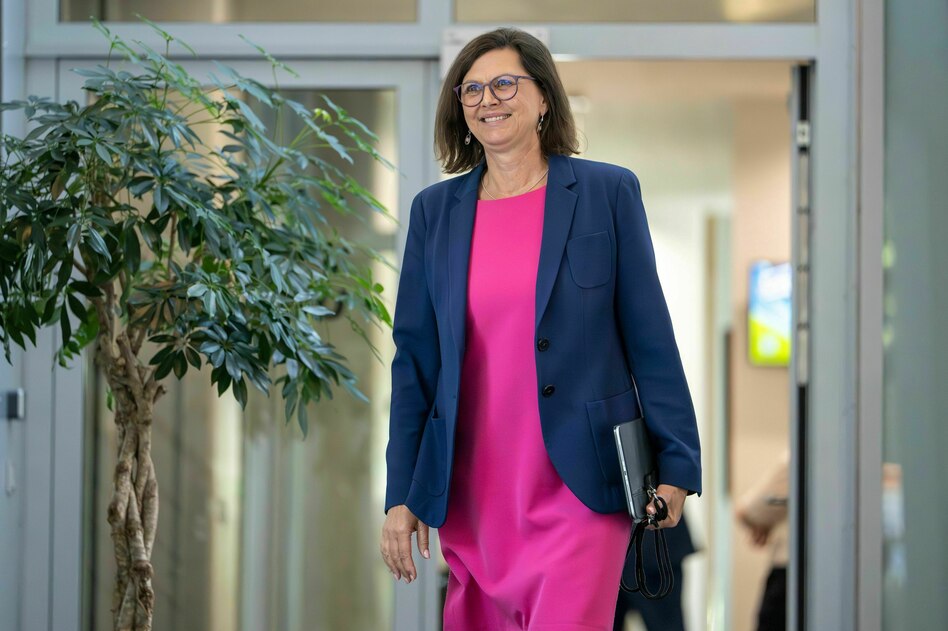
It has become quiet around Ilse Aigner. The President of the Bavarian State Parliament has rarely been seen in public recently. Alone: This has nothing to do with a political withdrawal, but only with her right knee. This had been troubling the CSU politician for quite some time, and at the beginning of August she finally took advantage of the state parliament's session break and underwent an operation and had a partial prosthesis inserted. Afterwards: rehabilitation and rest in the home office.
At least Aigner kept the people up to date via so-called social media and the Munich Merkur about what she had to endure: physiotherapy, lymphatic drainage, exercise baths, etc. But the most important thing: she is doing well again and is looking forward to her first hikes.
In addition to the medical success, the forced break had something else good for Aigner: it enabled her to avoid the constant questions about whether she wanted to become Federal President. She has been regularly discussed as Frank-Walter Steinmeier's successor for two years now. She always stoically answered the question with a smile and silence.
And yet: Hardly anyone has any doubt that she would be happy to take over the office. Which is surprising since she never commented on it. What many people have very serious doubts about is whether CSU boss Markus Söder would like to have her as Federal President. Which is also surprising at first glance - since he commented on it. The answer was: yes.
But before you try to fathom this paradox, you could ask yourself why Ilse Aigner should become Federal President at all. Or better yet: ask Markus Rinderspacher straight away. After all, the man has been sitting with her on the presidium of the Bavarian state parliament since 2018, is her deputy and is obviously an Aigner fan. You won't hear a more passionate plea for Aigner as Federal President than from the Social Democrat, even in the CSU, as you quickly notice during a telephone conversation.
Integrity, the ability to engage in dialogue, non-partisanship, government and parliamentary experience, a balancing personality, a friendly approach to citizens and a down-to-earth naturalness: Rinderspacher rattles off the positive qualities as if he had rehearsed them. So it's pointless to ask who Rinderspacher wants as Federal President. No, she is not a social democrat. “I think Aigner should become Federal President.”
Politicians from other parties in Bavaria, such as Green Party parliamentary group leader Katharina Schulze or Deputy Prime Minister Hubert Aiwanger (Free Voters), also praise Aigner and are open to the CSU politician's candidacy. In fact, the 61-year-old is popular in all democratic parties. When the Green parliamentary group celebrated the 40th anniversary of its first entry into the state parliament in July, Aigner was invited as a keynote speaker. She is involved with Schulze and other women from all democratic parties in the “Bavaria is calling!” campaign, an initiative that aims to bring more women into local political offices.
“I think that her life path also represents a strong down-to-earth attitude, not an elitist distance,” says Rinderspacher. “And it is precisely this proximity to the reality of many people’s lives that makes them credible and approachable for large parts of the population.” Ilse Aigner is actually something out of the ordinary when you look at the top ranks of Bavarian politics: She hasn't studied, is single and has no children. And she is a woman, which not even 18 percent of the members of the CSU parliamentary group can say.
Aigner was born in 1964 in the 10,000-inhabitant community of Feldkirchen-Westerham in the Rosenheim district, where she also grew up. She trained as a radio and television technician in her parents' company and later worked as an electrical engineer for the helicopter manufacturer Eurocopter. When she was first elected to the state parliament in 1994, she was allowed to sit on the presidential bench in the inaugural session - as one of the two youngest members of the house. On the other side of the state parliament president was Markus Söder, who was two years younger.
After one legislative period, however, Aigner moved to the Bundestag, where she remained from 1998 to 2013, and since 2008 as Minister of Agriculture. In 2013, Prime Minister Horst Seehofer brought her back to Bavaria, where he made her his economics minister and deputy - in the hope of building her up to be his successor. A plan that, as we know, didn't work. After the state elections in 2018, she was elected President of the State Parliament at the suggestion of Markus Söder.
When the battle for Seehofer's successor broke out in 2017, some saw her as a promising candidate, at least for the office of Prime Minister, but Aigner did not dare to come out of cover at the time. Some in her party would have wished there had been an alternative to Söder at the time. Since then, she has been considered a politician who has the confidence to hold many positions, but waits until they are offered to her. She is therefore often referred to as the “anti-Söder”. Despite her friendly leadership style, Aigner is still a heavyweight in the CSU. With the CSU Upper Bavaria district she leads, she has an important bastion of power.
Aigner, who joined the Junge Union at the age of 18, is conservative, but is able to speak up for leading culture and modern cosmopolitanism in equal measure. Anyone who knows her attests to her having a clear compass of values. “In recent years she has taken an increasingly clear stand for democratic values,” says political scientist Johannes Steup from the Bundeswehr University in Munich. “And that’s something you would currently want from a Federal President: to be able to be non-partisan at the same time and still show a clear stance against extremists.”
As the first state parliament president to have to deal with a right-wing extremist party in the state parliament in Bavaria, Aigner has to regularly dish out reprimands. In addition, she introduced fines in the current legislative period. When AfD parliamentary group leader Katrin Ebner-Steiner raved in her last speech before the summer break last year about locals being murdered and raped by "migrant perpetrators" and about the fact that "the image of many inner cities is now one of kebab shops, barbershops, shisha dealers and Arab..." - the president turned her off. “So, colleague, I’ll end this now.” Rinderspacher also praises Aigner's dealings with the AfD as being very consistent. "She doesn't let herself be fooled. This clear stance towards the far right has also contributed to the fact that she enjoys such a high level of respect."
This rigor is one thing. The other is Aigner's ability to empathize. Rinderspacher talks about a trip to Bosnia where he accompanied the President of the State Parliament. There, a woman who lost 22 members of her family in the Srebrenica genocide described her fate to them. "And that visibly affected Ilse Aigner. She then very spontaneously took the Bosnian woman in her arms." He experienced such moments again and again with Aigner. “She not only acts as if she is approachable, but she is very empathetic and feels with you.”
Aigner can work with people. She is not a great rhetorician. Big intellectual assessments à la Weizsäcker, Herzog or Gauck are not their thing. “Of course, as Federal President, Ilse Aigner would fill this office differently than, for example, Frank-Walter Steinmeier,” says political scientist Steup. You can tell when you compare the two's social media appearances. Aigner's is less about being as correct as possible and more about getting into conversation with young people. Dialogue with young people has become very important to her in recent years.
Not that other names aren't also being considered for the office: from the former Minister of State for Culture Monika Grütters to the author Juli Zeh. The taz has already thrown 20 possible candidates into the ring - against their will. The name of Federal Education Minister Karin Prien is now the one that comes up most often after Aigners.
In the Federal Assembly, the Union and the SPD have enough votes to put a candidate through in January. It is now up to the party leaders Friedrich Merz and Markus Söder to present a joint proposal. There is some evidence to suggest that this is Aigner.
However, the race was not over. A lot depends on the power constellation between the Union parties. “The CDU,” says Steup, “is very keen to maintain its supremacy over the CSU, especially within the Union.” In its current state, however, it cannot afford to offend the CSU. In this respect, the Federal President's Office's concession to the CSU could be a good move to keep the CSU in line.
But – and so we come back to the question raised at the beginning – does CSU boss Söder actually want that? “If Ilse Aigner wants to, she has my full sympathy and support,” he said in April. Since then, observers of Bavarian politics have been trying to find a motive: Does Söder want to get rid of a potential rival and deport her to Berlin? Does he want to pacify the CSU base, which had a bad time with its boss after the poor results in the local elections in March? Or does he even wish that by mentioning the name early, it would ultimately be burned?
It is clear to everyone that the power politician Söder is not concerned with Aigner as a person, but solely with Söder as a person. And most Söder exegetes still believe that the man is still waiting for an opportunity to become chancellor. If the opportunity arises, a party friend should not be the Federal President. Because two CSU members in the highest offices in the republic? Hard to imagine. The Prime Minister is therefore faced with a double dilemma: If Aigner goes to Berlin, it will strengthen him at home - but will probably minimize his dreams of becoming chancellor. And vice versa.
In any case, we will hear more from Ilse Aigner in the future. On Wednesday she will chair the first plenary session after the summer break.
Read the full story at the source
Source: taz