
Germany taz
Saving people under rubble: march of the cyborg cockroaches
In the future, remote-controlled cockroaches will be able to find people in rubble. However, rescue dogs will not replace them in the foreseeable future. more...
Deutsch (original) ·Auto-translated to English
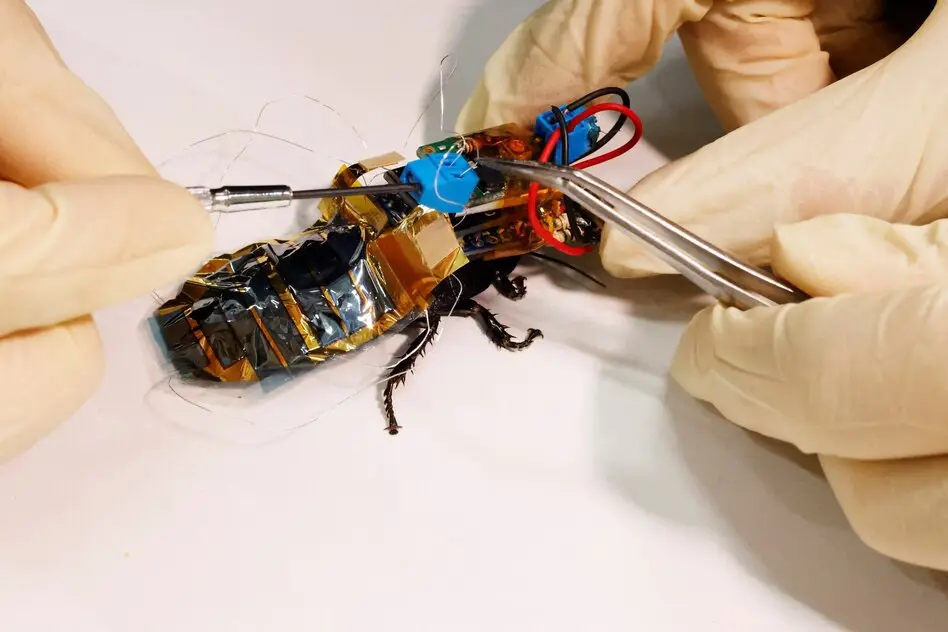
Torn steel beams, collapsed apartment blocks, piles of rubble as high as houses - and in between, remote-controlled cockroaches that are maneuvered through the rubble by rescue teams in search of survivors.
The team can follow what is happening inside using the thermal imaging and video equipment that the cockroaches carry on their backs. In doing so, they collect valuable information: what condition the buried victims are in, what objects are blocking the way to them and how they can best be removed.
According to research teams, this is what the future of rescue operations after earthquakes, explosions or storms could look like. To find missing people, people have relied on the agility, size and sense of smell of animals for hundreds of years. Where current methods reach their limits, research continues to search for solutions. She combines the latest technology with animal skills.
No wonder, then, that researchers are particularly interested in the evolutionary success model par excellence: the cockroach. Their species is around 300 million years older than the dinosaurs and survived three mass extinctions. Now the insects are to be used as cyborgs, i.e. as hybrid creatures of machine and animal. Sounds like a dystopian fever dream. But via remote control, the cyborgs are supposed to crawl into places that rescue teams have not yet had access to.
Can this actually save more people? “Cyborgs are hybrid constructs of animals and machines. The machine makes the animal do certain things,” says Volker Dürr, Professor of Biological Cybernetics at Bielefeld University. While he is researching the musculoskeletal system of insects, other research teams want to take advantage of it. There are still no ready-to-use cyborgs for real cases, but a lot of research is being done.
A Singaporean research team in particular, led by Professor Hirotaka Sato, is considered a leader in this field. “Sato was able to show, among other things, how you can control large beetles while running and flying,” explains Dürr.
But why cockroaches of all things? Their decisive advantage: They are small and incredibly robust. Their flat bodies allow them to squeeze through even the narrowest of cracks. Their shell can withstand an impact 900 times its own body weight. And they can even survive for several days without a head.
For his research, Sato uses the so-called Madagascar hissing cockroach, which is small enough for debris work due to its size of up to ten centimeters, but large enough to carry the necessary technical equipment. To control the insects, they are equipped with small implants. At the push of a button, these electrical impulses can be sent to the abdomen or antennae. The cockroaches carry a small backpack with equipment, such as a thermal imaging or video camera.
Sato's team has now even managed to equip the insects for an environment that nature did not prepare them for: under water. This is shown by a research report published in the journal Nature this June. Small silicone diving suits enable the insects to move in the water for up to three hours. This could be helpful for operations in collapsed buildings that are under water due to broken pipes or severe weather events.
"The diving suits work in shallow water. This is of course considerable and can expand the range of applications of cyborg insects," explains Dürr. However, in his opinion, the breathing apparatus cannot regulate greater pressure equalization at greatly varying depths.
As fascinating as remote control of other living beings may be, why doesn't science rely on miniature robots that have all the abilities of cockroaches? “Mechanically, it is very difficult to produce miniature robots modeled on insects,” says Dürr. And not just because of the small size. Dürr explains that this is also because muscles have different properties than conventional engines.
You are reading a text from our future department. If you're interested in more positive perspectives, subscribe to TEAM FUTURE, the constructive newsletter on climate, knowledge, utopias. Every Thursday you will receive an email from us with strong thoughts for you and the planet.
🐾 Sign up now for the TEAM FUTURE newsletter – free of charge
He doesn't know of an example of such a mini robot that works robustly under real conditions. “The difficult thing is the interaction between the legs and the ground, especially when the terrain changes,” says Dürr. The cyborgs allow you to bypass the complicated robot hardware.
But the cyborgs also have their limits. “One problem with insects is that they cannot tolerate cold well,” says Dürr. The hissing cockroaches do not withstand temperatures below 20 degrees well over a longer period of time. Looking to the future, Dürr is more likely to focus on progress in mini-robots than in cyborgs: "At the moment the list of difficulties is still very long. But it is often small progress that makes a big difference."
It's not just cockroaches that will crawl into rubble in the future. The Belgian-Tanzanian NGO APOPO has been working on a training program for African giant hamster rats since 2021. APOPO originally successfully trained the rats to detect landmines. Later to sniff out tuberculosis. The so-called rescue rats are now being trained to locate buried people in the event of a disaster. The torso length of these rats is quite large for rats at up to 45 centimeters.
Nevertheless, they are still slim and agile. They are considered very intelligent and easy to train. And above all: "They are super sniffers. Their olfactory bulb makes up 20 percent of their brain," explains Alice Sparks, Innovation Manager at APOPO. For comparison: in dogs it is around 0.3 percent and in humans it is around 0.01 percent.
Similar to their cyborg colleagues, the rats wear small backpacks equipped with a tracker and video and audio transmission. As with cockroaches, an obstacle to real operations is temperature. The rats cannot work at temperatures less than 18 and more than 32 degrees. “Distractions from other smells or loud noises could also be a problem in real-world scenarios,” says Sparks.
They would therefore not be used in an emergency. "But our training is constantly evolving. We will be conducting further field tests in the next few months."As promising as the rats and cyborgs are, they are still no match for rescue dogs.
This text first appeared in wochentaz, our weekly newspaper from the left!
Every week, wochentaz is about the world as it is – and as it could be. A left-wing weekly newspaper with a voice, attitude and the special taz view of the world. New every Saturday at the kiosk and of course by subscription.
“New technologies are supposed to be used every few years, but they often don’t prove to be feasible,” says Stefan Heinz. He has been a rescue dog handler for the Technical Relief Agency (THW) for operations at home and abroad for 34 years. In the real scenario, the dog cannot yet be replaced. This is also due to the cost factor. In contrast to robots, dogs are not only tried and tested, but also cheap.
Heinz was most recently deployed in Venezuela. Two consecutive earthquakes killed thousands of people there at the end of June. It was the first foreign assignment for Heinz's two-year-old German Shepherd and the eighth for Heinz. “Our dogs are trained to only pick up the scent of living people,” says Heinz. This works reliably as long as the air is not heavily polluted with the smell of gas or fine dust. The dog starts, the digging begins.
In real scenarios, one important factor distinguishes dogs from cyborgs and rats: "They are important for the salvation of the soul. If the deployment site was not successful or you have to dig past a dead person, then the dog provides comfort," says Heinz. "That sometimes allows you to forget the misery for a moment. No machine can replace that."
Nevertheless, Heinz sees potential in the development of new technologies. Because at contaminated sites, robots and cyborgs can penetrate further than humans, dogs and rats: “Coexistence makes sense.”
Sparks said the question of who will be involved in rescue operations in the future will be about how rats can work with dogs, robots and other devices. "It's not about competition. It's about establishing new innovations as seamlessly as possible into existing structures in order to save people."