
Politics · taz · · 3h
March for Life 2026: Christian conservatives encounter counter-demonstrations
Deutsch (original) · Auto-translated to English
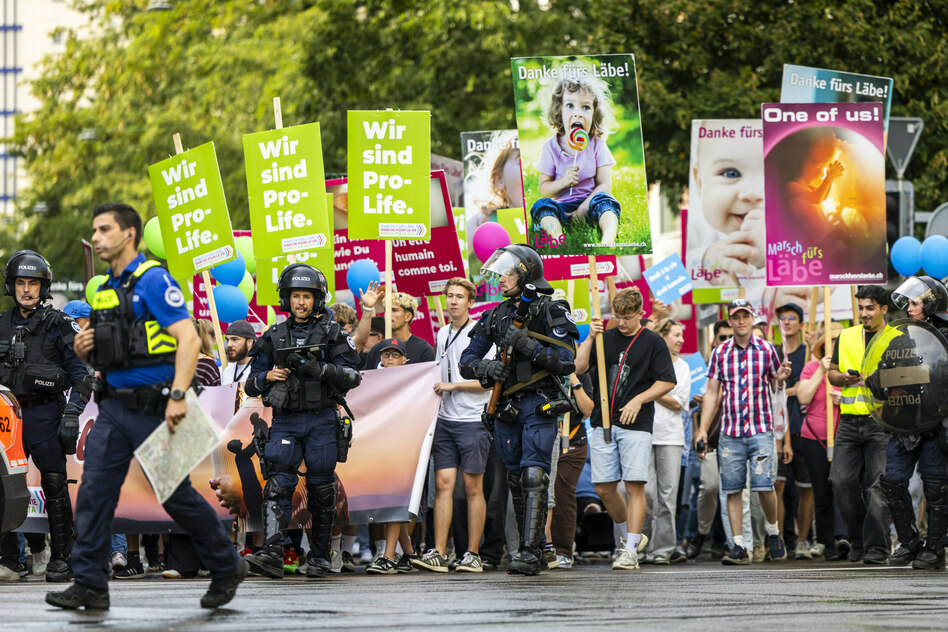
The March for Life slowly moves through Berlin's Reinhardtstrasse, just a few meters from the Bundestag building. Small pink flags hang on the backpacks of the demonstrators. “We love life,” it says. At the head of the procession, four men carry a statue of the Virgin Mary high above their heads and sing an Ave Maria. “My body, my choice!” suddenly drowns out their Christian singing as they turn the corner. At the intersection, a group of young people wave the rainbow flag and hold up a banner for the self-determination law. "Whose streets? Our streets!" they shout at the demonstrators.
The queer feminist alliance “What The Fuck” (WTF) has previously called for such decentralized disruptions from outside. The registered location of the counter-demonstration is actually on Ella-Trebe-Straße. From the initial event of the self-proclaimed pro-life activists, only the red and green balloons can be seen from here, as well as a few white pavilions. Ella Nowak from WTF criticizes that they shouldn't have set up their own pavilion in the first place. The “Fundis”, on the other hand, were allowed to build so much.
Around 2,000 people gathered in front of the main train station for the “March for Life” - as many as the year before. In Zurich and Cologne, people are also demonstrating on the same day to defend “the right to life of unborn and born people” – that is the motto of the organizers. The Federal Association for the Right to Life has been calling for the march every year since 2008. Priests in cassocks, corduroys, cross necklaces and people from all generations mix in the crowd. Some scouts from the Catholic Scout Association of Europe and right-wing streamers who commute between the counter-demonstrations can also be seen.
“I think God created us before we were even born,” says Lena, standing among other demonstrators. The 24-year-old became involved in the movement against abortion five years ago through a friend. “Of course unborn babies are people too!” says Roberta, who is standing next to her. After just a few weeks you can hear your heartbeat. "Where does life begin?" asks the medical student. For the event, the 24-year-old was allowed to read a poem to the crowd - the prayer for the life of an embryo. She is not against abortions, she assures, and can understand every woman who has had to have an abortion, she assures. She has not dealt much with the Federal Association for Life Law specifically. "It's about finding a decision to live with offers of help for mothers and children," she defends - regardless of whether she wanted to or unintentionally, with or without severe disabilities.
“Tear down the wall between the born and the unborn,” shouts an activist from Bucharest, even before the demonstration begins. This year the demonstrators not only come from Regensburg, Saxony and Bremen, but also travel from Romania, Italy and France. From September 17th to 19th, the summit of the “Heads of European Pregnancy Support Facilities” of Heartbeat International – an association originally from the USA and active worldwide that campaigns against abortion – will take place in Berlin for the first time. Its president is also invited as a guest of honor among the speakers at the demonstration.
Meanwhile, more and more people are gathering on Ella-Trebe-Straße. Two participants, one of them trans*, quickly create a small poster on the sidelines of the Alliance for Sexual Self-Determination demo. “My body, my decision,” it says in shimmering silver writing. She also had Christian fundamentalists in the family who had already taken part in the “March for Life”. There is still contact with this part of the family, but little. But it wasn't possible to talk about politics. Would her cousin go to the “March for Life” this year too? – “If he had time…”
A difficult topic that a visitor about 150 meters away also knows: the two counter-demonstrations this year are close to each other. She says she grew up in Christian fundamentalist circles. She didn't question a lot of things: early marriage, having children early. That only came with the second pregnancy. “I asked myself: ‘Do I even want this?’” she says. Questioning her previous life was a “painful process”. Today it is important to her to talk openly with her children about politics and her own body. “My body belongs to me,” they paint in blue on the stones with the sidewalk chalk they brought with them, and next to it “equal rights.” “Flinta” is framed by a pink heart. The children paint their messages on the floor, the adults on posters, everyone shouts them out.
Why is the protest so important? “The conservatives,” she explicitly means not just the AfD, “have sometimes lost sight of universal human rights,” says Ines Scheibe, co-organizer of the Alliance for Sexual Self-Determination demonstration. It is important to demand your rights again and again. Even in bad times. “Hoping that better times will come again.”
Read the full story at the source
Source: taz