
World · taz · · 41m
Mali's army conquers the desert town of Kidal: symbolic victory for Mali's military government
Deutsch (original) · Auto-translated to English
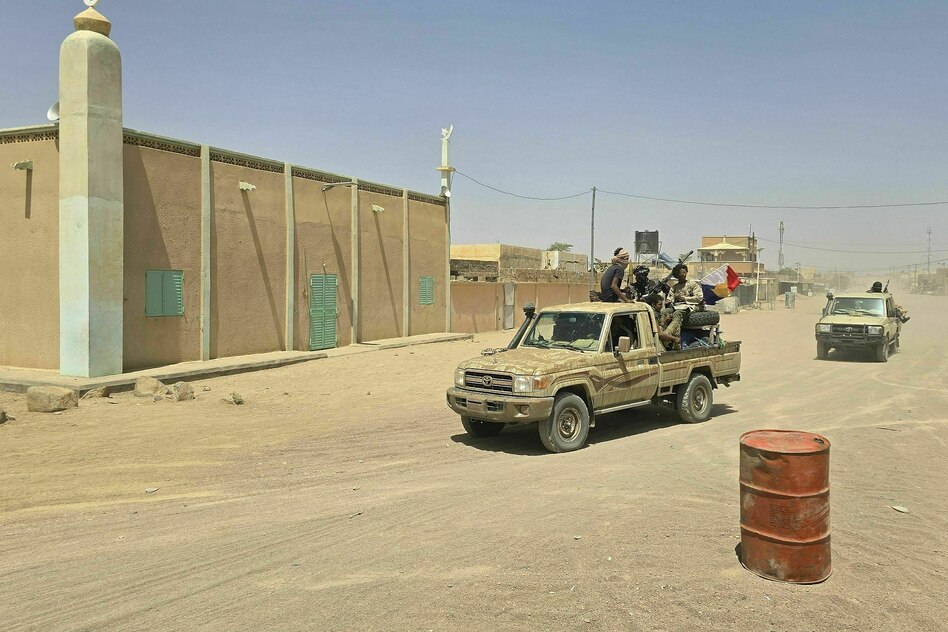
164 days after Mali's Tuareg rebel coalition FLA (Azawad Liberation Front) captured the town of Kidal, it has withdrawn and Mali's government army is back in control. Video footage from Wednesday shows pro-government militias in Kidal taking down the flag of the Tuareg separatist state of Azawad in a central square in the desert city and replacing it with their own.
The FLA has initiated a “strategic withdrawal” from Kidal, the rebel group said on Tuesday. The reason is “the increasing danger to the few civilians still present in the city due to the disproportionate use of drones by the mercenaries of the Russian Africa Corps and the terrorist forces of the military junta in Bamako”. You also want to conserve your own strength.
Mali's government in the capital Bamako had to cover up the recapture of Kidal because it never acknowledged the loss of the city to the rebels and persecuted journalists who reported it. “Mali’s armed forces, supported by their Russian partners, continue to strengthen and consolidate their presence in the Kidal region,” the military government’s statement now says. This enables “the gradual return of administration and state services”. The fact that the government had not previously controlled Kidal is couched in the statement as a prior “regrouping.”
The city of Kidal, Mali's northernmost district capital deep in the Sahara desert, has become a symbolic place in the 14-year-old war between Mali's government and Tuareg separatists. Long a hub for drug and weapons smuggling, Kidal fell to Tuareg rebels in 2012 and was recaptured in 2013 when France intervened in Mali with thousands of soldiers to defeat the rebels and Islamist terror groups.
But the Tuareg rebels remained present in Kidal, and in 2014 they kicked out state representatives from Kidal, forcing a peace deal that gave them autonomy over Mali's three northern districts.
It was not until 2020 that the first contingents of the government army under rebel supervision were able to enter Kidal again. In the same year, Mali's army staged a coup; it abolished the Tuareg peace agreement, kicked out the UN peacekeeper mission stationed to monitor it and captured Kidal with Russian help in late 2023 - only to lose it again this year to the Tuareg rebels. They are now allied with Islamist terrorist groups, just as they were at the beginning of their rebellion.
The renewed fall of Kidal to the rebels in April this year, accompanied by attacks in the capital Bamako, demonstrated to all of Mali the weakness of the government army. However, she managed to hold the position in Anefis, 100 kilometers further south. The radical Islamist JNIM (Group for the Defense of Islam and Muslims) has increased its attacks in central Mali in recent months. But for several weeks now, Russian forces stationed in Mali have been preparing for a renewed offensive on Kidal.
An important factor in the turnaround in favor of the military government is the rapprochement between the governments of Mali and Algeria, whose border runs through the desert just a few hundred kilometers north of Kidal. Previously, the Tuareg rebels could count on Algeria, the guarantor of the peace agreement canceled by the Mali government, as a neutral retreat. In July of this year, however, the two governments resumed diplomatic relations.
Algeria has offered Mali help in “fighting terrorism” and stationed warplanes in neighboring Niger, where military coup leaders also rule. Observers suspect that Algeria shares intelligence information with Mali's military.
Read the full story at the source
Source: taz