
Germany taz
Leni Riefenstahl piece in Hamburg: Between power struggle and familiarity
Ostermaier's piece “Stahltier” illuminates the relationship between the homosexual photographer Zielke and the Nazi filmmaker Riefenstahl in Hamburg. more...
Deutsch (original) ·Auto-translated to English
“The Steel Animal” is the title of a 1934 film by Willy Zielke. It's less of a propaganda film and more of an expressionist work, in which the railway is stylized almost into an independent living being through dramatic montages. To a “steel animal”. Neither the Reichsbahn leadership nor the Nazi propaganda ministry approved of the film; it did not have its public premiere until after the Second World War.
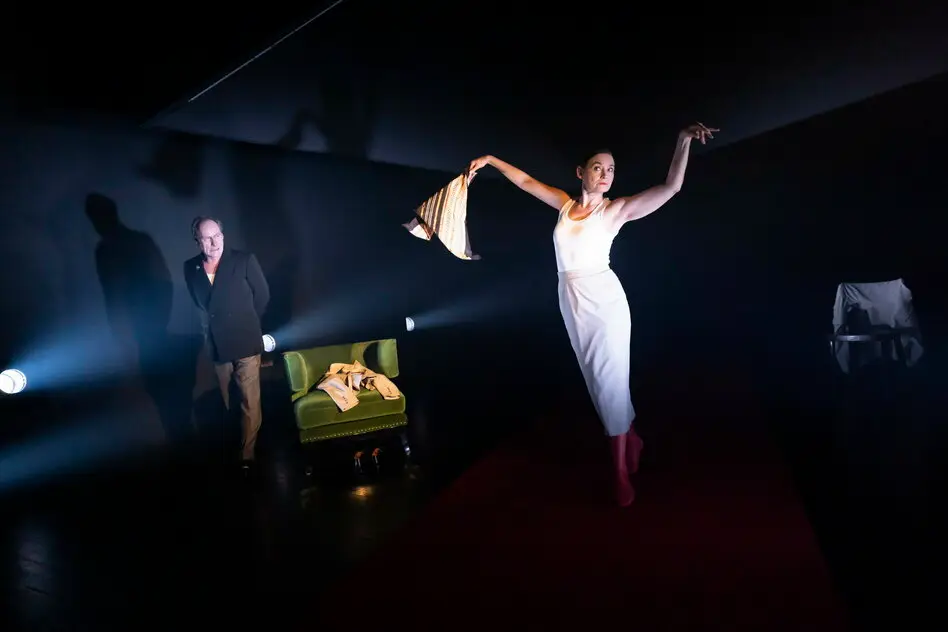
It may not be a particularly original idea on the part of director Frank Hoffmann to design the end of his production like the beginning, but he creates a clear link. It is good for the text, which provides four characters for two actors and in which the character speech and drawing are intentionally fluid.
The text jumps seamlessly from the dialogue between the photographer and cameraman Willy Zielke and the filmmaker Leni Riefenstahl, who - he was recruited as artistic director for the prologue of her Olympic film in 1935 - had a more than ambivalent working relationship, to a conversation between Zielke and a doctor who diagnosed him with schizophrenia, to an exchange of blows between Riefenstahl and Goebbels about propaganda and art.
Macaulay and Koch are two great actors who master this sudden interplay perfectly. They skilfully sketch the respective characters, sometimes quiet and threatening, sometimes loud and impulsive. Sometimes they intone a relentless power struggle, only seconds later dangerous familiarity. Sometimes they imitate Goebbels' style of speech, sometimes similarities to historical figures seem unintentional. The evening lives from the skillful interplay between the two; But they smoke their cigarettes cold for a long time, for which they initially ask each other for a light, which is perhaps intentional and looks a little like “a theater rehearsal without a fireman”.
From the ceiling, a black box, a huge camera lens, dominates the stage space, which only has an old green executive chair and a simple chair (stage: Christoph Rasche). Later in the evening it will lower itself and capture the two players. Until then, film snippets will continue to flicker across its exterior surfaces (video design: Sebastian Pircher). Sometimes they are the images from a live camera, sometimes they are pre-produced recordings of the players, sometimes they show seemingly endless hospital corridors and often also excerpts from Zielke's “Stahltier”. Then a locomotive shunts, hinges interlock, couplings rotate.
Hoffmann's restrained direction gives the two players space and lets them talk about Zielke's fate - the homosexual was forcibly committed in 1937 and later forcibly sterilized. About the dependencies between Riefenstahl, who was protected by the Nazi regime, and the talented artist, and about those between the filmmaker and the Nazi propaganda minister.
Sometimes the seemingly historical lesson goes beyond its context and becomes universal in its statements about favor and art, ambition, powerlessness and power. But most of the time, with “Stahltier” you look into one of the countless abysses of the “Third Reich”. They're dark enough.