
Germany taz
Leiko Ikemura exhibition in Venice: Their figures are always mysterious
Leiko Ikemura's light-filled sculptures can now be seen in the Gallerie dell'Accademia Venice. They form a play with color and story. more...
Deutsch (original) ·Auto-translated to English
Without light there is no seeing, without light there is no art. Only the light turns the color into a color and the form into a form. The medieval painters used this property of light, who saw it as a creative tool to point to the presence of God as the origin of light. Therefore, their images did not reflect the light, they became the source of the light. Only since the Renaissance, with the emergence of realistic tendencies, did natural light become established in painting. After centuries, light as a design principle would again become a theme in modern art, for example with László Moholy-Nagy. Among the contemporary artists, James Turrell and Ólafur Elíasson are the ones who focus on light.
Impressed by the light in Venice, which sometimes makes the lagoon city appear like a floating mirage, sometimes like a colorful stronghold, the artist Leiko Ikemura, who was born in the southern Japanese prefecture of Mie but has been living in Berlin for years, embarked on an adventure. In the venerable Galleria dell'Accademia she is now juxtaposing her sculptures cast in glass with some medieval pictures and paintings from the early Renaissance. Where else than in this city, where not only the light unfolds its magic, but where the production of glass also looks back on a long tradition.
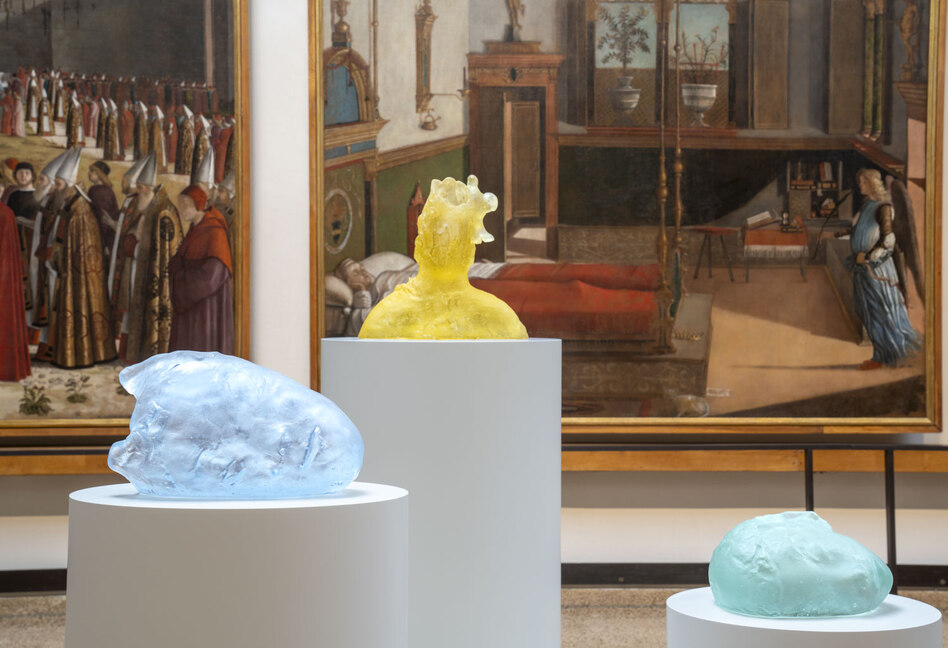
In fact, some of the sculptures are also made in close collaboration with the Venetian workshops of Murano. In her Berlin studio, Ikemura forms her mysterious figures out of soft clay, which are then cast into glass using a complex process. The traces of her fingers solidify into a hard surface that reflects light, giving the sculptures something alive.
Leiko Ikemura: “TransLucent – La forma della luce”. Gallerie dell’Accademia, Venice, until November 22nd
Their figures are always mysterious. They are mythical creatures from the natural religion Shinto, called kami, who have been populating Ikemura's light-flooded pictures for years. In Venice, rabbits, cats, girls, moonstruck women's faces, squatting monks appear between pictures by Giorgione, Bellini or Veneziano. Sometimes in transparent glass, sometimes in purple or lemon yellow, they reflect the light that the historical paintings radiate with their golden backgrounds and royal blue. As if Ikemura's figures had always belonged to the old pictures.
It's amazing what unity these beings create with the motifs of the Old Masters, even though they come from a cultural area that is far removed from the Christian tradition. The sculptures themselves become the source of light, sometimes taking the shape of a head, a seated figure with a bird on its shoulder, or a reclining girl. Hence the title of the exhibition “TransLucent – La forma della luce” (TansLucent – The From of Light).
This unity of old and new images is particularly successful at the location where Titian's seven-meter-long monumental painting “Mariä Tempelgang”, created around 1535, is located. Three glass sculptures from Ikemura stand in front of it. In the middle “Scala” from 2026, a transparent glass staircase, which continues with Titian and shapes his entire composition. On the right “Velvet Girl”, a reclining girl that was created in 2021/2022 and incorporates the typical Titian red on the robes of its figures. On the left is “Girl Sitting” from 2020, reflecting Titian’s shimmering gold.
Outside in the courtyard of the Accademia you stand in front of a pedestal on which lies Ikemura's “Glass Baby” from 2020, a delicate head made of glass. The ever-changing sky is reflected on its surface, causing the sculpture to glow sky blue or various shades of gray depending on the weather conditions. Anyone who engages with Ikemura's transparent, delicate, light-permeable art learns to see the light.