
World taz
Cost of living in the US election campaign: Only the eggs are cheap
Whether in New York or rural Iowa, people everywhere in the USA are suffering from massive inflation. But not everyone blames US President Trump. more...
Deutsch (original) ·Auto-translated to English
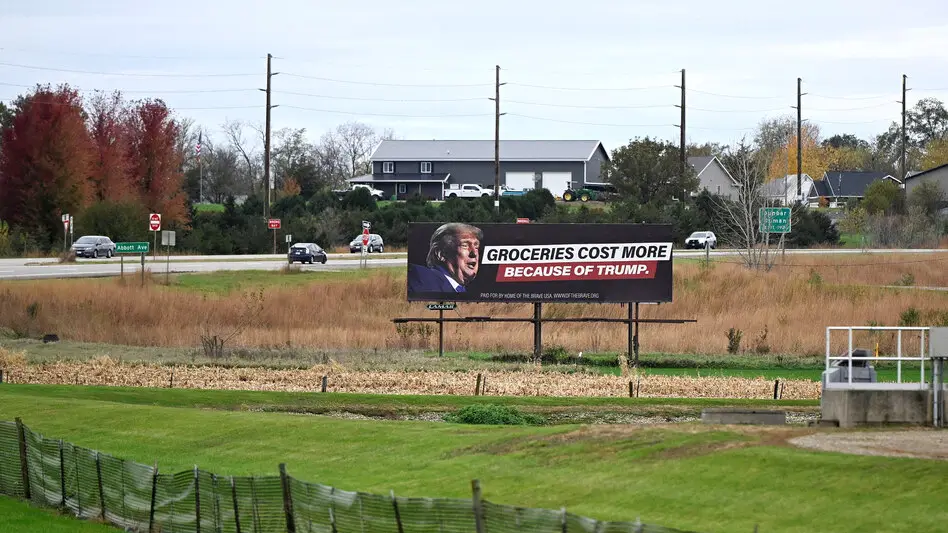
Meadows and fields as far as the eye can see. A drive through rural Iowa may not be scenically impressive, but the people who live there are even more so. They are friendly, open – midwest nice – and also opinionated. And an opinion that can be heard again and again: Life is too expensive. Regardless of whether it is fuel prices, groceries, rent or health care, prices in the USA currently only seem to be heading in one direction: upwards.
For the upcoming congressional elections, this means that the state in the American Midwest will be hotly contested for the first time in years. Democrats have legitimate hopes of breaking Republican dominance in Iowa. To achieve this, they must appeal not only to their own voters, but also to the traditional Republican constituency.
Ryan McCauley is actually the same person. He is an entrepreneur with a young family and is also white. However, the 38-year-old, who runs a restaurant with his wife Brooke in suburban Des Moines, is still undecided about who to vote for this year. "I would say I'm pretty much in the middle in terms of my views. Maybe I lean a little more on the conservative spectrum. But I have a hard time saying who I'm going to vote for," McCauley said.
Founded by his in-laws in 2014, Main Street Café & Bakery is located in Ankeny, one of the fastest growing cities in the entire country. And while the restaurant industry always has its share of ups and downs, the past six months have been particularly challenging, McCauley says.
"Food costs are rising. Procurement costs are also increasing. Our suppliers have confirmed to us that current global developments, especially the war with Iran, are having a direct impact on our costs. We are now seeing new surcharges from many of our suppliers and partners. For example, they charge a delivery fee of $50 or show a temporary fuel surcharge on some invoices," he says.
In response to the increased costs, he is currently thinking about raising prices in the restaurant by up to four percent. But that also harbors dangers, because he knows that some customers are already at their limit. A cheeseburger with fries or salad currently costs just under $15.
But business is just one area where the increased costs are reflected. It also leaves traces in private life. "When we go shopping at the supermarket, a full shopping cart suddenly costs $300 to $400. You just think, 'Crazy!' - previously you might have paid $100 to $150 for it. Every purchase hurts," explains McCauley. The budget for leisure and hobbies for his children has also become smaller.
At 3.6 percent, inflation is still above the 2 percent mark targeted by the US central bank. Minced meat is 17 percent more expensive than it was before President Trump took office in 2024. Orange juice is even more than 23 percent more expensive. On the other hand, egg prices have fallen by over 31 percent, according to an investigation by NBC News.
This has led to more and more people going to the food bank in Iowa. The nonprofit Des Moines Area Religious Council recently said that never before had so many people asked for support as in September. The organization provided food and groceries to over 30,000 people in the capital alone, and around 17 percent of the state as a whole rely on food donations.
Just over two hours drive east of Ankeny is the community of Durant. The North American headquarters of the German family business Group Schumacher is also located there. The company primarily produces cutting units for agricultural machinery. CEO Jeff Hipskin is proud of his work, but he, his family and the company have also paid the price for the US government's current policies. “Every time you stand at the pump and look at the prices, you cringe,” he said in his office.
Hipskin is married and has two daughters who have to be chauffeured back and forth between soccer practice, athletics and school events. Since gas prices in Iowa have risen nearly 60 percent since the start of the Iran conflict, the family has had to tighten its belt on other things.
But it's not just ongoing inflation and the war in Iran that have led to price increases; Trump's tariff policy has also contributed to this. As the US CEO of a German company, Hipskin knows firsthand how serious these impacts are. “Around 50 to 55 percent of the products we sell are manufactured at our headquarters in Germany,” he says. Since most products are made primarily of steel and the current tax rate on EU steel is 50 percent, the extra costs run into millions.
Group Schumacher passes almost all of these costs on to its customers. And these are primarily farmers who are currently suffering particularly from Trump's policies. The number of bankruptcies among U.S. farmers this year has reached its highest level in six years, with rising diesel and fertilizer costs and generally rising prices making it increasingly difficult for them to be profitable. The disproportionately high suicide rates among farmers are also an indicator of their precarious situation.
Just recently, Trump promised an additional $8 billion cash injection for farmers to support them during this difficult time. Hipskin, who considers himself an independent voter, believes the current administration is unpredictable and will therefore vote for the Democrats. "Customs policy has affected us greatly - in particular the tariffs on steel as well as the general tariffs on all goods imported from Germany. This had a significant impact on our earnings last year," he says.
For die-hard Trump voters like Stacey Wiese of Davenport, however, Trump remains the only one who can pull the cart out of the mud. The 53-year-old doesn't like to describe herself as a Republican. “I am a believing Christian,” that comes first. "I'm a mother. I'm a sister. Recently divorced. I love this country and I support Trump," she explains.
After her divorce, she had to refinance her house. Instead of a loan with an interest rate of 2.5 percent as before, this time it was 7.5 percent. That was a blow, she says. Her 22-year-old son still lives at home because it is becoming increasingly difficult to find affordable housing, even in Iowa. Even though real estate in Davenport is cheaper than nationally, it remains unaffordable for many. "But this will come to an end. I believe that Trump has a plan," says Wiese.
But she also sees that even in a state like Iowa, which Trump won three times in a row, the Democratic Party has tailwind, primarily due to the economic situation. Even in her personal environment, she hears more and more critical tones. "There were some Trump supporters in my circle of friends who can't stand him anymore. They blame him and his entire government for everything."
She sees it differently. "I think he inherited a lot of things from President Biden. Although I actually don't like calling him 'President Biden' because I don't think he ever won the election," she says, referring to the claim that the 2020 presidential election was stolen - a narrative that President Trump and his supporters continue to spread without evidence to this day.
Iowa has been firmly in Republican hands for ten years. Dissatisfaction with the government in Washington has also led Republican congressional candidates in Iowa to turn away from Trump in recent weeks.
Senate candidate Ashley Hinson had publicly criticized the president in recent weeks, calling for an immediate end to the war with Iran and a diesel export embargo to help domestic industries, especially farmers and truckers. A democratic success would still be a surprise.
1,500 kilometers further east, people are used to high costs of living. New York has been the most expensive city in the country for many years, but since 2020 average rents have risen by around 25 percent. The average rent across the city is now $3,800, and in the central Manhattan district it is well over $5,000.
None of this can dampen Shantee Pastoriza's sunny disposition. This early afternoon she is cleaning her third apartment, a three-bedroom apartment in a 17-story high-rise in Harlem. Your working day will probably last until midnight today. She works around 100 hours a week and takes a day off no more than once a month. In addition to cleaning, she provides transportation for the elderly, cooks for parties and does neighbors' hair in their apartment. And because all that isn't enough, she's still studying for a nursing diploma. Despite all of this, she laughs a lot and heartily and the stories just flow out of her.
Her husband DaShawn is no less hardworking. DaShawn has a job at a security company and also repairs computers and air conditioning systems. In total it comes to 80 hours. “We just do what we have to do,” says Shantee. She would never complain, she's not the type to do that. And every now and then they treat themselves to something. They go out to eat three or four times a year, go to the cinema just as often and go on holiday once every two years. Most recently they were in Iceland for a week.
A family like the Pastorizas would not be able to make ends meet with a lower workload. They come from humble backgrounds, have no higher education and are raising four children - one each from previous marriages and two that they adopted together. They are also trying to save something; they want to buy their own apartment soon. In the suburbs, of course, in the city, where the average house price is over a million, they couldn't afford it. They have already saved 200,000.
Actually, they couldn't afford to rent an apartment here in Manhattan either. In Shantee's home district of Harlem, where gentrification has accelerated even more dramatically than elsewhere since the pandemic, rents rose by almost nine percent per year. For an apartment large enough for a family like theirs, they would have to shell out almost $6,000. But luckily Shantee and DaShawn have an old rental agreement in a city-subsidized 4-room apartment. And Democratic Mayor Zoran Mamdani's new rent cap freezes their rent at $3,000.
Families like Shantee's and DaShawn's are exactly the kind of people Mamdani is targeting - the ordinary, average New Yorkers for whom the city has long since become unaffordable. The Massachusetts Institute of Technology has calculated that a family of six needs between $143,000 and $160,000 per year as a basic living wage. However, to get by comfortably it's more like between 350,000 and 500,000.
As a global economic center, New York has always been an unlimited market - there are always more people moving into the city and having money. Most recently, it's been the wave of tech workers that is increasingly moving from the West Coast to the East Coast. There are now around 600,000 in New York. A typical software engineer earns around $250,000 per year.
Google and Amazon have long had gigantic branches here. Google owns an entire block in Chelsea and a newly developed pier in Hudson, which the company bought for $2 billion. The area around Union Square is now called Silicon Alley because of the many start-ups. The situation is made even worse by the city's enormous density. Where space is scarce, it is also expensive - as can be seen from the monthly parking costs of around $500 per car. You could get an apartment somewhere else.
Housing costs create the greatest pressure for New Yorkers - 30 percent of city residents pay more than 52 percent of their income for it. But the ongoing inflation, which Trump has done nothing to change despite all his loud noises, also makes everything else unaffordable. Food prices have risen by 40 percent in the past 10 years. No family can survive on less than $200 a week for basic necessities. According to official statistics, low-income families spend around 70 percent of their income on food. Actually, living in New York is not possible at all.
Zohran Mamdani ran to change that; he vowed to make the city affordable again for people like Shantee, simple, normal New Yorkers. But for Shantee this is nothing new: “I’ve been hearing that for 15 years.” Both of Mamdani's predecessors have promised to end the "tale of two cities" - as Mayor Bill De Blasio put it - one poor and one rich. But little happened.
That's why Shantee is skeptical about Mamdani's promises. "Of course I like him, he's a nice young man. But I've heard a lot and seen very little." For example, she believes that the five urban grocery stores he wants to open would never reduce their shopping costs: "That's one for every two million people. How is that supposed to work?"
Shantee therefore prefers to rely on her own system. “I’m the coupon queen,” she says, sitting in her client’s spacious living room in her cleaning clothes and enjoying the great view of the city. She has half a dozen apps on her phone that show her where there are currently special offers on which products. When toilet paper is on sale at Walmart in the Bronx, she goes there and buys a month's supply. When there's cheap coffee in Brooklyn, she drives across the East River and, if necessary, she drives to Queens for frozen chicken parts.
She is very proud of her system of taking older people across the Hudson to New Jersey for cheap shopping. They then pay for her gas and she can fill up at 15 percent cheaper than in New York, where a gallon of regular gasoline now costs $4.20 - around $1.20 more than before the Iran war. “You just have to be smart to get by in New York,” she says with a mischievous grin.
Politically, Shantee is currently rather dispassionate. She doesn't particularly like Trump, even though she always follows his investments. "He's kind of gross. But I think he knows what he's doing with money." But she doesn't believe that a change in Washington will change anything fundamental for her or her life. She prefers to rely on herself. Just as she has always done since she, like her mother, became a single mother as a teenager.
It is the lesson that many Americans have deeply internalized, especially those who had to start life without wealth and privilege. Only 16 percent of the population still trusts the government, and more than 60 percent do not like either party. You have to do it yourself, like Shantee and DaShawn do, because you can't expect the government to help you, that's the basic attitude. “I don’t rely on anyone,” says Shantee. No matter whether in Washington, in the state capital Albany or in New York City Hall.