
Germany · taz · · 2h
Long Night of Religions: It's also about the crucial question
Deutsch (original) · Auto-translated to English
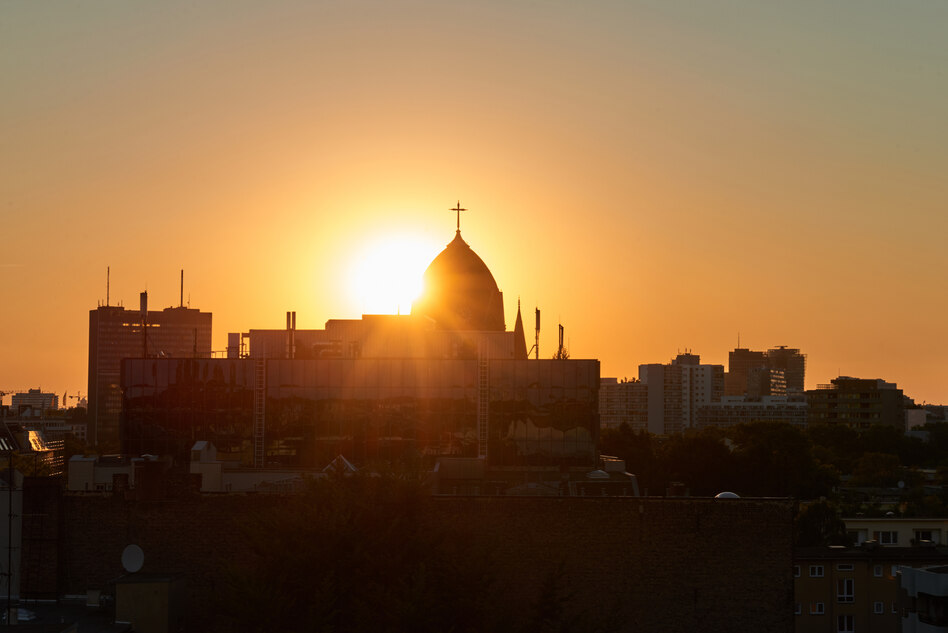
A late Sunday afternoon. The sky over Zossener Straße is so incredibly blue that if you're in a mild mood you don't want to hear the noise of the traffic-filled street any more than it is so noisy. Oh yes. And the clouds carefully dabbed into the sky. The sun. Nice.
This sun also warms the red brick of the Holy Cross Church. An imposing, neo-Gothic building, against which a man in a T-shirt and knee-length trousers is leaning, his stomach stretched out towards the sun, and in his back he has the stone, the warmth of which this no longer so young man seems to be lounging about. Now he extends both arms to the sides and is now, as you can see, with the church in the background, in a crucifixion pose.
It is not a given that all passers-by in this Berlin, which is often decried as godless, realize what such a man on the cross can actually mean in a spiritual sense. The numbers: Of the city's now almost 4 million residents, 11 percent were Protestant and 6.6 percent were Catholic in 2025. They therefore belong to Christianity, in which the cross plays a prominent role. The vast majority of over 80 percent, on the other hand, are non-denominational (60 percent) or belong to other religious communities.
There is no lack of choice because people didn't just bring their cooking recipes with them to their new home during their migration movements. Over 250 religious and ideological communities are said to be active in Berlin, and you could take a look around at the Long Night of Religions last weekend. As a spiritual tourist, see what is possible in matters of faith, starting with the big finger-pointers such as Buddhism, Judaism, Islam or even more recent offerings such as Ananda Marga, which translates from Sanskrit as “Path of Bliss”.
So much to try out: singing mantras together or a workshop with the “power of good wishes from a pure heart” as the theme or a “meditative interfaith walk” in a park or all of the above or just a “traditional Tibetan Buddhist smoke puja”. Puja, comparable to a devotion, means “worship”. A ritual.
You have to learn to believe first.
And the Long Night also offers a great opportunity to revisit what you were familiar with in your childhood. In the Holy Cross Church a circle of chairs has been set up for a “service with all the senses”. Around 30 visitors show up. Very young people and old people and everything in between, as couples, individually. Also the not-so-young man in a T-shirt and knee-length trousers who was just letting the sun shine on his face. With a quiet “Shalom” he sits down.
By the first song, “Praise the Lord, my soul,” it becomes clear that this is probably not the first time anyone has found their way into a Protestant service. They are familiar with the routines, everyone actually sings along, some just mumble.
“Gratitude” is the leitmotif of the evening. In between, you can also walk through the church and tie a ribbon to the ropes that have been prepared. You should think of a personal moment of gratitude. The evening should be an opportunity to relax. Together with others. Not alone. There is talk of the spirit of love, but also that counting is taking place in Saxony-Anhalt at this very moment.
For the “Our Father” everyone stands up, hands folded or arms crossed.
If you want, you can throw something into the bell bag at the door. The noise of the city welcomes you outside. It's still pleasantly warm.
A slogan that you can already stick to (the sentence of the Buddhist nun Pema Chödrön is quoted in the program for the Long Night of Religions): “May I be happy, may you be happy, may all beings be happy.” Thomas Mauch
Read the full story at the source →
Source: taz