
World · taz · · 3h
Agriculture in a war zone: tender plants
Deutsch (original) · Auto-translated to English
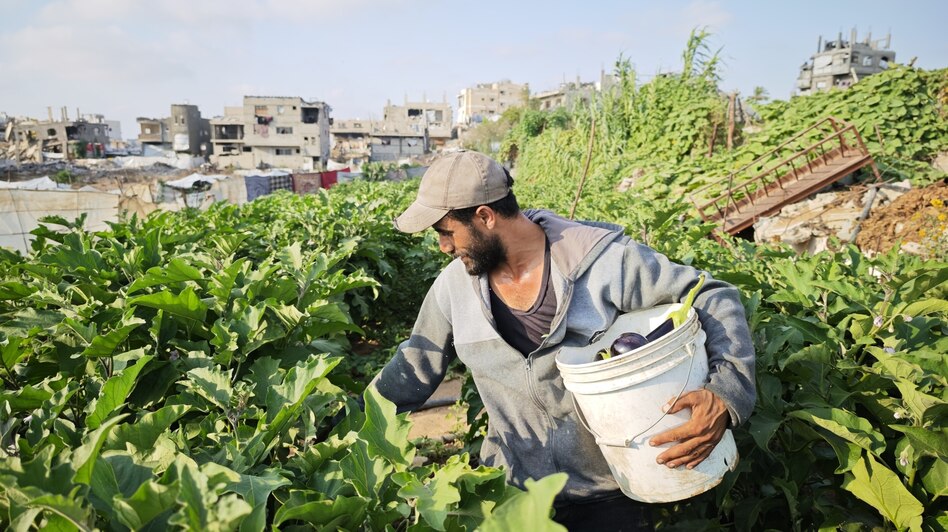
A hmed Tanbura was waiting for the harvest. Using white plastic buckets, he and his employees comb through row after row of eggplant bushes. It is the end of July in Beit Lahia in the north of the Gaza Strip. The plants reach up to the men's chests. Ahmed Tanbura watered and cared for them for months - and hoped that he wouldn't have to flee again before the harvest season. The 29-year-old farmer has dark earth stuck to his hands. Where the small field ends, the desert of rubble that the Israeli army left of the city begins.
Tanbura pays a high price for the shiny black fruits. He has been expelled from his country several times in the past three years, at times as far as Rafah on the Egyptian border, 40 kilometers away. He had to leave his fields and machines, the greenhouses and the family home behind. When he returned from the south with his wife and two children about a year ago, all he found was rubble and ruins.
When a ceasefire was announced last October, many in Gaza had hoped for calm and reconstruction. But US President Donald Trump's grandly announced plan has now shrunk to a small pilot project in southern Gaza. In the rest of the coastal strip, Israel continues to attack targets almost daily; around 1,400 people have fallen victim to the attacks since October, according to the UN Palestinian Relief Agency (UNRWA). Hamas refuses to give up its weapons.
Tanbura and other Gazan farmers no longer wanted to wait for peace. They begin to cultivate fields again among the rubble. So that we no longer suffer from hunger as soon as Israel closes its borders. To create your own income. But how do you grow vegetables in a completely destroyed war zone?
“It took almost a month to clear the rubble from the small plot without heavy equipment,” says Tanbura, his gray T-shirt wet with sweat from working in the sun. “Because no one could have done it alone, the farmers here started working together and sharing the few tools that weren’t broken.”
This text first appeared in wochentaz, our weekly newspaper from the left!
Every week, wochentaz is about the world as it is – and as it could be. A left-wing weekly newspaper with a voice, attitude and the special taz view of the world. New every Saturday at the kiosk and of course by subscription.
In order to buy the necessary materials and start planting, his neighbor sold his motorcycle and another sold his car, says Tanbura. The problems only began with the rubble. “At the beginning, we didn’t even have seeds that we could plant,” says Tanbura. Before Hamas' terrorist attack on Israel in 2023, Beit Lahia was a small agricultural town. Next to the fields were market gardens, lemon and orange plantations. At the beginning he and his employees looked for old eggplant and pepper seeds from the rubble. Many would have predicted that the seeds would not grow. But the harvest was good. A single pepper plant produced around a dozen fruits from which he was able to grow new seeds.
But Tanbura cannot ignore the war and the Israeli blockade. The Israeli army now controls between 60 and 70 percent of the Gaza Strip, forcing the approximately two million residents into a very small space. Tanbura says Israeli soldiers' shots can be heard again and again from his field. The yellow line, which the military has pushed further and further into the coastal strip since the ceasefire began a year ago, runs not far away. Israeli soldiers also regularly shoot Palestinian civilians there.
According to the UN Food and Agriculture Organization (FAO), only around 450 hectares, around three percent of the Gaza Strip's agricultural land, are currently safe to use. 75 percent of the fields are in areas controlled by Israel. 3,650 hectares are accessible, but are so heavily polluted that they first have to be cleaned. Bulldozers and tanks have removed the precious, fertile earth. Unexploded ammunition, pollutants such as asbestos from destroyed buildings and heavy metals lurk in the ground. The dirty wastewater and the wild garbage dumps from the tent camps put additional strain on the soil.
The Israeli human rights organization Gisha, which advocates for the freedom of movement of Palestinians, sees the systematic destruction of agricultural production in the Gaza Strip as “signs of the commission of genocidal acts.” In 2025, at the height of the Israeli blockade of Gaza, the country's own agriculture could have mitigated the humanitarian catastrophe. Instead, the Israeli leadership promoted “the destruction of the agricultural and food sector as an integral part of a targeted policy.”
When asked, the UN Food and Agriculture Organization said it would support around 1,700 farmers today so that they can start working again. They currently manage an area of around 600 hectares. In addition, around 7,000 households would improve their supply, some through allotment gardens.
The farmer Tanbura is also supported by the Palestinian NGO Thamara. 22-year-old Lina al-Madhun visits the farmer and films the workers during the eggplant harvest. The videos are for Thamara’s social media presence, Arabic for “fruit.” This is used to collect donations from abroad.
Al-Madhun wears a beige vest with the Thamara logo and a matching floral blouse. They use the money to help local farmers buy seeds, fertilizer and other materials.
The photographer and former psychology student founded the organization in 2024 with a young farmer while they were stuck in besieged Gaza City. Vegetables were difficult to obtain or unaffordable. “We said to ourselves at the time: Why should we wait idly for the borders to reopen when we can grow our own food in our gardens?” says al-Madhun.
Thamara supports around 200 farmers, says al-Madhun. During visits like today, she tries to find out what each of them needs individually. Tanbura leads al-Madhun through beds of fragrant mint and tomatoes to his problem child.
You are reading a text from our future department. If you're interested in more positive perspectives, subscribe to TEAM FUTURE, the constructive newsletter on climate, knowledge, utopias. Every Thursday you will receive an email from us with strong thoughts for you and the planet.
🐾 Sign up now for the TEAM FUTURE newsletter – free of charge
An oil-black monster from the last century stands under a light awning at the edge of the field. From a well a few meters away, the old water pump not only supplies Tanbura's fields, but also those of the neighbors - provided it works.
One of the employees gets busy with a heavy crank. The iron flywheel that reaches up to his head slowly begins to turn. The engine is difficult to start, says Tanbura. The mechanic estimated the equivalent of almost 3,000 euros for the repair. Priceless for Tanbura.
Even if it works, the business is hardly profitable. The fields have to be irrigated daily, but to save expensive diesel, the pump can only run every two days. In the meantime, they watered the fields by hand using canisters. “I would like to work with solar pumps in order to be independent of fuel imports,” says Tanbura.
Israeli authorities decide what goes into Gaza. Anything on a secret list of dual-use goods is excluded or strictly limited. According to Israel, this is intended to prevent Hamas from rearming itself militarily. According to the UN Food and Agriculture Organization, seeds or irrigation technology should not be rejected on this basis. But these very things would hardly reach Gaza, says al-Madhun.
This practice is not new. Since Hamas came to power in 2007, Israel has been blockading the area with Egyptian support. The non-transparent import and export restrictions hinder the local economy. Security zones defined by Israel also applied along the border fence and at sea, which closed off large parts of the agricultural land and the sea to the Palestinian population before October 7, 2023.
In practice, this created a smuggling system in which, according to the AP news agency, not only Hamas but also Palestinian and Israeli middlemen and Israeli soldiers enriched themselves. Even the brother of Israel's intelligence chief David Zini is on trial for his alleged involvement.
The consequences for food production in Gaza are massive. Currently, the farmers registered by the UN organization provide around 120,000 people with fresh vegetables, even on the limited cultivation area, around 5 percent of the population. The FAO estimates that if agricultural imports were approved, they could meet the needs of 270,000 people. According to the FAO, if all of Gaza's agricultural land were accessible, the area would be able to fully meet its own vegetable needs, as it did before the war. The same applies to eggs, milk and fish. The export of surpluses could also serve as a source of income for the population.
The Palestinian NGO Thamara and the UN experts agree that Gaza will not be able to feed itself completely in the future. The area is smaller than the city of Cologne, but has around twice as many inhabitants. Wheat, rice and other staples were also imported before October 7th.
“Local agriculture is not just about the quantity produced,” says Faten al-Nabahin. The 36-year-old works for the platform for urban and semi-urban agriculture in Gaza, or Gupap for short. “It also gives us some control over our food supply.” At the same time, they also provide knowledge about traditional cultivation techniques and local vegetables that are adapted to the conditions in Gaza.
Gupap was founded in 2017. The NGO became particularly committed to seed preservation after the Israeli army bombed the only seed bank in the Gaza Strip shortly after the start of the war. The Muhanna family stored 70 tons of seeds in al-Qarara in southern Gaza, a total of 42 local varieties, including wheat, beans and watermelon.
Al-Nabahin reports via video call from Gaza City. From there, the organization maintains contact with the Muhanna family in the south, who have rebuilt a small stock of around 30 varieties there. Gupap arranges storage and transport options, distributes seeds to small farmers in the north and brings a portion of the seeds produced back to the bank.
Gupap also wants to sensitize people to techniques that will help them deal with the shortages caused by the Israeli blockade. “We work a lot with families with vegetable gardens and small farmers in the city and show the scope they have.” The lack of water, for example, can be counteracted by using rain or gray water. In order to counteract the import bans on organic fertilizer for farmers, we are also working with compost projects. The gardens next to the families' homes also have positive psychological effects on the people, who are often displaced several times, says al-Nabahin.
Ahmed Tanbura in Beit Lahia is proud of his harvest. In a good mood, he shows rows of mint, cucumbers, zucchini and tomatoes that should be ripe in a few weeks. “We simply can’t afford anything without pesticides and fertilizers,” he says. He calculates: In order to fertilize, he would need five kilograms of chemical fertilizer for around 500 shekels, the equivalent of around 150 euros. But he only earns a good 40 euros from the expected harvest.
“There are also the costs for diesel, transport and salaries.” None of his colleagues have yet recovered the money they invested; instead, they have run into debt. This is also because the Israeli blockade has a massive impact on the prices of production and food. He is happy that vegetables have become affordable again through private imports and local production. “But it also means that I now only get 15 shekels for a box of eggplants, even though everything we need to work is still prohibitively expensive.”
If you ask Tanbura how he imagines the future, he points to the ruins in the area. Flowers used to be grown there in greenhouses and sold beyond Gaza. One day he would like to grow Damask roses again even more than vegetables. Before the war, people came all the way from southern Gaza to Beit Lahia to buy them. It should be like that again.
Read the full story at the source
Source: taz