
Politics · taz · · 3h
State elections and right-wing extremists: On the hunt for bad news
Deutsch (original) · Auto-translated to English
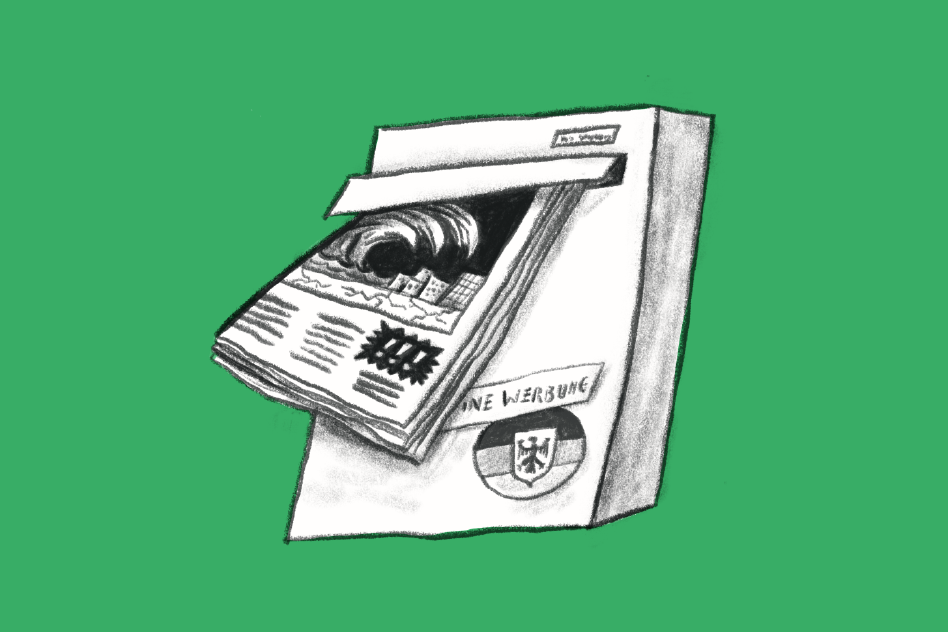
The morning after the election in Saxony-Anhalt, an AfD voter is interviewed on the radio. He is asked whether he believes that things will get better in his state with a government led by Ulrich Siegmund. “It can’t get any worse!” he immediately says indignantly. Can't it get any worse? Seriously? Life in one of the richest and freest countries in the world, which is constitutionally defined as a social market economy, sees itself as a welfare state, grants everyone basic security and in which health insurance is a given for everyone, is simply unbearable? How does he come up with that?
You can of course blame the AfD and its doom-and-gloom, demagogic propaganda for this view of Germany - and you would certainly not be wrong to do so. But you can just as easily ask yourself whether we, the critical media, are not also partly to blame for the fact that a large part of the population in Germany believes that we live in a country in which things have never gone downhill as rapidly as they do today and which is ruled by an incompetent, ridiculous, power-hungry and, in doubt, corrupt political elite.
Media research suggests that this question is more than just journalistic navel-gazing. The political scientists Charlotte Galpin and Hans-Jörg Trenz speak of a systematic “negativity bias” in the news media: bad news is preferred over good news, and political reporting often focuses on mistakes, polemics, scandals and crises. Long-term studies of Western democracies have shown an increase in news negativity since the 1970s.
The taz is an independent, left-wing and opinionated daily newspaper. We have been arguing in our comments, essays and debate texts since the taz was founded in 1979. We often cannot and do not want to agree on an opinion. That's why you'll find some completely opposing positions here - all part of the very broad left-wing spectrum of opinions.
The pension? A disaster with an announcement! The healthcare? Expensive and bad. The social systems? Bad, unfair, undignified. Education? It couldn't be worse. One word is enough: Pisa study. Climate change: We are doomed. And we could go on like this forever. Germany seems like a place from which one should flee as quickly as possible - or else one could wish for a radical turnaround.
Communication scientists therefore speak of a “spiral of cynicism”: Anyone who experiences politics predominantly as a series of failures, scandals and conflicts loses trust in political institutions - and at the same time increasingly expects precisely this negative news. Galpin and Trenz describe such a self-reinforcing mechanism for European reporting: audiences, political actors and media reinforce each other's negativity.
After the elections in Saxony-Anhalt and Mecklenburg-Western Pomerania, there is a threat of an AfD government for the first time. The taz reports what is at stake - and who is now defending democracy. All texts about the series can be found here.
So what do we want to do when the right-wing extremists claim that the ruling parties have completely run the country down and that only the AfD can turn things around when the media themselves constantly show what's not working? What does the Federal Republic's political system have to offer and why is it worth preserving? Because we in the media criticize, complain, complain, condemn and outrage ourselves about the state of Germany as if we had never seen what things are like elsewhere in Europe or the Western world.
Gasoline prices in the Netherlands are around 40 cents higher per liter than in Germany; Rental prices for new rentals are more than twice as high. In Great Britain, follow-up treatment in a rehabilitation clinic after knee surgery or cancer is generally not provided. In the United States, entire families go into debt when a family member gets cancer. Studying in England costs around 10,000 pounds a year, but also around 2,500 euros in the Netherlands.
In Scandinavia, Europeans pay little, but non-EU students sometimes pay five-figure amounts to enroll at universities. How politics tries to solve problems is often portrayed in a journalistically insufficiently complex manner. Christoph Hickmann, head of the Spiegel capital office, also doubts the type of reporting today and asks “whether we journalists can carry on as before at this time when liberal democracy is threatened”.
Because the basic consensus that has underpinned every journalistic criticism for decades was that there is a lot to complain about, but today's political system is still the best we've ever had. As early as 2016, Zeit editor-in-chief Giovanni di Lorenzo called for self-criticism in journalism in his Dresden speech “Our reputation is at stake”. Just at a time when Pegida and AfD were making the term “lying press” socially acceptable again, he spoke explicitly about “scandalization and tabloidization of reporting.”
Journalists must not gamble away the trust placed in them, he warned - because critical journalism is essential for the functioning of democracy. The consensus that Hickmann speaks of no longer exists since the AfD became radicalized and expanded its voter base so much. She sees herself in the role of the citizens' movement in the final phase of the GDR. “We are the people” is much more than a stolen battle cry. People see the current system of the Federal Republic of Germany at its end and themselves as the only alternative.
But what to do with this knowledge? Critically questioning, uncovering grievances and acting as a corrective to those who exercise power is the most important task of journalism. Political debates in the media are conducted on behalf of the readership, ideally even the population. Nevertheless, it must be asked whether the hunt for grievances and scandals has not become an obsession by which journalistic quality is measured.
“Investigative journalism” is the supreme discipline of the industry. The term is slightly misleading, because of course all journalists do research, not just investigative ones. Nevertheless, it is clear who and what is meant here: colleagues who, like truffle pigs, are looking for particularly nasty stories. They are at the top of the industry hierarchy. Prizes, fame and honor await you here.
And in some political magazines you can tell that they are exaggerating and scandalizing what it takes to belong to this elite of “investigatives”. However, those colleagues who dare to write a positive portrait of a politician, for example, are punished with contempt or at least viewed with great suspicion.
You are immediately suspected of having fallen for clever PR or of lacking any critical distance and, in any case, of not having done your job properly, which is almost tantamount to a journalistic death sentence. Conversely, you are always on the safe side if you know how to throw around plenty of criticism. Maybe there is a structural problem there. After all, negativity is not just a journalistic stance, but newsworthy.
A story about something that works has to prove its relevance first. Last but not least, reality often gets in the way of a good story. Since “storytelling” has dominated journalism and been showered with prizes, reporters have often been sent out with a thesis that is then confirmed in on-site research: Please show in the report that social injustice leads to the radicalization of voters.
But what if the local people say something completely different and the entire situation cannot be brought to a head according to this theory? So what if damn reality ruins your well-crafted storytelling? The American journalist Amanda Ripley has found a counter-formula for this problem: “Complicating the Narratives” – making the stories more complicated. Journalists tend to edit out contradictions because a story needs to be coherent.
However, it is precisely this coherence that can become a problem, especially in polarized societies. Reality is often more contradictory than the story we want to tell. You can imagine that not only good things come out of this. In any case, it is often no longer enough to simply show what you observe on site. And yet so-called constructive journalism is not an acceptable solution at a time when liberal democracy is under threat.
It is not our job to provide solutions. But it is certainly important to report on them and show the complexity of issues such as pension reform or social security. Not only scandals and grievances are worth reporting, but also successes, role models and successful projects. Interestingly, local journalism is more likely than national media to maintain a good balance between critical and positive reports.
Maybe it's because at the local level you're always in danger of running into the person you just harshly criticized. Or that the pressure to deliver a journalistic masterpiece is limited. In any case, we need reporting that presents reality in a more balanced way than before. The media should remain critical, investigative and definitely sharp-tongued. What we should focus on, however, is balance.
Read the full story at the source
Source: taz