
Germany · taz · 6h
State elections in Saxony-Anhalt: buckets of pink letters
Deutsch (original) · Auto-translated to English
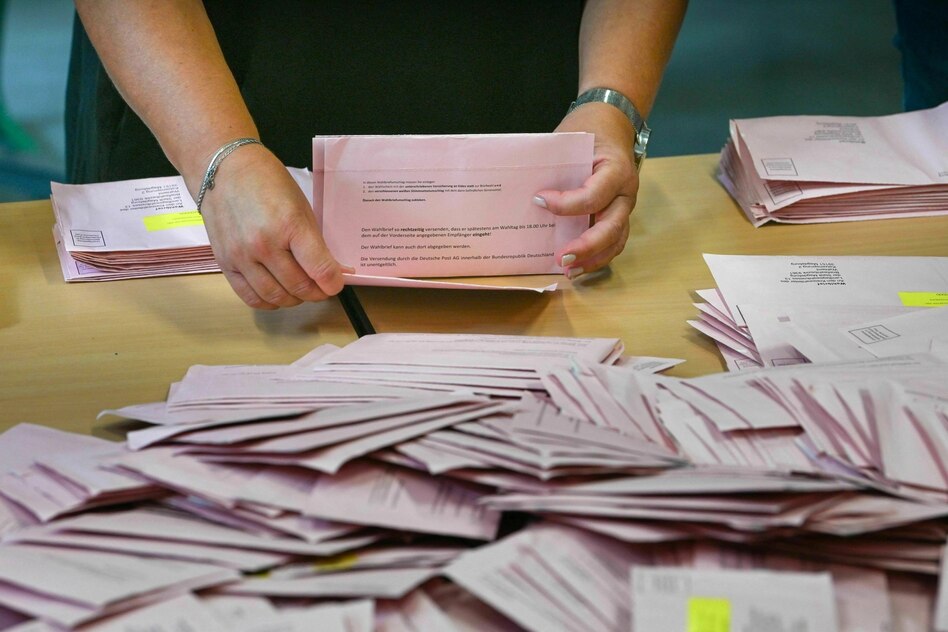
A huge mountain of pink postal ballot envelopes lies on the table in front of the election workers. It is shortly after 3 p.m. on election Sunday in Saxony-Anhalt. First, the helpers sort and check whether the constituency on the letter is correct. One actually got lost. He will be picked up later and taken to the classroom with his constituency. 424 letters remain.
According to the State Statistical Office, interest in this form of voting is increasing: just two weeks before the state elections in Saxony-Anhalt, according to the State Election Office, 335,000 postal voting documents have already been sent - that is 20 percent of those eligible to vote. In the last election there were only 315,567 postal voters.
One of the poll workers opens the first pink envelope. Everything is correct: the signed voting slip and the closed envelope with the voting slip are inside. Put it in the sealed ballot box. The votes have been counted since 6 p.m. The result was not yet available at the time of going to press.
A man stands against the wall and watches what is happening critically. He wears all AfD merch: T-shirt, cap and keychain. When asked what he is doing here, he simply says: “I am from Canada”. This is disturbing for one of the poll workers: “He should register as a poll worker,” she says to her colleague. Then he can see that everything is carried out carefully.
But that's exactly what the AfD wants to cast doubt on. In advance, the party and its supporters had already created a strong mood against postal voting. A tactic also popular with US President Donald Trump and the FPÖ. They suspect alleged election fraud and call on their supporters to vote at the polling station. The effect: A large proportion of AfD voters vote at the polling station. The resulting low number of AfD postal voters is then used by the party to support its own theory of election fraud.
In keeping with this, AfD lead candidate Ulrich Siegmund called for coordinated election observation shortly before the election on X. Trust is good, but control is better, writes Siegmund and shares a digital election observer map. This comes from “One Percent”, an association that the Office for the Protection of the Constitution has classified as right-wing extremist. In his post, Siegmund describes the group as a “citizen network”.
According to the website, more than 700 people followed the call. An election observer in the center of Magdeburg came especially from Thuringia for this purpose. He doesn't necessarily believe in election fraud, he tells the taz. But you have to look closely at the voices of nursing home residents.
A particularly popular narrative among right-wing actors – and by no means new – is to question postal voting in nursing homes. “One Percent” has been warning about supposedly systematic fraud for ten years. Even if there is no evidence for it.
Hannah Schimmele, disinformation analyst at the political consultancy Polisphere, has analyzed how the narrative of postal voting fraud in nursing homes is spreading on X. The AfD is concerned with “creating fundamental doubts about democratic institutions and electoral processes,” Schimmele tells the taz.
A few weeks before the election, there were glitches in sending postal voting documents, which provided additional fuel for the narrative of possible election fraud. In Magdeburg, 440 voting letters were delivered twice, and in Halle there were even 1,184. The affected ballot papers were declared invalid and the letters were resent. The election authorities of the two cities assured that double voting was impossible.
A few days before the election, an alleged case from a nursing home became public. However, the responsible public prosecutor's office has now stopped the investigation. According to a statement, “no evidence of manipulation of the postal vote” could be found.
For Schimmele, the doubts about postal voting are a win-win strategy for the AfD: "If they win, they can say that it was successful despite electoral fraud. And if the absolute majority is not achieved, then only because of the alleged electoral fraud."
The election workers have now completed the first round. There are abnormalities in eleven envelopes. You can read the election regulations. How the cases are to be classified is decided democratically. Four are still approved, seven are invalid.
Read the full story at the source →
Source: taz