
War & Militarism taz
Cultural Destruction Ukraine: Russia's War on Books
More than 13 million books were destroyed in Ukraine this summer and 900 libraries were damaged. Language and culture are important targets for Putin's regime. more...
Deutsch (original) ·Auto-translated to English
Viktor Kruhlov stands in front of a shelf full of children's books, where the edges are particularly noticeable. An educational book has charred black paper peeling off the pages, a cover with a blue and a brown dinosaur shows burn marks, as does the colorful book with Ukrainian folk tales.
The battered books are a tiny sample of what the Ukrainian publishing house Ranok, which Kruhlov runs, lost in a Russian missile attack in early August. “A total of 8 million books were burned and destroyed,” says the head of the publishing house from Kharkiv, “and it is a miracle that none of our employees were injured or killed.”
Ranok Verlag exhibited some damaged exhibits at the Ukrainian stand in Germany as part of the Frankfurt Book Fair in October. Kruhlov sits at the stand and reports on the attack. He and 50 other employees were in the building when several drones struck the publishing and warehouse building at 11 a.m. on August 1st.
Crowdfunding: https://foundation.kse.ua/en/projects/support-for-small-ukrainian-publishers/
https://www.gofundme.com/f/send-ukrainian-publishers-to-frankfurt-book-fair
“I heard a loud explosion and almost immediately saw a fire about 30 meters away from us,” says the 56-year-old. “There was a first attack, followed within a few minutes by the second.” Fortunately, everyone was able to get out of the building before the roof collapsed.
Many colleagues were deeply shocked when they saw the books burning; after all, their work and ideas were in them. “It’s terrible to see all of this being destroyed.” The fire continued to burn for a week after the attack and was only then completely extinguished.
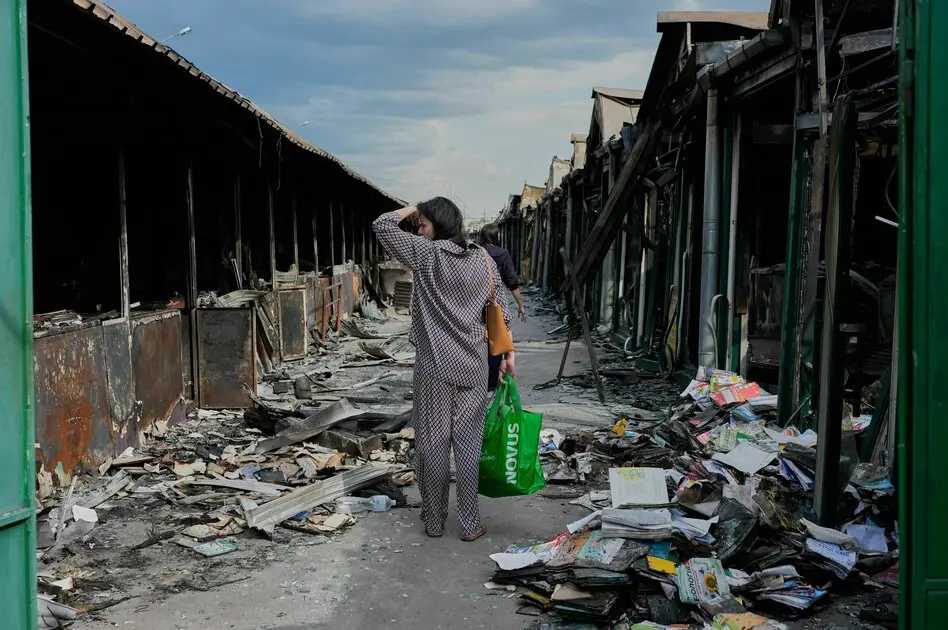
Russia's war of aggression is not only directed against people, nature and cities, it is also aimed at books. Throughout the summer and fall there were a series of drone and missile attacks on publishers, book warehouses, bookstores and a book market.
At the beginning of July: The BookChef publishing house in Kyiv is attacked, 800,000 books are damaged. Mid-August: It hits the famous Pochaina antiques market in the capital, hundreds of stalls and thousands of books are damaged. At the beginning of October: The large Ukrainian publisher Knyholav is attacked for the second time. Mid-October: The Ivan Federov Book Chamber of Ukraine, responsible for the administration, cataloging and infrastructure of the book market, is met.
End of October: A Russian missile hits the KSD Publishing house in Kharkiv, damaging 300,000 books. Just a few examples. Russia destroyed more than 13 million books in Ukraine in the summer months alone. At least 21 publishing locations and book warehouses are affected, and more than 30 publishers suffered losses.
Of course, other industries – such as the steel and food industries – have also recently been affected by massive and concerted attacks. But right from the start, Russia's war also targeted Ukrainian language and literature; some speak of a “bibliocide”. Putin repeatedly demotes Ukrainians to “Little Russians” and declares the Ukrainian language to be a dialect of Russian that has been corrupted by Polish influences.
In doing so, he places himself entirely in a tsarist tradition, as Russian Interior Minister Pyotr Valuyev saw things similarly in 1863. In May 1876, the Russian Tsar Alexander II issued the “Ems Decree,” which amounted to a ban on the use of Ukrainian in spoken and written languages. Ukrainian schools were closed. The suppression and persecution of the Ukrainian language goes back much further: it has been going on for four centuries now.
And since February 24, 2022, language and culture have been targets in the war of annihilation. According to the Ukrainian Ministry of Culture, over 900 libraries have been damaged or completely destroyed so far. In the occupied territories, Ukrainian-language books are being sorted out, schoolchildren are being Russified. Written and spoken Ukrainian should be banned from public spaces.
But Russia will not achieve its goal, says Viktor Kruhlov: "No matter how much the Russians can bomb, they won't destroy the Ukrainian language. They can burn the books, but they won't manage to destroy the meaning and ideals behind them."
In Ranok's case, the physical copies were burned, but fortunately the books' files were in the cloud. Kruhlov is currently starting to have most of the books reprinted; in total, he estimates it will take three to five years. 620,000 textbooks were damaged, they now have priority: “This is our responsibility towards the students and the schools.”
Ranok is one of the major manufacturers of textbooks in Ukraine. A school reform is currently underway, says Kruhlov, there are new curricula and new subjects. The schools are therefore dependent on the new books.
The publishing house has existed since 1997 and is a typical child of independent Ukraine, says Kruhlov. “Ranok” means “morning”, the name also stands for a new beginning. In terms of sales, Ranok is the second largest publisher in the country; in 2025 it was 842 million hryvnia, which is 16.6 million euros.
After the attack, most of the publishing employees are now working from home. Ranok has other book warehouses that were not affected, and it is now renting additional warehouses in various locations in Ukraine. Storing books decentrally is safer.
When it comes to reprinting, you now have to rely on the goodwill of the printers. “We have an agreement with six printing companies,” says Kruhlov. “Everyone has agreed to wait a while for payment because we have to raise the money first.”
As a publisher, he cannot insure himself against this damage - the Ukrainian insurance companies would not take part. “You can insure yourself against damage caused by environmental disasters, but not against damage caused by war,” he says. Ranok might receive government loans, but that could take time.
The book industry has actually been on the rise recently. It was only in a deep crisis in the first year of the war of aggression, but recovered very quickly. In 2023 there was even talk of a book boom, with many new bookstores and publishers popping up.
Most recently, the industry's sales rose from 8.2 billion hryvnia (163 million euros) in 2024 to 8.9 billion hryvnia (176 million euros) in the following year. The number of published titles increased again. Ukrainian authors dominate in fiction; their share in this segment is 70 percent.
The proportion of Russian-language books produced in Ukraine (excluding imports) continued to decline after the occupation of Crimea in 2014: while it was just under 40 percent at the time, the number fell to around 5 percent before the start of the war of aggression and was recently only 1 percent. [Link to https://ubi.org.ua/en/activity/programa-pidtrimki-perekladiv]
To promote Ukrainian literature abroad, there are programs such as “Translate Ukraine”, which financially support translations by Ukrainian authors. This year alone, 100 translations will be made possible in 33 different countries.
The Ukrainian Deputy Minister of Culture Bohdana Laiuk now sees small publishers in particular as threatened by the massive attacks on the book industry: “If they lose one or two editions of their books, that can endanger their entire existence,” says Laiuk in a Zoom conversation. “Small publishers will probably only feel the main consequences next year.
If some had to close, that would mean: fewer debuts, less experiments, less diversity.” The Ministry of Culture has therefore initiated crowdfunding together with the Kyiv School of Economics Foundation, especially for indie publishers.
Laiuk says she is aiming for a higher budget for culture in the next budget, but defense spending makes increases in all other departments difficult. There has been direct funding from the Ministry of Economics for printing companies in the past, but not yet for publishers, but they are “considering specific programs”.
The recent attack on the Ivan Federov Book Chamber of Ukraine once again shows Russia's intention to destroy Ukrainian culture, Laiuk said. “And when libraries are attacked, texts and manuscripts are sometimes completely lost,” she says. “We know from the experiences of the 20th century how dangerous this is.”
Laiuk points out the boom that Ukrainian literature experienced after the start of the war of aggression - with many young voices, with war literature, with a wave of translations. She therefore appeals to publishers abroad to continue translating and printing these Ukrainian authors. “Germany in particular can be a window to the world for Ukrainian literature,” she says.
https://foundation.kse.ua/en/projects/support-for-small-ukrainian-publishers/
https://www.gofundme.com/f/send-ukrainian-publishers-to-frankfurt-book-fair