
Climate taz
A20 coastal motorway: climate killer built on sand
The new A20 coastal motorway, much of which is still in the planning approval process, is intended to run straight through the moor. A lot of nature is destroyed in the process. more...
Deutsch (original) ·Auto-translated to English
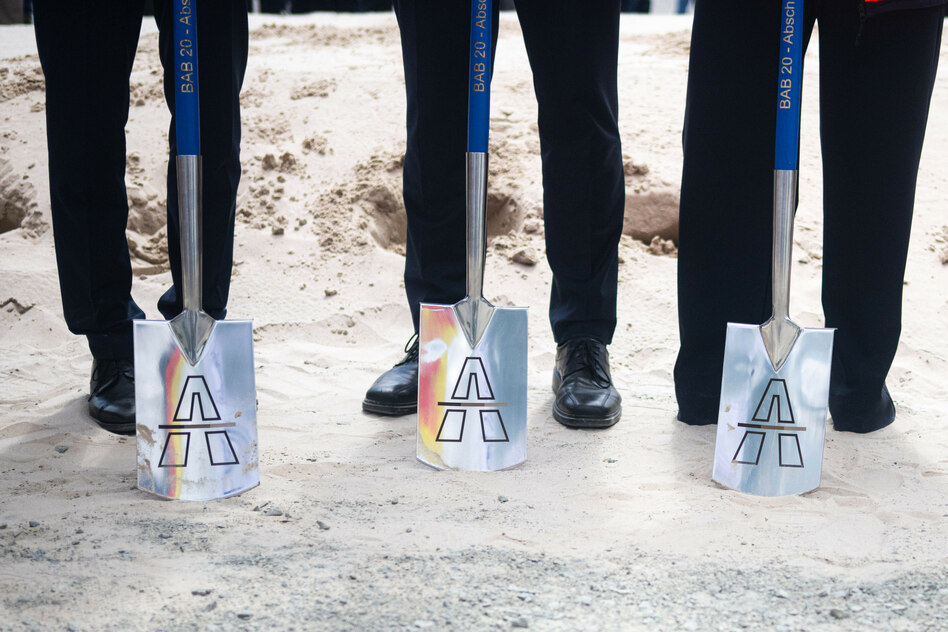
At the beginning of June 2026, on the occasion of the groundbreaking ceremony for the A20 coastal motorway on Lower Saxony soil, Patrick Schnieder (CDU), then Federal Transport Minister, spoke of a “new main artery of the maritime north”. That was at Jaderberg, for planning section 1. When Schnieder symbolically pushed his spade into the obligatory pile of sand, he must have known that it was precisely this sand that divided opinions on the A20, both in terms of construction and nature conservation.
This is particularly evident a few kilometers further, in the approximately 22.5 kilometer long planning section 2 between the A29 near Jaderberg and the B437 near Schwei. The planning approval process is currently underway for him. Where the motorway is supposed to run, between villages and through grassland, there is almost entirely moorland, up to 20 meters deep with extremely wet ground. It is impossible to build on this. In addition, the subsoil is permeated with organic clay, which has the consistency of porridge.
Sand dams up to 13 meters high will therefore be built over the future route. Their compacting weight pushes the water into the depths. There it collects and is drained away through drainage pipes: a pre-construction process that takes several years.
“The result is a cascade of damage,” says biologist Susanne Grube from the BUND Ammerland district group to the taz. "Not only does the moor contain important potential for climate protection. Huge amounts of sand are mined, have to be delivered and most of them transported away again afterwards. Forests have to be cleared for mining. In addition, nature reserves are affected."
The sand is extracted from the nearby Bekhauser Moor, on 41 hectares and up to 55 meters deep. In addition, the Seepark Lehe holiday and weekend home area is being mined on eleven hectares, up to 21 meters deep. A total of 6.6 million cubic meters of sand will be removed.
“The roots of the remaining trees that are close to the excavation in Lehe could lose their connection to the groundwater,” warns Grube, “because the deep excavation reduces the level of the groundwater significantly.” Drainage systems on both sides of the motorway route must ensure that the A20 does not stand in water. “That takes up additional space.”
The route also runs close to several nature reserves and, through a bridge, shades parts of the EU-protected flora-fauna habitat area “Dornebbe”.
The draft statement by the road construction administration of the state of Lower Saxony notes: “Overall, after the intervention has been completed, there will be no significant or lasting impairments in the performance of the natural environment and the landscape.” There is “no significant impairment” of the conservation goals of the “Marschen am Jadebusen” bird sanctuary and the FFH area.
“We are extremely critical of the construction of the A20 in the section between Jaderberg and Schwei,” writes the transport policy spokesman for the Green Party parliamentary group Stephan Christ in the taz. "We shouldn't just talk about how much nature the motorway route destroys. We also have to talk about how much additional nature should be sacrificed in order to obtain the building material for this motorway."
“We consider it problematic when such massive interventions in existing landscapes are justified with the prospect of lakes being created later,” says Christ. “An artificial quarry pond is not automatically a valuable habitat and cannot easily replace the functions of natural soils, forests and existing ecosystems.”
For the Greens, the motorway project cannot be justified in view of the climate and biodiversity crisis. “We reject the construction of the new A20 and are committed to maintaining the existing transport infrastructure and strengthening climate-friendly alternatives.”
The resistance to the A20 is strong. The Rasteder “Coordination Circle of Initiatives and Environmental Associations Against the A20”, which is made up of 30 citizens’ initiatives, has been fighting for over 20 years with its “A20 never!” initiative. against the coastal car plans, from the demonstration to the petition, from the bicycle rally to the lawsuit fund. In the “Thought Shards” section of his website you can find statements like: “The A20 will destroy a lot of nature and massively damage biological diversity by devaluing unfragmented spaces.”
Grube also works on it: “We’re trying to bundle the criticism and resistance,” she tells the taz. Your fellow campaigners range from Fridays for Future to the ecologically oriented German Transport Club (VCD).
In September 2025, the alliance breathed a sigh of relief: the federal government had put the A20 on a “cross list” of infrastructure projects that no longer needed to be pursued. Then the deletion came about. Today the project is run by the federal government's Autobahn GmbH. When asked by the taz to comment, she remained silent.
Naturally, there will be compensation for the disruption to nature caused by the construction and operation of the A20. This happens on the former Wehrmacht and former Bundeswehr site in Friedrichsfeld near Varel. Here the soil is to be unsealed by demolishing barracks and dismantling roads, and coniferous forest is to be turned into deciduous forest.
Grube is skeptical: "Actually, nature cannot be compensated for at all. And what is being unsealed in no way compensates for the sealing caused by the A20." The former Friedrichsfeld air base was already a “jewel”, but now it is being “worsely improved”. An example: the lapwing population, whose breeding grounds are being lost due to the A20. For them, a 15-hectare swamp forest with lots of orchids was cleared on the military site 15 kilometers away, says Grube: “That’s grotesque, absurd!” Whether the birds move there is anyone's guess.
The Wesermarsch district association of the Left describes the new motorway as an “insane project” on its website.