
World · taz · · 3h
War in Ukraine: “You don’t scare us!”
Deutsch (original) · Auto-translated to English
If you sit in the shade of the sprawling maple trees on Cologne Boulevard in the Ukrainian city of Dnipro, listening to the babbling of the ornamental stream and watching the children running carefree across Uspenskaya Square, you would never think that a deadly war is raging just 120 kilometers away.
There is a high-tech atmosphere in the center of Dnipro; you could easily imagine yourself on Berlin's Potsdamer Platz. “Just imagine how dangerous it would be here if the city came within the range of FPV drones,” jokes my friend Alexander, who works for a charitable foundation.
Sascha and I walk along the banks of the Dnipro. At Poplawok – a legendary restaurant – two weddings are taking place on this day. A tour guide shows a group of tourists around. There is hardly anyone else on the streets. Many men hid at home from the mobilization, had food delivered and only went outside late in the evening, Sascha explains to me.
Fortunately, Dnipro cannot yet be called a front-line city, even if the Russians are very close: a small part of the Dnipropetrovsk region is occupied, another borders on the Zaporizhzhia region, where Ukrainian troops are holding off the Russian forces near Hulyaypole. In the east, the region borders on one of the three deadliest sectors of the front - the one near Pokrovsk.
Dnipro is an important logistics center for the Ukrainian military, an evacuation point for the wounded and a new place of residence for refugees. A particularly large number of people came from neighboring Zaporizhzhia - a city that the Russians have long been able to reach with artillery and guided aerial bombs, says Sascha.
Only a few military personnel can be seen in uniform. Most wear civilian clothes. But you can easily recognize them: by their serious looks, beards and tattoos. Many of them seek relaxation in parks and green spaces.
But there is not always peace here. In the spring, the Russians bombarded Dnipro daily with ballistic missiles. At that time, Telegram channels tried to stir up panic in the city by distorting the contents of an interview that Dnipro Mayor Borys Filatov gave to the French newspaper Le Monde. The mayor had said that Dnipro was an important city for the Russians. However, on Telegram these words were “translated” as if Filatov had announced an imminent Russian attack on the city.
The risk of being shot at remains high. Traces of previous shelling can still be seen in the city: for example, on an office building near the train station or on the former security service building. Closed offices and shops also represent traces of the war.
Although it is not yet a mass phenomenon, as I walk through the city I keep seeing signs saying “For Sale” or “For Rent”. Immediately next to it: expensive shops of international brands for food, clothing and perfume.
In Dnipro, air alerts are sounded five to seven times a day. The city remains a major industrial center in southeastern Ukraine. The Soviet Union was also dependent on the factories here: the Yuzhmash plant manufactured launchers for space travel and for the Soviet Union's military programs. Because of this work, foreigners were banned from entering Dnipro until the end of the Cold War.
And it was precisely against Yushmash that the Russians used the so-called “Oreshnik” – an intercontinental ballistic missile that can be equipped with a nuclear warhead. The Russians are currently attacking Dnipro primarily with jet drones and “Banderoli” – a new type of hybrid weapon. This is a combination of a drone and a compact cruise missile. The “Banderoli” sound like passenger planes flying past.
From August onwards, the warehouses around Dnipro were particularly targeted. Since the Russian armed forces are just a stone's throw away from there, everything happens in a matter of seconds. While I'm sitting on the tram, the air alarm sounds. As I get out at the train station, I see a message about an explosion on my smartphone. Shortly afterwards I hear another explosion. I later learn that the Russians hit an oil factory owned by a US company.
Amid the Russian attacks, Mayor Filatov notes that Moscow's goal is to demoralize the civilian population so that they force the government to surrender. However, if you listen closely to the residents of Dnipro, you will not get the impression that the bombings will lead people to demand that the leadership make peace with Russia on its terms.
Ukrainian is hardly heard in the city. Russian President Vladimir Putin often justifies his war crimes in Ukraine by protecting the Russian-speaking population. But the Russian language is omnipresent in Dnipro. However, the law requires the use of the official language, Ukrainian, in cafes, hair salons and public transport.
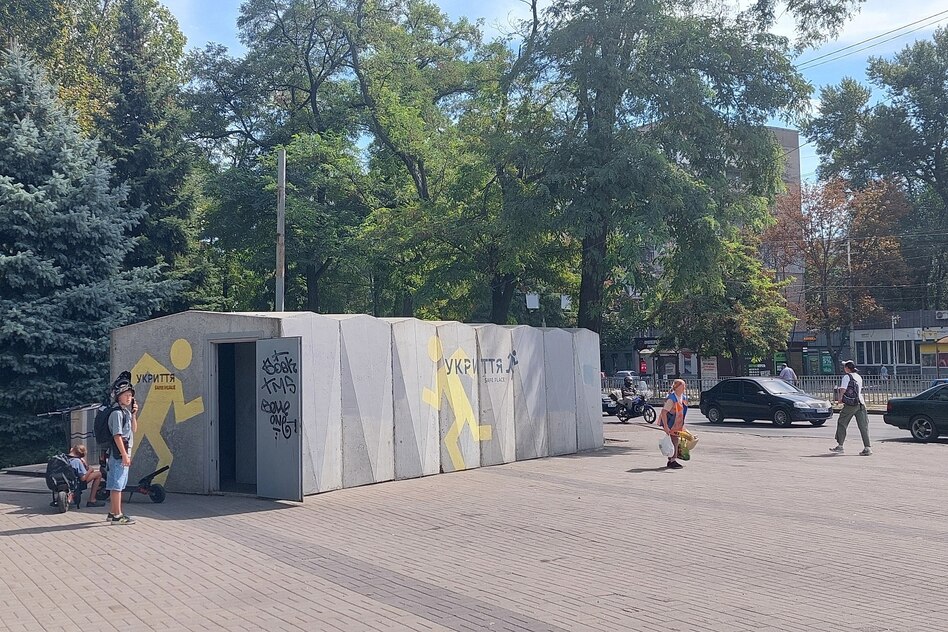
Alexander and I sit on a bench next to a concrete bunker. There are a few dozen of them in the city. In the event of fire, passers-by can seek protection from splinters there. As long as there is no alarm, children play in the bunker.
Nearby on the lawn, a group of teenagers are eating pizza and discussing how their lessons will go. “My parents wanted to take me to Lviv or Poland, but I ran away to my grandmother in the country and didn’t return home until the 11th grade.” “At our university, classes take place via Zoom and some of the lectures are held in the basement.”
"My mother and I moved from Zaporizhzhia. She doesn't have a good salary yet. I agreed with the school that I would take online classes until 12 p.m. and then go to work." Air alarm sounds again in Dnipro. Nobody runs into the bunker. One of the young people sprayed the words on the wall: “You don’t scare us.”
Read the full story at the source
Source: taz