
Germany · taz · · 2h
“Creatures” by Bianca Bagnarelli: Images of great sensual succinctness
Deutsch (original) · Auto-translated to English
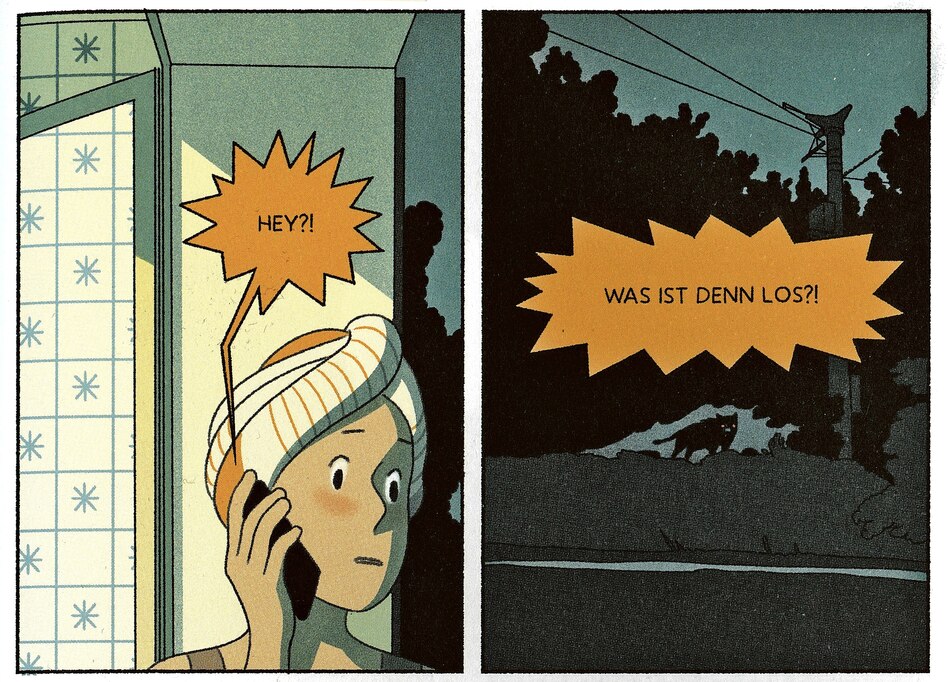
A short story is a short story, but not all short stories are short stories. When it comes to comics, the difference can be quickly explained with the standard-setting stories that were published by New York's EC Verlag in the 1950s. In magazines like Shock SuspenStories, Frontline Combat or The Vault of Horror you can find articles that are never longer than 6 to 8 pages and move purposefully towards an unexpected, often macabre final point that casts what has happened before in a new light.
A short story is completely different, a short story. Not only does it begin abruptly, it also doesn't aim for a clear conclusion; on the contrary, the open ending is one of its trademarks. “We ourselves are disappointed and look concerned / The curtain is closed and all questions are open” – these often quoted lines from Brecht’s “The Good Man of Sezuan” describe the feeling with which reading a short story can leave you.
And also unlike the short story - which is similar to the novella in this respect - the short story does not tell anything adventurous; Its subject matter is the everyday, even banal, the description of which, however, claims to point beyond itself to something universally valid. This avoidance of anything spectacular is also why there are only a few attempts to flawlessly transfer the short story aesthetic to comics. The Italian draftsman and illustrator Bianca Bagnarelli, born in 1988, has dared to do this once again. Her volume “Creatures” contains 13 stories ranging in length from 4 to 24 pages.
In “Wolves,” the first of them, a couple is on vacation in a holiday home in the countryside when a young woman suddenly rings the doorbell. She claims to have seen a wolf in the bushes and asks to be driven to the train station, which is quite far away; the friends with whom she was staying here have already left. After some hesitation, the man gives in to her request. His partner is left alone and is afraid: Maybe this was just a trick by criminals who will now attack her? But then she sees a wolf with three of his cubs running past the house.
This is a classic short story: a lot remains open, but one suspects that after this intrusion of the latently uncanny into the familiar, nothing will be the same again. All of Bagnarelli's characters are confronted with shocks to their existence.
In “Philosophy” – the most beautiful story – an older teacher blossoms thanks to late love, but only temporarily. The protagonist in “Myriam”, whose father or mother apparently has acute, massive health problems, vigorously woos a girl of the same age on the dance floor of a disco, but is rejected. In “Rabbit,” a woman puts a dead rabbit she finds on the side of the road in her car; If she strokes his fur as she continues driving, it reminds her of her little son, with whom she probably no longer has contact for reasons that are not explained.
Not everything in “Creatures” is so successful. “Daughters” and “David” seem more like excerpts from novels, as if they were torn out of a larger context. In the four-page stories, however, Bagnarelli exaggerates the minimalism; the distribution of information remains all too rudimentary. In “Say Hi for Me,” a little girl travels alone by train after her mother says goodbye to meet a man who lives in a snow-covered province. Not a single word is spoken. The woman is probably a single parent and the man is the father of the child. But for this sequence of scenes to have any impact, it is simply too short.
Bagnarelli's qualities as a draftsman are to be praised without reservation. Her ligne claire style is impeccably elegant. Chris Ware may have influenced her without her falling into his formalistic excesses. The page layouts are very variable and imaginative, but do not push themselves into the foreground to the detriment of what is being told. “Philosophy” consists almost entirely of two very large panels placed one below the other, while in “Myriam” four rows of small panels alternately show only black and the silhouettes of people dancing - and below them four larger panels in which the main character sits crying and lonely at the bar.
Despite a reduction that sometimes makes the depiction of objects reminiscent of pictograms, Bagnarelli's pictures are of great sensual concision. A panel in “Wolves” shows an early evening landscape and, nestled in it as small as toys, a church and two houses. These are all just lines and contours, but through the coloring - dark green the trees, hills and mountains in gradually lighter green, yellow the sky in which narrow orange clouds float - Bagnarelli achieves enormous depth and vividness.
On the first page of “The Match,” she creates a visual rhyme in four vertically arranged panels with various shades of yellow and sometimes related shapes. First you see the round head of a blonde young man, then a tennis ball flying through the air, underneath a traffic light that is yellow, and finally a young woman wearing a yellow dress sitting on the luggage rack of a bicycle. “Creatures” is a comic that you like to open again and again after reading it to enjoy the details of its visual design as if it were an illustrated book.
Bianca Bagnarelli (text and drawings): “Creatures”. Verlag Reprodukt, Berlin 2026. Translated from Italian Myriam Alfano. Lettering Minou Zaribaf. 224 pages, 25 euros.
Read the full story at the source
Source: taz