
Germany · taz · · 3h
Kracht and Kitamura at the ilb: shock and cheers
Deutsch (original) · Auto-translated to English
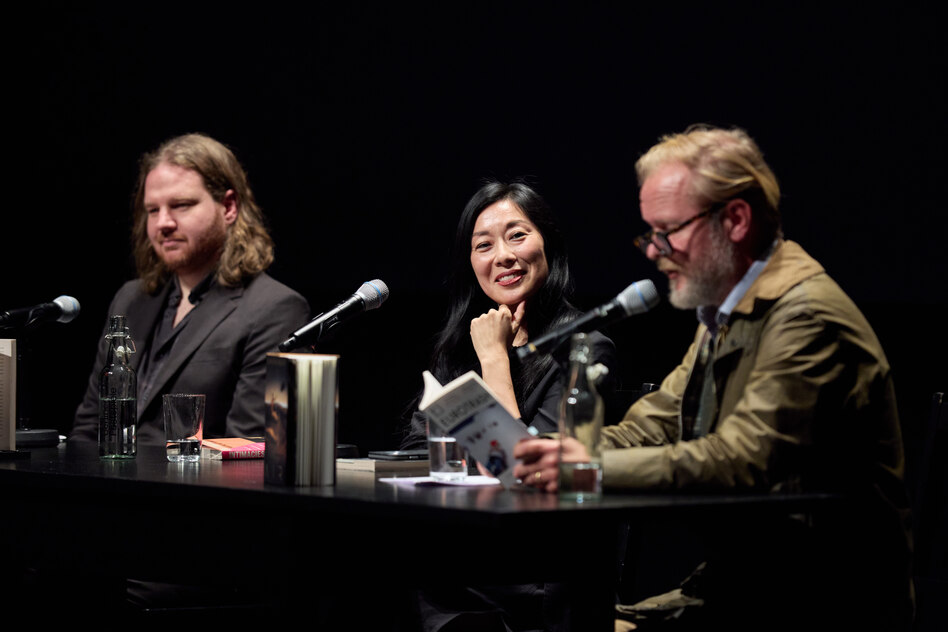
When writers talk about writing, what interests them first and foremost: writers. At least that's what one would assume and the visitor forecast for an event called “The Art of Writing” would be low. When the hall is full, one can be astonished to discover that there are apparently more writers among us than expected, or revise the previous assumption. Both would be welcomed.
Whatever ideas ultimately become books, chance always plays a role in this equation. The American author Katie Kitamura, who is sitting on the stage at the Berlin Festival House this Thursday evening, describes this circumstance as “benign neglect”; She often carries ideas around with her for years, pushing them away. Whatever survives this neglect becomes the material of a novel.
Christian Kracht explains how he hardly structures his writing; the ideas come to him “like in a dream”. The Swiss writer may have been dreaming particularly wildly in recent years, as the strange, fantasy-like parallel world that he created in his last novel “Air” seemed to have been drawn with the pen of dreams. “Tell a dream, lose a reader,” Kracht quotes from Henry James and laughs. He then confesses that the “Air” scenery actually came to him in his sleep. He says he has dreamed of a vast landscape since his childhood, which he has finally described in a novel.
The world of Katie Kitamura's narrator, however, is significantly smaller. In “Intimacies,” the protagonist spends her time at the court in The Hague in a translation booth, from where she puts the really big crimes into language and translates them for war criminals. The narrator, like Kitamura herself, knows that sometimes the individual word matters: every one of her precise sentences hits the mark and sheds light on the human psyche.
“Shockingly good” is what Kitamura wrote, says Kracht, who appeared very accessible that evening. He complimented his fellow writer from the USA several times, and then he confessed that he had banned further translations of his first novel, “Faserland,” because he thought: “It’s just not that good of a book.” The audience rewards the whole thing with benevolent laughter.
People are fond of the guests at the International Literature Festival; the audience is primarily made up of fans, fans of the authors, but also fans of literature in general. This was also noticeable at the sold-out reading by the American Dave Eggers, whose charisma visibly captivated the audience. Eggers recently published an artist's novel “Contrapposto” and said in Berlin that he didn't own a smartphone. When he then launched into an incendiary speech against tech fascists and AI, he received thunderous applause.
And even Boualem Sansal's personality didn't become a political issue. The Algerian-French writer is the festival's patron this year and was imprisoned in 2024 for criticizing the Algerian government. The trigger was statements in an interview he gave to the right-wing extremist media portal “Frontières” in France. Sansal is controversial in France, as after his release in November 2025 he moved from Gallimard to Grasset, the publishing house of the right-wing extremist media entrepreneur Vincent Bolloré, for an advance of 1 million euros. Almost at the same time, 250 renowned authors left Grasset.
There was hardly any criticism of Sansal's patronage of the international literature festival in this country. Although the festival hosted a discussion with Sansal, in which his controversial change of publisher was also discussed, it turned out to be rather strange, according to the FAZ. It was said that there was a “buzz” there.
Read the full story at the source →
Source: taz