
Germany · taz · · 2h
Artistic Dialogue: An Image-Spewing Monster from Kinshasa
Deutsch (original) · Auto-translated to English
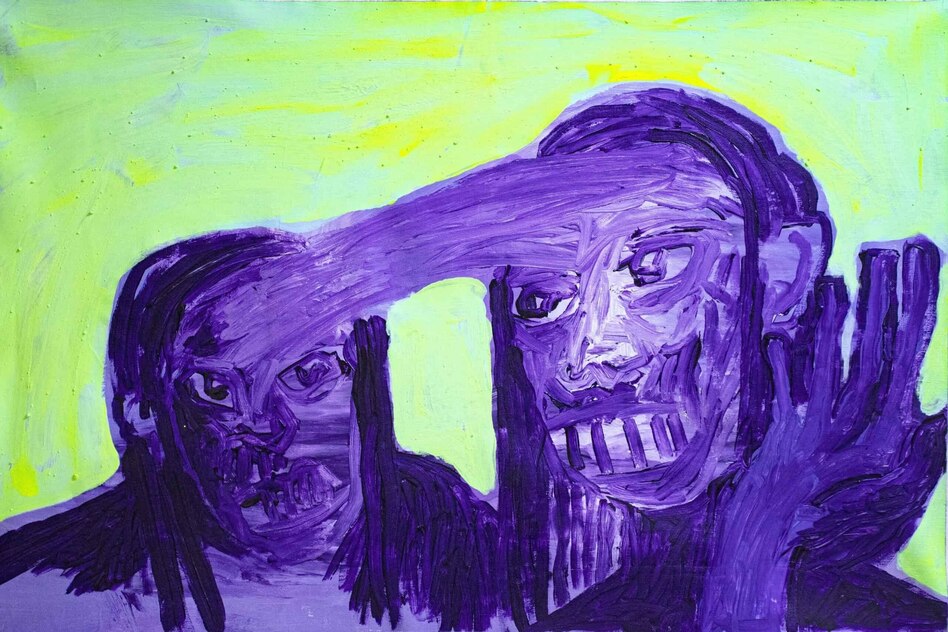
After ten years of collaboration, the incarnation is complete. At least on screen. Now even the artist, one half of the duo, can no longer tell exactly where his own handwriting ends and the artist's, the other half of the duo, begins when looking at the pictures. “We've been doing something for three or four years without talking about it beforehand.
The dialogue occurs purely visually," says Christ Mukenge. "There are translation processes that take place between us," adds Lydia Schellhammer. Between the different influences, assignments, associations that both bring with them. And the clash that results from it.
Lydia Schellhammer and Christ Mukenge describe working together on canvas as an almost automatic process; they also create fabric sculptures, video works and multimedia installations. They founded Mukenge/Schellhammer in Kinshasa in 2016, and now they just call themselves the DUO. Their formats are large, the colors bright or dark, purple, black, neon green.
Mukenge/Schellhammer: “Elima – NoBody”, Kunsthalle Gießen, until November 1, 2026.
Mukenge/Schellhammer follow their own visual logic that seeks to overcome boundaries of geography and gender. A hybrid of traditional knowledge and acquired mysticism in the multi-ethnic state of Congo, of European art history and contemporary street art in Kinshasa, which includes analogue as well as virtual reality. Pop culture, luxury and gaming aesthetics, all of this finds its way into its own image mythology, such as interpersonal relationships and spirit animals.
Mukenge and Schellhammer met in 2012 at Carré Magique, a location on the campus of the Académie des Beaux-Arts in the Democratic Republic of Congo. An art academy based on the European model - or, as Christ Mukenge specifies, an art academy as imagined in Belgium as a model for the colony: copy of the European masters, strict canon, little interest in artistic freedom.
In this mixed situation, a kind of counter-movement of students was formed on campus, including Lydia Schellhammer, who had previously had no contact with art, and Christ Mukenge, who was a student at the art college. When both report on this, a certain punk narrative emerges from the art school occupiers of Kinshasa. An unlikely place for artistic socialization.
Artistic practices such as partagism, a collaborative work on images, were established here, the code of honor of which included that all proceeds from sold images were shared equally. A model that produced exciting images, but also loud arguments.
Four years after meeting and working in different constellations, the two founded Mukenge/Schellhammer. A formal setting in which they share authorship and do not want to be the focus of their individual biographies: "Today we work exclusively as a duo! There is nothing else for us."
Mukenge and Schellhammer each spend about half a year in Germany and Kinshasa. The duo regularly collaborates with other disciplines, from theater, dance, performance or art history. They both found a partner in Nadia Ismail; the director of the Kunsthalle Gießen had long wanted to organize an exhibition project on the African continent.
What sounds good in theory is, in practice, a stress test, as all three say. Mukenge says you have to react quickly to changes as a golden rule for working in the Democratic Republic of Congo. Even power outages shouldn't cause you to panic. The exhibition opened in the spring at the Musée d’Art Contemporain et Multimédia, the only museum for contemporary art in the DR Congo. Now a second part of the show has moved to Germany.
Mukenge/Schellhammer come from practical experience, but are keen observers of their time and their business. We are talking about calls and self-designations for which it seemed in vogue for a while, especially beyond the African continent, to imagine a post- or decolonial. Of course, says Schellhammer, “postcolonial” as a concept was always important for her own work – although she was not familiar with the term at the time.
Mukenge remembers the appearance of a Belgian artist at the art academy and the impression that someone was coming by to tell people what they were actually doing. How all of this can be categorized in terms of discourse. “We know this quite well ourselves,” says Mukenge. “We’ve been doing it that way for a long time.”
Ironically, the self-reflective criticism of Eurocentrism sometimes produces truly Eurocentric attitudes. Schellhammer confirms that what is important to Europe is of no interest to anyone in Congo. At the same time, she sees how the preferences of the art market with its economic centrifugal forces help to cement such images: “African artists are always expected to be ‘authentic’.”
Against the appropriation, the duo describes themselves as transnational and post-postcolonial. A term that does not exclude the brutality of historical facts, but also does not allow itself to be determined by their ideas.
In general, the interest in transformation is a determining factor in their work together. Christ Mukenge and Lydia Schellhammer also understand painting as a three-dimensional and virtual creation of images. Some works are created with VR glasses on, the brush strokes result from the movements in the virtual world - and hand-painted canvases are placed next to video works as a diptych in the exhibition that has just opened.
This results in interesting observations about translation processes, here between the languages of artistic media and techniques that have not been seen before.
“Elima – NoBody” is what Mukenge/Schellhammer called their large solo show at the Kunsthalle Gießen, referring to two things. The desire to merge into a duo, to celebrate the non-identical. And art as a possibility of re-transformation. In the Bantu language Lingala, Elima means a higher mental state, describes Mukenge - the Catholics drove the ambivalence out of the term, and since then it has had a primarily negative connotation in the country.
As an ominous spirit, demonic. The exhibition title could also be applied to the Mukenge/Schellhammer duo themselves: a picture-spewing, friendly monster from Kinshasa. Committed to drive out our fear of symbols - and in passing to throw new, unseen images into the room for a transnational future.
Read the full story at the source →
Source: taz