
Germany taz
Cologne show “Along the Color Line”: Whoever collects and exhibits determines the center and edge
On its 50th anniversary, the Cologne Museum Ludwig is taking a critical look at its famous modern collection in a critical way. Does the color line run here too? more...
Deutsch (original) ·Auto-translated to English
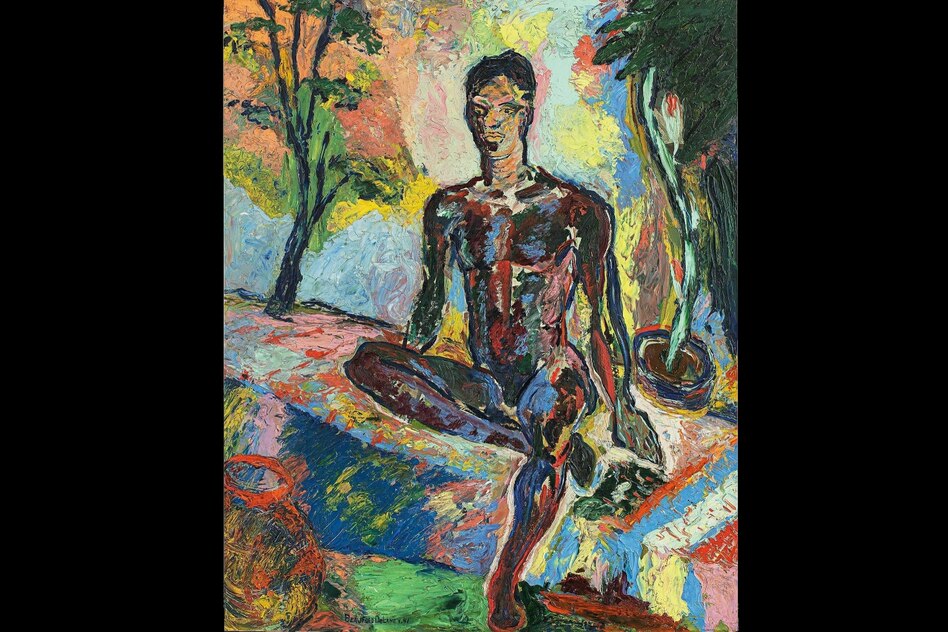
A young man sits unclothed on an elevated surface, one leg across his body, looking past us. Tree, potted plant and clay pot surround him. Violet, reddish brown, blue and green lights connect skin, trees and ground in pasty tones. The pose is reminiscent of landscape nudes from Cezanne to the Bridge. But Beauford Delaney did not paint a nameless model in 1941, but rather James Baldwin, who had preached in Harlem as a youth. In the Ludwig Museum, “Dark Rapture (James Baldwin)” hangs, so to speak, as a satellite of the exhibition “Along the Color Line – Traces of a Transatlantic Modernism” between works of classical modernism, opposite Picasso’s “Woman with an Artichoke” and Beckmann’s “Still Life with Green Glasses,” painted in Nazi-occupied Paris and in exile in Amsterdam.
“Along the Color Line” is the guiding concept and working method for curator Eboa Itondo to examine the empty spaces in his collection on the fiftieth anniversary of the Cologne Museum Ludwig. They go back to the foundation, Josef Haubrich's donation from 1946: the city filled some of the gaps in its modernity with works that National Socialism had ostracized as “degenerate.” Black artists were not included.
Around 1900, the American sociologist, historian and civil rights activist W. E. B. Du Bois (1868–1963) declared the color line to be a problem of the 20th century. For the Paris World's Fair in 1900, he and students developed geometrically reduced diagrams on the property, education and professions of black Americans a generation after the end of slavery. He countered racist stereotypes with data of emancipation. In 1936, when presenting an exhibition in the German Museum in Munich, he noted that the most visible places were reserved for German inventions. He also visited Cologne. Itondo transfers this to the Museum Ludwig: whoever collects and exhibits determines the center and the edge.
“Along the Color Line – Traces of a transatlantic modernity”. Museum Ludwig Cologne, until March 7, 2027. Catalog (publisher of the bookstore Walther and Franz König): 38 euros
Itondo places the loans discreetly and naturally in the collection. Laura Wheeler Waring’s “Gold Earrings” (1940) hangs next to Paula Modersohn-Becker’s “Self-Portrait against a Blue-Gray Background” (1906). Waring designed covers for The Crisis, Du Bois' magazine and forum of the Harlem Renaissance. Her “Still Life: Daffodils with Figurine” stands next to Maria Marc’s “Still Life with a Blue Cup and Red Bowl” (around 1911/1912). Both are accompanied by a display with the painted objects that belonged to the painters: here the ceramic figure, there the cup, bowl and rider figure. The same presentation eliminates hierarchies between inventory and loan, canon and satellite.
These works hang below the portraits without explanatory texts or a chapter on Black Modernism. This matter-of-factness has been worked out. Unlike many recent collection revisions, Itondo does not have to show the correction for it to be considered as such.
One floor below is the question of the second history of the collection, which Peter and Irene Ludwig founded in 1976 with 350 works and the demand for their own house. The Aachen couple had been buying pop art since 1967; Cologne canonized on the Rhine what was just emerging in Manhattan. Itondo recognizes their importance for Cologne as an art city, takes the Ludwigs' transatlantic aspirations at their word and asks why the route from Manhattan to Cologne led past Harlem. The fact that the Museum Ludwig also asked itself this question is shown in the exhibition by the collage “Mother Catherine” by Betye Saar, one of the central figures of the Black Art movement, who died this summer at the age of 99. The museum purchased her portrait of a spiritual healer in a white robe and red cape in 2020. At this point it becomes clear: Itondo names flaws and previous efforts to address them without deriving any absolution from them.
Du Bois’ diagrams hang alongside paintings, sculpture and photography. A spiral chart illustrates the 67-fold increase in the assessed value of Black household and kitchen furniture in Georgia from 1875 to 1899: Du Bois quantifies property rather than poverty. Next to it is Thomas E. Askew's photograph “Young African American Woman” (1899/1900): sitting upright, feathered hat, patterned curtain, a cut piece of furniture. The diagram is missing the individual household; the portrait gives the property a face, but not a location. The furniture acts as a studio prop, civility as a self-expression against the racist caricature.
Diagrams group the works into subchapters, Du Bois quotes on the walls divide the rooms. Dated like diary entries, in German and English, the text tracks reproduce passages from his reports from 1936. Under June 27th it says: "One of the reasons to learn a foreign language is that in every language there are some untranslatable expressions [...]. This is the case with the German word 'Schadenfreude'." Yellow highlights reveal the curatorial reading: the quote is not hung on the wall as an authority, but as working material, the selection of which is up to you. Itondo reads the collection along the color line and derives the grammar of the show from Du Bois' method. He himself curated the 1900 World Exhibition in Paris.
This modernity is also happening in the Rhineland. Herbert Gentry, who grew up in Harlem with his mother's salons, went to Paris in 1946 on the GI Bill. His hand-painted monoprint “Paris – New York” (1977) describes the pendulum movement of his life. Next to it is an inconspicuous poster announcement: In 1981, the Cologne gallery Glaub exhibited the artist Gentry, a few hundred meters from the new museum building that opened in 1986. In 2024, the poster came to the museum as a donation from his estate, more than forty years after this local presence of Black Modernism.
Mildred Thompson should also be mentioned. The US artist returned to Germany in 1964 because no gallery in the USA offered her representation. In Düren she taught at the high school, but her studio was in the forests. She built Wood Pictures from their wood and left the grain and annual rings as traces of time. This is the point of the exhibition. Düren is halfway between Aachen and Cologne: While the Ludwigs were buying pictures from Manhattan, a few drives away a black artist from the USA was working with material from the Rhenish landscape. Thompson's work was created here long before the museum purchased a Wood Picture in 2025. Itondo doesn't have to import transatlantic modernism, just seek it out locally. Representation becomes a question of institutional responsibility.
Installations from the archive of the contemporary artist James Gregory Atkinson, born in 1981, run throughout the entire Cologne exhibition. Lend her the title, the structure and the view from the outside to Du Bois; Atkinson brings together the traces of black life in the Federal Republic. Including his own: His father was a US soldier in the Ray Barracks in Friedberg, Hesse. Display cabinets, pinboards and drinking fountains come from the barracks. The growing archive shows Black Germans in the young Federal Republic as actors and at the same time as subjects, sought after and racially marked. A doll based on the child actress in "Toxi" (1952) lies between CARE packages and Disney's Dumbo crow "Mr. J. Crow", whose name refers to the Jim Crow segregation of the US South. Black life in Germany shows itself here in phases of visibility, without a datable beginning.
With Atkinson, Itondo shares themes and work with showcases, pinboards and timelines, the tools of exhibiting. Occupation and desire, post-war guilt and children's toys, the familiarity of a family photo and the uncanny nature of a doll meet here. None of these registers dominates or is dissolved. The order is there earlier than the view that recognizes it. Itondo makes Atkinson's art of exhibiting the process of the house: what he began in showcases continues in the halls. In the show, the transitions between artistic and curatorial work become permeable. A method that you would like to see become a standard.