
Germany taz
Documentary “Biermann”: He always answered loudly
Jens Meurer traces the life and work of the songwriter in his documentary “Biermann”. He stays close to the subject of his investigation. more...
Deutsch (original) ·Auto-translated to English
“And did he get annoying sometimes?” someone can be heard asking in the background. Barbara Honigmann, who is sitting in front of the camera, laughs and confirms: “Sure, the wolf always annoyed everyone, that was part of it!” At the relevant point in Jens Meurer's documentary “Biermann” it is about the long years that the songwriter spent in Chausseestr. 131 spent in East Berlin under a ban on appearances and publications. The result was that a counter-public formed around Biermann within his private walls. Black and white photos show who stopped by to hear his latest poems and songs. Not only “DDR-Intelligenzija” was there, but also illustrious guests such as Joan Baez, Rudi Dutschke and Allen Ginsberg.
In a certain sense, nerves are Wolf Biermann's life theme. In the film he shares the childhood anecdote in which he sees his father Dagobert Biermann for the last time. As a six-year-old, he was incredibly proud of his singing skills, says Biermann. Which is why, when he and his mother Emma visited his father, who worked underground for the KPD and had already been arrested several times, he absolutely had to sing him one of the songs he had just learned, it was called “Bombs on England”. “Imagine,” says an emotionally charged Biermann to Meurer, “he sees me again and I sing him the song of his mortal enemies.”
The rough dates of Wolf Biermann's life are, so to speak, German history: born in Hamburg in 1936 as the son of a Jewish communist who was murdered in Auschwitz in 1944, he and his mother Emma survived the bombing of Hamburg. She raised him in the spirit of her father, or at least as she imagined it: “My Karl Marx was called Emma Biermann,” explains the songwriter in his own figurative language.
In 1953, when he was 16 years old, he moved to the GDR and graduated from high school there. At the beginning of the 1960s he began performing with self-written songs, which he was quickly banned from doing in 1965. The years mentioned above followed at Chausseestrasse 131, in which he really annoyed the Stasi - and of course the other way around, as is revealed in the film with striking details from the "plans to dismantle his person".
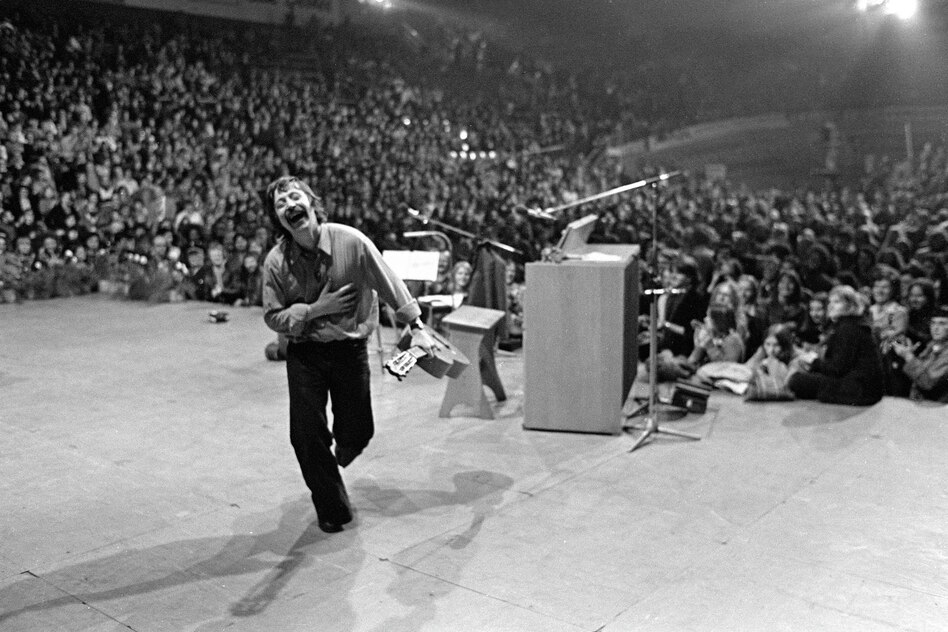
In November 1976 the central event of his life occurred, which simultaneously marked a turning point for both Germanys, for the GDR as well as for the FRG. At the invitation of IG Metall, Biermann gave a concert in Cologne that was broadcast live by WDR. You can see excerpts from it in the film that not only make Biermann's excitement palpable, but also the special atmospheric charge of the entire event.
Not only that someone who had only sung in front of people in his own apartment for 12 years was suddenly standing in front of a completely overcrowded sports hall audience of 6,000 to 8,000 people. The concert lasted four and a half hours! That alone turned the audience present into historical witnesses. Although no one yet knew what the concert would actually become famous for in retrospect: namely, that the GDR leadership used it as an opportunity to expel Biermann from the GDR “for a gross violation of his civic duties.”
Jens Meurer doesn't spend much time in his film about what all this entailed. With Armin Mueller-Stahl – what a joy it is to see the soon-to-be 96-year-old again! – says one of the many actors and artists who subsequently left the GDR. With polite self-irony, Mueller-Stahl gets to the point of Biermann. He was an egomaniac: “When I said hello to him quietly, he answered loudly!”
In the 50 years since then, Biermann has not missed out on “annoying” appearances, as archive footage from Leipzig in 1990, where Biermann insulted the majority of the audience as cowards, or from 2014 in the Bundestag, where he subjected the Left Party to a tirade, shows. Meurer continues to work his way through the stages of Biermann's work and life, but it turns out that the view actually always goes back. Be it the intellectual reflections on one's own “childhood belief in communism” or the plans to one day be buried in the cemetery on Chausseestrasse.
The film is pleasantly reserved with details about private life. And yet in the end you have the feeling of a missed opportunity. As a documentary portrait, “Biermann” does full justice to its subject. But the historical phenomenon his name represents remains underexplored. How could it happen that someone who sang songs like “Don’t wait for better times …” or “I would like to be gone and would prefer to stay here …” became so important that a state exposed itself so much about how to deal with him?
“Bierman”. Director: Jens Meurer. Germany 2026, 120 mins.