
Germany · taz · · 54m
Climate protection in construction: Architects call for a stop to demolition
Deutsch (original) · Auto-translated to English
This number illustrates the whole dimension: the construction industry causes twice as many greenhouse gases worldwide as the whole of Africa. More than 1.5 billion people live there, whose diet, their clothing, their mobility and their lives are responsible for only half as much carbon dioxide as the annual construction of new roads, skyscrapers, tunnels, shopping malls and the like.
“In order to finally implement the construction turnaround in practice, we are calling for a stop to demolition,” explains Corinna Tell from the “Anti-Demolition Alliance”, an alliance of architecture, urban planning, administration and research. This Thursday, Tell and other activists marched in front of the Red City Hall in Berlin to demand from politicians a “conversion order that puts preservation before new construction”.
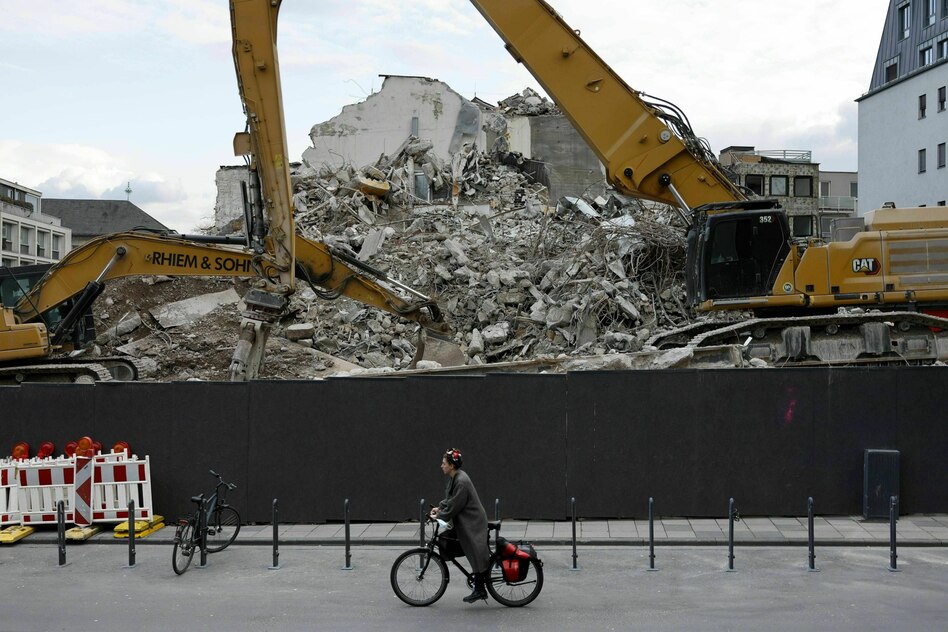
According to official statistics, 12,000 buildings are demolished in Germany every year, which on the one hand creates huge amounts of building rubble and on the other hand creates space for new buildings. In the vast majority of cases they are built with cement. Every year, 10 percent of Germany's emissions are caused by construction. This further heats up the climate.
According to the EU Earth observation program Copernicus, August this year was the hottest August worldwide since weather records began. The global average temperature was 16.96 degrees, Copernicus announced on Thursday. This exceeded the previous high of 2023.
The Conference of Construction Ministers needs answers to this. Last year she promised to pay more attention to building renovations. “But nothing happened,” says Leon Beck, chairman of “Architects for Future”.
The alliance, which includes a total of 70 organizations, is therefore demanding a binding approval requirement with alternative assessment for every planned demolition. “This is the only way to preserve valuable inventory and make it available for use at short notice,” says Beck, who is himself an architect. This also has a social component: “The housing issue is not decided in the new building, but in the existing building.”
The actual number of buildings demolished in Germany is likely to be significantly higher than the official 12,000: not every demolition is actually recorded statistically. “Even complex existing buildings such as churches can be easily converted into neighborhood centers or living space,” says monument conservationist Corinna Tell. However, the approval requirement for demolitions that the alliance is demanding did not even make it onto the agenda of this year's conference of building ministers. Architect Beck says: “There is exchange, but not in the technical depth that would be necessary.”
“We want to make housing affordable, available and environmentally friendly for everyone,” the Union and SPD wrote in the coalition agreement and that a “Federal Research Center for climate-neutral and resource-efficient construction” should be set up. The traffic light had already set aside millions in funding for this in the 2024 budget: In order to become climate neutral by 2045 - that is the law in Germany - research must be carried out into how construction emissions can be reduced. Apart from a location decision, the center is not making any progress: Stuttgart, Weimar and Bautzen in Saxony will share the research, and an association will soon be founded for this purpose.
The new institute does not have to start from scratch: the Fraunhofer Society founded the “Future District Alliance” in 2022 to develop future scenarios for the cities of tomorrow. In Vienna, an attempt was made to build a residential area of the future with the Seestadt Aspern. Last year, the Bundeskunsthalle in Bonn dedicated the exhibition “We/Trans/Form” to the future of building. Traditional building materials such as clay or wood were once again honored; they bind greenhouse gases and store them as long as the building stands. In Munich, 600 wooden apartments were built in Prinz-Eugen-Park, an old barracks area. In Berlin, the first work on the largest wooden construction district in Europe has just begun at the former Tegel Airport: 5,000 apartments entirely made of wood are to be built here by 2029.
There are a number of approaches to climate protection in construction. “Unfortunately, many climate-friendly materials are even more expensive than those that are harmful to the climate,” says Leon Beck from “Architects for Future”. Politicians can help by “consistently factoring the CO2 costs into such building materials”. But for this to happen, politicians would have to recognize the problem. Beck promises to stick with it for the alliance: “We will now specifically work out a demolition permit requirement - and then be back on the mat with the construction ministers.”
Read the full story at the source →
Source: taz