
Climate taz
Climate adaptation in agriculture: Don't tear up the ground
In the Uckermark, a conventional farmer uses new soil management techniques to keep yields stable in drought and heat. more...
Deutsch (original) ·Auto-translated to English
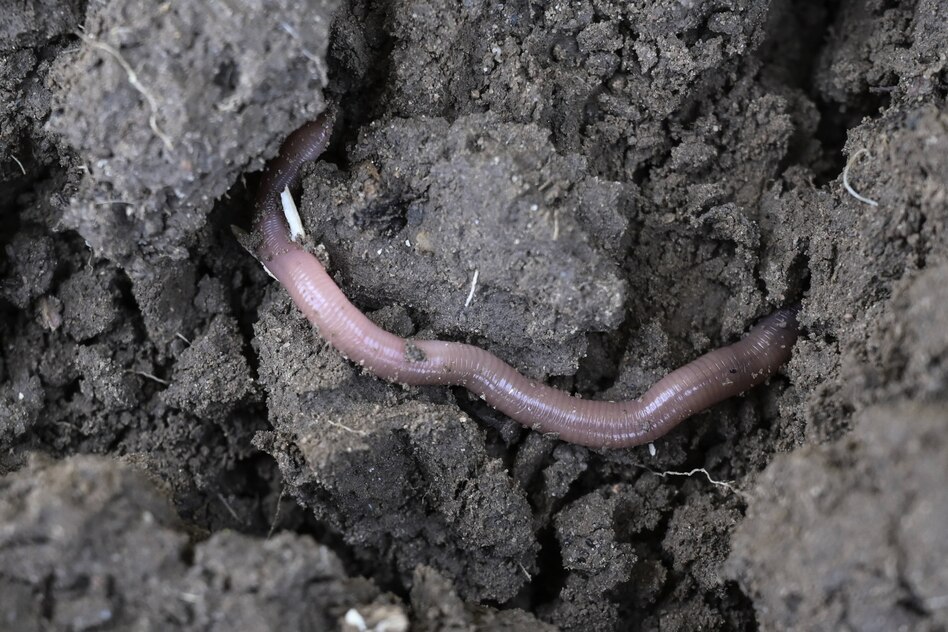
No matter where Stefan Bernickel puts his small spade into the field, whether in the rapeseed field or in the delicately green winter grain: the chunk of earth that he pulls out always looks the same. At the top there is a dry layer of earth, then slightly damp soil and hectic wriggling earthworms fleeing from the sunshine. “The soil is alive,” the farmer states happily. And that despite the fact that it has hardly rained here in the Uckermark, around 100 kilometers north of Berlin, in the past few weeks.
It could be on the ground, but it isn't, on the contrary: the sand content is high. There is another reason for the wet earth - Bernickel has radically changed his soil cultivation. No more deep plowing and cultivating on his 300 hectares of fields to undermine the stubble. No second trip to sow. Instead, the huge machine he bought for this purpose only loosens the seed strips slightly and sows and fertilizes in one go - in the so-called strip-till process. “This means that 80 percent of the ground is not torn up,” says the 43-year-old.
The qualified electrical engineer and master agriculturalist took over the four-sided farm with brick and half-timbered barn from his father in 2021. Until then, the conventional concept had worked well: no animals, cultivation of wheat, barley, rapeseed. "It's highly lucrative when the weather is right. But those days are over," he says.
In 2018 the drought came, huge clouds of dust rolled over the fields. At the end of June 2021, a torrential rain of 250 liters washed out the fields in one night. “People are still talking about it today.” Even then, Bernickel realized that he had to change something. During his travels as an electrical engineer, he had also seen how drought was dealt with in Eastern Europe and North Africa. So he started trying out alternatives, in soil cultivation, in crop rotation, in seed varieties. He ordered the new machine and made the switch.
The success, which is not only reflected in the measurably more common earthworms: "The stubble field stays light and therefore does not heat up so much - heat kills soil life. The soil life is protected, the soil retains more water and is better protected from wind and water erosion. It is also easier to drive on, and I save diesel and working time." He calculates that he used around 10,000 liters less diesel per year, 40 percent of his requirements. This year, the process also brought a nice bonus into his coffers: the federal “Blue Compass” prize worth 25,000 euros, awarded by the Ministry of the Environment and the Federal Environment Agency.
The strip-till method is not new. It is part of the conservation tillage without plow that is becoming more and more widespread in Germany. The model is down under: In Australia, strip-till with no-till - the seeds are placed directly on the ground - is the common method to protect the soil from drying out. There are six other farmers in Brandenburg who use strip-till, says Bernickel.
The disadvantage, also in Australia: If you don't plow, you have to fight weeds differently. And Bernickel did not become an organic farmer with his conversion. He uses agricultural poisons against insects, fungi and wild herbs and he likes to explain in detail why he considers the ban on treating seeds with neonicotinoids to combat pest infestation to be fundamentally wrong. “Instead, I now have to use resources above ground, in much larger quantities, and repeatedly,” he complains.
But at the same time he is trying to reduce the use of all resources, if only for cost reasons. He sows mustard, radish and fenugreek with the rapeseed, which are intended to distract the rapeseed flea beetle from the rapeseed. Winter wheat is planted as late as possible to make it difficult for blackgrass. Instead of chemical growth regulators for grain, which are intended to prevent the stalks from tipping over, he uses a regulator that organic farmers also use. “This enabled me to reduce chemical use by 75 percent.” He feeds his strip-till machine with data so that the machine sows and fertilizes precisely depending on the soil quality. "This is not yet standard, but it is currently spreading. Without such technology, agriculture has no future," says Bernickel.
His goal is not to increase yields, but to stabilize them in the face of climate change. "I have better risk diversification, depending on heat, drought, rain or frost. Corn, for example, loves warmth, but wheat loses quality when it's hot. And above all, I can use it to reduce costs, including fertilizer, diesel, working time and pesticides."
At the same time he tries to look into the future. Why not grow the frugal chickpeas in Brandenburg? They love warmth, need little water and so far over 90 percent are imported. He has been trying out cultivation on a test field for three years under scientific – and honored – supervision; he is a member of the Brandenburg “Chickpea Ring”. So far with little success: in the first year the bean seed fly ate the plants, in the second the peas germinated in the pod after too much rain, this year the harvest was poor due to dryness and cold. He still wants to carry on. And soon he will harvest the corn. Everything from the plant, except the grains, will remain on the ground - for the earthworms.