
Politics · taz · · 2h
Chancellor attacks AfD: Merz criticizes “remigration” as “ethnic cleansing”
Deutsch (original) · Auto-translated to English
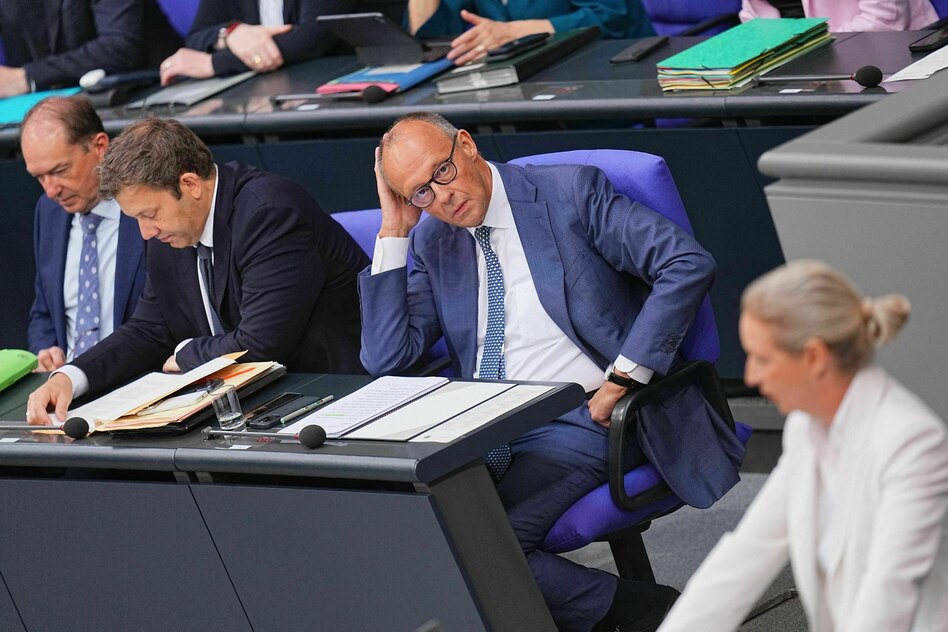
afp/dpa/rtr | Chancellor Friedrich Merz (CDU) criticized the AfD's migration policy with sharp words. Their concept of so-called remigration is “nothing other than ethnic cleansing based on skin color and origin,” said Merz on Wednesday during the general debate in the Bundestag. He referred to the dangers for the labor market, in which many people with a migrant background are employed.
If things were to happen as the AfD wanted, “the trades in Germany would no longer be able to work, then not a single nursing home would work anymore, then not a single hospital would work in Germany anymore, then not a single restaurant would be able to operate in Germany anymore,” the Chancellor continued. “That would be the result of your remigration policy,” he said to the AfD parliamentary group.
It is true that there is a “consensus in the coalition” that there are still many people who are not allowed to enjoy permanent residence in Germany and that more should be deported. “But we carefully differentiate between those who work in Germany, who contribute to our prosperity, who are welcome in Germany, and those who do not have permanent residence in Germany and who have to leave our country again.” The government makes this distinction carefully “unlike” the AfD.
After its election success in Saxony-Anhalt, Merz warned the AfD against excessive certainty of victory. “Mrs Weidel, today you can hardly walk because of your strength,” the Chancellor said on Wednesday in the Bundestag to the AfD parliamentary group leader. “But you don’t have an absolute majority, and you won’t achieve that in Germany,” said Merz. “Nowhere in Germany will you get a majority with this policy: you are and you will remain a destructive force.”
The Chancellor harshly criticized the AfD and its political style. “What characterizes you is a contempt for our democratic institutions and a constant personal degradation of our state’s representatives,” he said.
In his speech, Merz tried to highlight the fundamental differences between the AfD and other parties. Addressing the AfD faction, he spoke of a “deep rift between you and us”. The Chancellor called “the deep rift in foreign policy, the deep rift in European policy and also the deep rift in social policy and peace policy.”
The Chancellor continued: "The majority in the German Bundestag is not following this path that you are pointing out here, and the majority of the population of the Federal Republic of Germany is not following it either. We will continue to defend our freedom in the future."
Merz accused the AfD of harming Germany's interests through its proximity to Russia. “The only thing that really threatens Russia and Putin is the charisma of democracy,” said Merz. “And yet you obviously remain on Russia’s side,” said Merz in the direction of the AfD faction. “You are part of this problem that we have in Germany – and we will defend ourselves against it with everything we have at our disposal.”
The Chancellor admitted that the AfD had achieved a “remarkable election result in every respect” in Saxony-Anhalt. "The voters spoke quite clearly. They also gave us, including me, a clear message." But the fact is that the AfD has missed its goal of an absolute majority in the Magdeburg state parliament.
The Chancellor's speech in the plenary session was repeatedly interrupted by outraged heckling from the AfD parliamentary group. Bundestag President Julia Klöckner (CDU) called the AfD MPs to order. “You also have to endure that when the mirror is held up to you,” said Klöckner. "You will also be expected to listen to others. Opinions can vary here and it is the rule here."
Merz sees a need for action after the poor German results in the Pisa education study. The results of the study are sobering, said the CDU politician in the Bundestag. He wanted to expressly offer the states to once again make a “great effort” together to improve the education situation in Germany.
Merz went on to say that it was also important that education and training could not be “outsourced” to the state. Families are also part of this and have a responsibility. In the new international Pisa comparison, students in Germany performed worse than ever before.
Federal Chancellor Friedrich Merz has also committed to further supporting Ukraine in its defensive fight against Russia and has thus distanced himself from the AfD. “We support Ukraine and we will continue to support it because it also defends our freedom,” said the CDU leader in the general debate in the Bundestag. He accused AfD leader Alice Weidel of an “almost grotesque reversal of perpetrator and victim”. Weidel had previously called on Merz to finally support peace negotiations. She accused him of “war propaganda against Russia”.
With regard to Russia's attack on Ukraine, Merz said: "Nobody has threatened Russia, not NATO, not the European Union, not Germany." Merz emphasized: “The only thing that really threatens Russia and Putin is the charisma of democracy.” Ukraine was on its way to becoming part of the European democratic family. The AfD is “obviously still on Russia’s side when it comes to defending our freedom here.”
“That is exactly where the deep rift runs between you and us – the deep rift in foreign policy, the deep rift in European policy and also the deep rift in social policy and peace policy,” said Merz. “We will continue to defend our freedom in the future.” Germany had to learn that this was necessary “in a whole new dimension” with the drone attack at Leipzig Airport on August 4th.
Merz emphasized that the gas supply in Germany is secure in winter. “We are of course keeping an eye on the filling level of storage facilities,” said Merz on Wednesday in the Bundestag during the general debate on the 2027 budget. “Assume that the Federal Minister of Economics, in consultation with the members of the federal government, will do exactly the right thing to ensure the gas supply in winter.” He accused the AfD of “publicly triggering hectic buying campaigns” with the warnings about empty storage facilities, which only led to prices on the gas markets rising very sharply.
Merz warned that this would not only affect public budgets, but also consumers in Germany. “We are getting clear indications that the energy supply, especially the gas supply, is secure in Germany over the course of the winter, and that is exactly what the federal government is basing its supply strategy on.” The gas storage association Ines had previously warned of bottlenecks in the event of a very cold winter due to historically empty gas storage facilities. The storage facilities were only around 53 percent full at the beginning of September. This is the lowest level at this point since records began 15 years ago.
AfD leader Alice Weidel sees the black-red coalition at an end after the state elections in Saxony-Anhalt. “The voters in Saxony-Anhalt have told you very clearly in the language of the democratic sovereign: Black-red is over,” she said at the first direct meeting with Chancellor Friedrich Merz (CDU) after the election Sunday in the general debate in the Bundestag. People wanted a change in policy and not “business as usual”.
Weidel attacked the federal government's financial policy and accused Merz of an unprecedented debt policy. The state finances are in ruins. He leaves “scorched earth” behind. “They are driving Germany into bankruptcy in record time,” said Weidel. The government's draft budget is a declaration of capitulation by the coalition and unconstitutional.
Left-wing parliamentary group leader Sören Pellmann has accused the federal government of promoting the rise of the right through wrong budget priorities. “You are making an anti-social policy for our country, against the majority of people in the country,” said Pellmann on Wednesday in the general debate in the Bundestag, addressing Chancellor Friedrich Merz (CDU). “Mr Merz, stop this wrong path,” warned the left-wing politician. “If you don’t finally come to your senses now, our democracy will be seriously damaged.”
The government led by Merz is carrying out “social clear-cutting,” said Pellmann. “In the social area, in many areas, there are minus signs everywhere,” he said. “Only when it comes to rearmament, in the future every third euro should go there – that’s a gun instead of butter policy.”
Pellmann was “impressed” that Merz had “sometimes self-criticized” in his plenary speech. However, he does not share the Chancellor's analysis that the coalition's reform policy would meet with more approval if it were better explained. Pellmann criticized it as “irresponsible to explain poor approval ratings by saying that you didn’t explain it well enough.”
The Left parliamentary group leader called for other federal spending priorities. More investment in housing construction is needed. The economy needs an “active industrial policy,” he said. “We need a comprehensive investment program so that our factories continue to produce in the future – affordable cars, e-buses, batteries, microchips and also climate-neutral steel.” There can only be state funding for this “if there are job and location guarantees, if there is collective bargaining and real co-determination”.
After the AfD's victory in the state elections in Saxony-Anhalt, Green parliamentary group leader Katharina Dröge called for a ruthless reappraisal by the democratic parties. “It is urgent time for you to act here,” said Dröge, addressing the black-red coalition in the general debate in the Bundestag. The Green politician spoke out in favor of considering a ban on the AfD. It is time for the Democratic members of the Bundestag to decide this question based on their own conscience, she said. Despite her criticism of the federal government, Dröge emphasized the responsibility of the democratic parties to find solutions together. We have to continue arguing, but at the same time we have to look for compromises.
Chancellor Friedrich Merz (CDU) confirmed that she clearly demarcated herself from the AfD. “I really appreciate your dismay and shock at this terrible election result in Saxony-Anhalt,” said Dröge, addressing the Chancellor. But that alone is not enough. People expected concrete answers from the federal government on how to deal with the AfD election results. “There are people in Saxony-Anhalt who are now afraid.” At the same time, Dröge warned against dismissing right-wing extremism as an East German problem. The AfD is particularly successful where people feel economically and socially left behind. This is exactly where the AfD comes in, “with the toxic slogans of nationalism and national isolation, with the wish for yesterday.” The democratic parties must act here.
Read the full story at the source →
Source: taz