
Politics taz
Lawyer on Gen Z protests: “Politicians consciously accept intimidation”
The CDU and the police union are threatening the Gen Z protests with a police force without mercy. The lawyer Michael Plöse explains what such statements do. more...
Deutsch (original) ·Auto-translated to English
taz: Mr. Plöse, on Saturday over a hundred thousand young people want to take to the streets nationwide as part of the Gen-Z-rules protests, many of them underage. What does this mean for the police? Does she have to act differently than when she has adults in front of her?
Michael Plöse: In principle, freedom of assembly is guaranteed as a fundamental right regardless of age and is therefore guaranteed by the UN Convention on the Rights of the Child. Special rules only apply after juveniles have been arrested. If the police want to question minors, they can only do so in the presence of their legal guardians.
taz: CDU politicians are already warning about riots. Manuel Hagel, Interior Minister of Baden-Württemberg, threatens “the full rigor of the rule of law.” How does this affect police behavior?
Plöse: First of all, what any interior minister says is of course legally irrelevant. Because the state must enable the fundamental right of freedom of assembly. Gatherings are necessary risk indicators for social development. Protests are therefore a necessary lever of the free democratic basic order.
is a lawyer in Berlin and a lecturer at the Humboldt University in Berlin and at the Berlin School of Economics and Law (HWR).
taz: What do you think of such statements?
Plöse: Even if these threats are only directed against individual – possibly actually violent – participants, they deter people from exercising the right to assemble. Politicians therefore consciously accept that peaceful protesters no longer dare to take to the streets because they are afraid of riots or police coercion.
Plöse: This can always happen. All it takes is a misunderstanding. If the police carry out tactical arrests in situations that are incomprehensible to the demo participants, this can lead to solidarity among the protesters. The police can then interpret this as assault, which entitles them to use violence. The police should therefore proceed with caution, especially with young people.
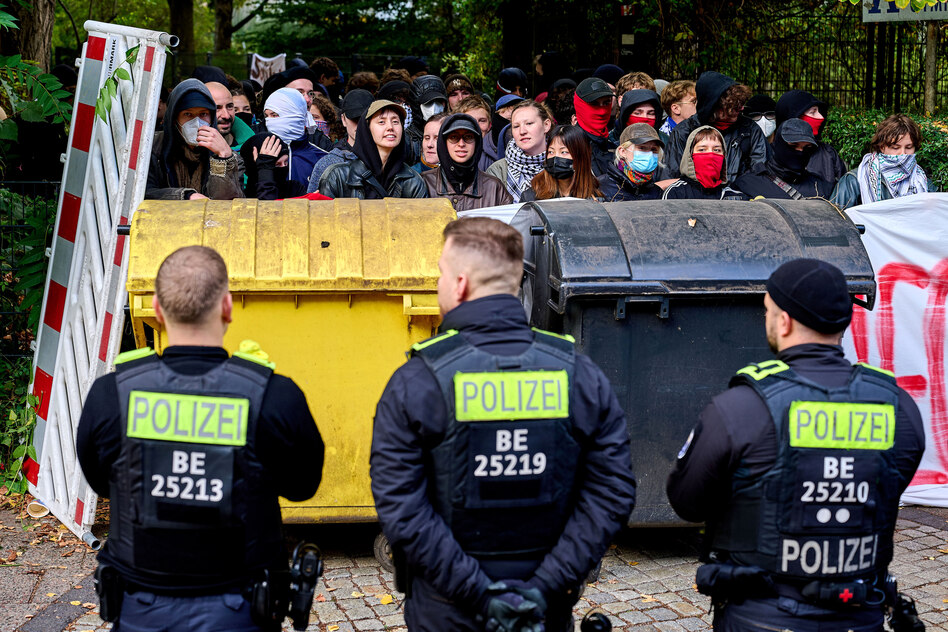
taz: During two school blockades in Berlin the week before last, the police took very brutal action against the students, there were scuffles and even arrests. Is that justified?
Plöse: That always depends on the individual case. Pushing a police officer is sufficient criminal law to classify it as assault. The police must always react proportionately. But she can also use violence against people if she wants to break resistance. The potential for violence is therefore very asynchronous.
taz: How should the police deal with school blockades? Does she have to clear them?
Plöse: In principle, the blockade is part of the right to assembly. If it exists without violence and danger, the state must protect it legally. However, if there are serious security concerns, the police may be allowed to break up a gathering. If the protesting people do not leave voluntarily, they can do so by force.
taz: What would be “security concerns”?
These include, for example, specifically blocked safety routes for ambulances. But if there is no need to rush, the police are not allowed to inflict pain on the protesters.
taz: Conservative and right-wing politicians are sometimes calling for the age of criminal responsibility to be lowered from 14 to 12 years. What do you think of it?
Plöse: The CDU demands responsible action from young people, but ignores their lack of future prospects. Firstly, experiences from other countries show that juvenile crime does not decrease by lowering the age of consent. The regulation burdens the courts with many additional procedures. Secondly, it does not meet the requirements of the United Nations Convention on the Rights of the Child.
taz: The federal chairman of the police union (GdP), Jochen Kopelke, spoke in an interview with Bild that there would also be young “riot migrants” among the students who “feel like violence against the police”. They should “expect no mercy” from the police. How irresponsible is that?
Plöse: There may already be an initial suspicion of incitement. A specific population group is addressed here. The statement probably still falls under freedom of expression, so I wouldn't take criminal action against it. But I definitely think it's a racist statement and a disinhibiting call to violence.
taz: Why is there so much excitement when things have always been peaceful in Germany, especially during the school strikes against conscription?
Plöse: There are various reasons for this. One is that it is much easier for politicians to conjure up violent scenarios than to deal with the problems of young people. That's why they delegitimize the protests.
taz: Have there been large, violent youth protests in Germany in the past?
Plöse: Yes, there were. An example is the Schwabing riots in the 1960s by students, apprentices and young workers. The hundreds of injuries and arrests led the police to rethink their approach towards de-escalation. The subsequent 1968 protests also saw major violent clashes with the police.
taz: The Berlin regional leader of the GdP said that no one who behaves peacefully should be afraid. Can young people rely on this?
Plöse: No, definitely not. I really think such statements are nonsense. It is always conceivable that a peaceful person could become collateral damage to a police action.