
Politics taz
Israel before the election: When AI videos flood the internet
AI-generated content is playing an increasingly important role in the Israeli election campaign. And AI is also used to polish the government’s image. more...
Deutsch (original) ·Auto-translated to English
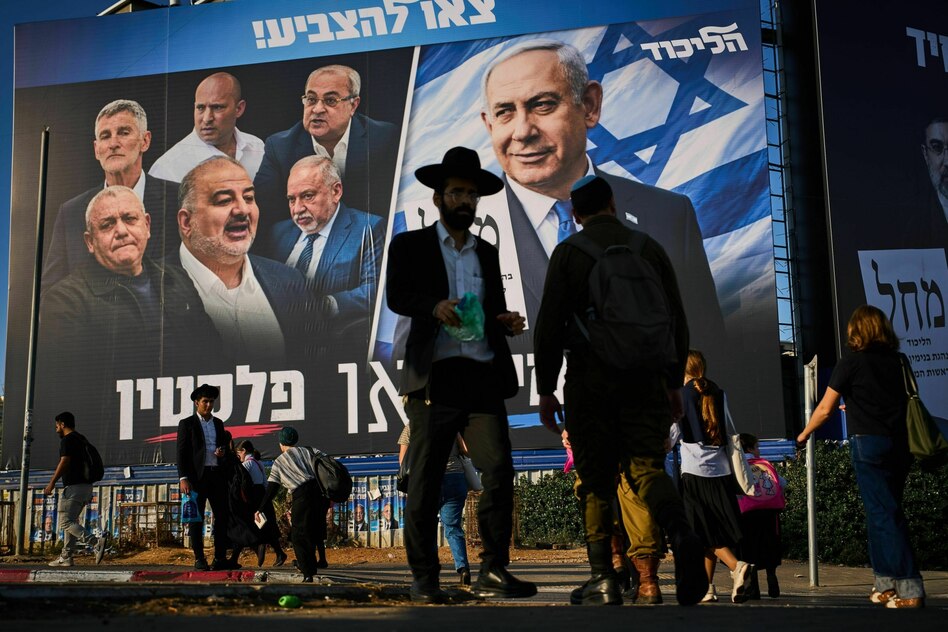
Under the title “Take off the masks,” Prime Minister Benjamin Netanyahu posted a video as part of the Israeli election campaign. It features his political rivals Yair Lapid and Naftali Bennet from the center-right B'Yachad party. They hug each other, then remove masks from their faces and reveal the two Arab-Israeli politicians Mansour Abbas and Ahmad Tibi. Finally, Yair Golan from the center-left Democrats party arrives and happily hugs the two of them.
The video has an obvious message: Whoever votes for Lapid and Bennet will get a coalition with the Arab-Israeli parties and the Democrats. And if you don't want that, you just have to vote for Netanyahu and his Likud party.
And the video has an obvious origin: artificial intelligence (AI). The “Ze Be AI” project from the Open University in Israel documents around 48,600 posts related to the elections, of which almost 15 percent contain AI-generated content.
The video shared by Netanyahu with Lapid and Bennet can be recognized as fake even by untrained eyes. With other images and videos this is much more difficult. For example, an alleged photo that shows Lapid and Bennet hand in hand with the leaders of the Arab parties in Israel. It is edited, in the original picture two other men can be seen in her place.
The content is the same - but the method is different. Tehilla Shwartz Altshuler speaks of “deepfakes” and “slopaganda”, a word created from slop and propaganda. She is a senior fellow at the Israel Democracy Institute, where she focuses on the influence of technology on democracy. The purpose of the AI-generated election campaign content: “promote polarization, defame competitors, spread disinformation.”
Back in January, she warned in a blog post for the Times of Israel that the use of AI in election campaigns would put democracy in the country to the test. This is the first election campaign in Israel in which technology plays a real role.
Israel's election commission has now responded to the problem; in July it established rules for this. AI-generated or AI-manipulated content must now be labeled as such.
The Sephardic ultra-Orthodox Shas party also uses AI for its election campaign. The videos are marked with a small black field that says “AI”. In one of the videos shared by the party, a little boy can be seen who is not wished a “Happy Hanukkah” in kindergarten, but rather a “Hannu-Christmas”, i.e. a mix between the Jewish Festival of Lights and the Christian Christmas. The party's message: "A state like all others or a Jewish state. You decide."
It is questionable whether such a conversation took place in a kindergarten somewhere in Israel. But it's not about the truth, about things that really happened. With the help of AI you can “create an alternative reality,” writes Tehilla Shwartz Altshuler.
The videos aren't the only problem. With the help of AI, manpower capacities can be accessed that would probably be significantly more expensive in an election campaign run solely by humans.
This was recently illustrated by a scandal involving Netanyahu advisor Jonathan Urich. He is no stranger: He is currently the subject of investigations in the Qatargate scandal surrounding Qatar's influence on Benjamin Netanyahu. He recently admitted that he continued to work with Qatar even after the attack by Hamas and other Palestinian militias in Israel on October 7, 2023. Israel accuses the Gulf state of supporting Hamas.
Netanyahu's trust in Urich seems unbroken and he continues to work with him. A project involving Urich: "Every 90 seconds, an AI-powered program searches around 50 news sources for mentions of Prime Minister Benjamin Netanyahu, his wife Sara Netanyahu, the Likud Party and their political opponents. When the program discovers something important, it sends a summary to one of two WhatsApp groups," reports the Jerusalem Post. Thanks to AI, the project runs virtually alongside.
And the AI not only comes to the voters, but they also come to the AI. A study by the Israel Internet Association showed: 88 percent of respondents generally use ChatGPT, and a quarter consider making their voting decision with the help of AI programs.
The Netanyahu government has already invested in influencing AI models like ChatGPT to be pro-Israel and pro-the current government. For this purpose, websites are set up by supposedly independent institutes, which then publish analyzes and comments in the interests of their clients. Programs like ChatGPT should then access this content and include it in their so-called thought process. According to the “Axios” portal, several million US dollars were due for such a project. However, it is still unclear whether there are similar initiatives to influence pro-Netanyahu specifically before the elections.
Ultimately, the use of AI is just one cog in a well-oiled campaign machine. Netanyahu repeatedly posts videos on his X account that emphasize: Be careful, the opposition parties want to work with the Arabs. Netanyahu doesn’t need AI to get his message across.