
Germany taz
Integration project in Stuttgart: No more chaos in your head
How do refugee children get into school? A model project in Stuttgart is testing new methods. A visit to the learning workshop. more...
Deutsch (original) ·Auto-translated to English
A simple office building in an industrial area in Stuttgart. In floor-length skirts, with glittering hair accessories in their long braids, Roma girls scurry into a lounge. The mothers leave cakes and snacks for the buffet, others bring flowers. Many parents don't speak a word of German. So on this morning at the end of July, gestures and a smile sometimes have to be enough to communicate.
In the Weilimdorf district of Stuttgart, the model project aims to give children and young people who have barely gone to school in their lives the chance to graduate from school later in life. During the holidays there is a school festival in the learning workshop. A boy named Ibrahim beams. The 12-year-old from Syria says that after this summer vacation he will go to the fifth grade at the attached community school. 12-year-old Sedrina and 13-year-old Sabrina are also ready for the regular preparatory class after two years of learning workshops. Although her German is still a bit faltering, her teachers see good chances.
The model project in the northwest of the city is attended by children aged 11 to 14 with a refugee background. They come mainly from Ukraine, where they belong to the Roma ethnic group, but also from Syria, Afghanistan and Iran. Hardly any of these children have ever attended school. In order to be able to attend the regular lower secondary level, they not only have to learn to read and write, but also how school works: How do you behave in the class structure? How do you structure yourself? And what about concentration?
They simply would not be able to attend the usual preparatory classes (VKL) for immigrant children without knowledge of German at the regular schools that are actually responsible for these children. In many of these cases, the children stop showing up at school at some point. The learning workshop, which receives funding from the state, the municipality and the private sector, not only wants these children to be able to graduate in the future. The aim here is to ensure that they actually enjoy going to school.
After the summer holidays, lessons continue: It is Friday, shortly before half past eight, school day number five after the holidays in the learning workshop. Lessons are about to begin, but many children are still missing. You never know exactly who is coming. Some of the children present are still eating their cereal, and a small group is playing Uno at a table in the common room. Finally, around 8:30 a.m., ten more girls and boys arrive. So you can get started.
The children follow their teachers to their respective classrooms. Yellow group first forms a circle of chairs. Tired faces look at Feyza Sentürk. The committed German teacher welcomes the group and throws a small ball of fabric to a girl. “How are you today?” she asks the child. “I’m fine,” she answers a little haltingly. This goes on and on, always with the same answer. “We’ll do a second round, but this time we won’t just say ‘good’,” asks Sentürk. With a little thought and a little support from the teacher, some people feel “bombastic”, “fantastic” and “super-duper”. And so your mood increases in a playful way while your tiredness slowly disappears.
In the learning workshop, everyone is divided into groups green, yellow, red and blue according to their level of learning. Those who start in green are not literate, blue are the most advanced. In the first week after the holidays, Feyza Sentürk's first priority is to see what the children still know. They spent the summer with their families and probably didn't speak any German. After a few more question-and-answer rounds have been played in a circle, Sentürk asks the children to sit at the tables.
This doesn't work without grumbling because not everyone likes the new seating arrangement. Sentürk has to call for calm several times. When everyone is seated, she holds up pictures and asks them the vocabulary. Time and time again, individuals simply call in the answer instead of getting in touch. The teacher patiently reminds them that they should wait until they are called. Sometimes it works more, sometimes less well. Then everyone copy the headings. Omar accidentally does this from right to left, like in Arabic. “In German we write from left to right,” the teacher explains to the boy. Other children have difficulty keeping the letters on the lines.
Most of them have been attending the learning workshop for a year, others have recently joined. In Baden-Württemberg, school-age refugee children between the ages of 11 and 14 are reported to the Migration Coordination Office in the Stuttgart School Office. If it comes out in conversation that a child can hardly speak German or hasn't been to school at all, they actually go to the preparatory classes at secondary schools - or alternatively to the learning workshop.
Sentürk, who taught German and English at a mainstream school for a long time, says enthusiastically: "This is something completely different. I am proud when a child is promoted to the red group or comes to a mainstream school. These are experiences of success." She never felt that way at regular school.
“We repeatedly had feedback from teachers that some children had difficulties in the preparatory classes,” says project manager Yvonne Schütz. “That’s how the idea for a safe space for these children came about.” Yvonne Schütz is in the Stuttgart city administration's department for educational partnerships, i.e. responsible for cooperation between schools and external project partners, and is therefore well connected.
In the fall of 2023, the Vector Foundation, which belongs to the software developer Vector Informatik, was offered vacant office space in Weilimdorf. There are accommodations for refugees nearby in the commercial district. From then on everything happened quickly. “In March 2024 it was clear that we could start in October,” remembers Schütz.
Within a short period of time, not only was a concept developed, but the necessary funds and cooperation partnerships were also organized. The learning workshop is formally connected to the Weilimdorf community school. The company made the building available to the school project free of charge for the five project years and had it converted into a school by an interior designer.
While the state finances the five teachers, the Evangelical Society of Stuttgart provides the five social workers. There is also a house economist and partners for art and sports projects. The learning workshop is scheduled to expire in 2029. The project manager emphasizes that the overarching goal is to then anchor the experiences gained in schools and youth welfare services. “We deliberately started as a model project because we don’t want to build a permanent parallel structure.” In the long term, this is simply too expensive.
It started two years ago with 11 children in the learning workshop. At the end of the last school year there were 51, and at times 58 children and young people. This September we started with 44 students. However, there is no waiting list here, also because there is a strong fluctuation in the project throughout the year. “This is mainly because it is mainly visited by children from nearby refugee accommodation, some families only live there temporarily and it also happens that children no longer show up after six weeks,” says Schütz. Sometimes you simply don't know where some families have moved on.
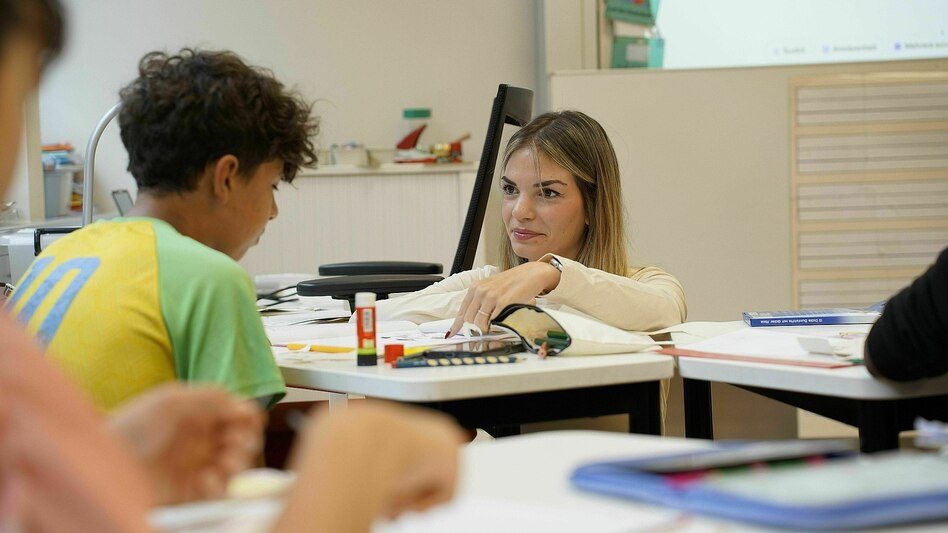
After two hours of German, an hour of math is on the agenda. For this learning unit, the children are mixed into new groups depending on their level of learning. Cornelia Blankenhorn's Stern group is the most advanced. The math teacher is also the educational leader of the learning workshop. “Let’s see how much is left after the holidays,” she says to the three girls and six boys.
She distributes several stacks of exercise sheets around the room. Because Blankenhorn wants the children to move around a little and not just have everything laid out on the table for them. "You now have 30 minutes to solve five task sheets. Then you put them in your blue folder," she orders in a clear and very specific tone.
Advanced here means solving tasks in the range up to the numbers 50. With the exception of one boy, all of them are in school for the first time. After 15 minutes one of the boys asks if he can go home. “Why?” asks the teacher. No answer, just a grin. The student hangs listlessly at his table.
Victor, on the front left, on the other hand, sits intently on his tasks. Blankenhorn knows that math suits him because he has already learned the multiplication tables. A girl gets up to get the next assignment sheet. “Are you finished with the other one and filed it away?” asks the conscientious teacher. No, she didn't and so the student goes back to her table to put the paper neatly in her folder. The scene repeats with other children. "They need structure. If they have chaos on the table, they have chaos in their heads," says the educator.
Blankenhorn knows this from her previous jobs. After her traineeship, the elementary and secondary school teacher was offered a ninth grade class. “I didn’t trust myself to do that when I started,” she says. So she started with a VKL, taught at a primary school and finally in a so-called alpha class for children who can neither write nor read. "The difference is worlds. The speed, discipline, the length of concentration or how to write in a notebook. Learning all of this takes a lot of time," she explains.
The persuasion and relationship work with parents and children was time-consuming, especially at the beginning. Roma parents in particular lacked fundamental trust in institutions such as schools. Many have experienced discrimination, whether by the authorities or in society, and are therefore sometimes afraid that the youth welfare office could take their children away from them, reports the head of the learning workshop.
Often the parents themselves have not been to school and are not literate, and it is necessary to explain to them the advantages of attending school. With discussions, interpreters and patience, it finally worked. “The trust has grown,” remembers the lead teacher. "Most of the children are always there. That wasn't the case in the beginning. Now they like coming to school and see the positive added value that they can read, for example."
In order to compensate for all deficits, the concept goes beyond the Ministry of Culture's requirements for preparatory classes. These include twelve hours of German, four hours of democracy education and nine hours of free choice. This is also how it is implemented here. Elective areas include, for example, art and sports, but also mathematics. The Ministry of Culture does not specify the latter as an integration course.
In math, the children should actually be integrated directly into the regular classes. But, says the educational director: “They need math from us in order to have a chance at regular school.” Because of course the transition to the regular school system is a central goal of the project.
To ensure that this is successful and everything is sustained, we rely on all-day operation until 4 p.m. In addition to the four classrooms, there are four classrooms on the two floors, a computer room, a library, an exercise room as well as a kitchen and a large lounge area on the ground floor. You also learn math and vocabulary when you prepare breakfast together in the morning and roll a large dice during sports to see who should do ten squats. There is a cooperation with the Community Experience Sport project for this purpose. According to Blankenhorn, “real exercise” is done on two afternoons. This promotes learning success and concentration.
If there is an argument or if a child is particularly tired because they could not sleep in the accommodation, a social worker takes them to a so-called differentiation room. In such rooms you can wind down, relax or work on a task undisturbed.
There is no need for that on this Friday morning. After the math lesson, a group lets off steam in the exercise room. The children drew a line with a rope. They now throw themselves off with a soft ball. As is often the case, it's girls against boys. They throw themselves at the ball, laugh, and when one boy takes things a little too seriously, the social worker calls him aside. The motto is to stay fair and not throw too hard.
On Fridays, normal classes end at noon. Because from 2 p.m. the learning center takes place, a kind of afternoon meeting for the alumni. This is looked after by two social workers. The open offer is intended to enable a smooth transition for students who have mastered the transition to a regular school.
Of the 51 students who went on summer vacation this year, 8 made it into the preparatory classes at the community school. A few of the older boys have been attending a pre-qualification year at a vocational school for a week, where the focus is on acquiring German skills. 12-year-old Ibrahim, who was the only one to make it into the regular fifth grade of the comprehensive school, is not here today.
Lunch is prepared together with the two social workers: today there are hot dogs. This resonates with young people. After dinner, Mascha Kavunska from Mobile Youth Work sits with Sedrina and Sabrina. The two Roma girls were actually proud to finally be able to attend the VKL at the community school, but now they would rather come back to the learning workshop.
And it's not just because of the probably botched German test, as both believe. They had to write this in the first week. Sabrina says she's being looked at askance at her new school, and she demonstrates the degrading look she's already noticed at her school. The girls stand out with their traditional long skirts.
But there is another pressing problem for the two of them. You urgently need exercise books. Masha Kavunska offers to get it with them now. But Sabrina admits that she left her ticket with her aunt in Göppingen, 50 kilometers away. The social worker is a bit annoyed because in such cases she always feels obliged to pay for the children's S-Bahn journey.
“It’s expensive in the long run,” she emphasizes, while the girls laugh sheepishly. Could her aunt send it to her by post? But she couldn't write. “Can’t someone help her with this?” asks the social worker. And so there is perplexity at the table today.
Nevertheless, the model project has been able to try out integration options for 11 to 14 year olds over the past two years. The younger the children are, the greater the chance of obtaining a school leaving certificate, sums up the educational director of the learning workshop. Sport and exercise also work well to introduce children to everyday school life and learning. But you can't catch up on primary school in just one or two years.
What makes matters worse is that the German school system is considered one of the most unjust in the Western world when it comes to equal opportunities. A study by the Leibniz Institute for Educational Trajectories showed in 2026 that social background in particular shapes performance and educational paths. And children with a migrant background often have lower social starting conditions than other children due to flight.
Cornelia Blankenhorn remains optimistic: “My hope is that we can still change things in the system.” The educator wants these children to continue to have a chance to see possibilities for themselves in the future. And so the experiences from the learning workshop should also be incorporated into the schools' preliminary classes after the end of the project period. Because: “The more difficult the initial conditions are, the more you can achieve.”