
Germany · taz · · 2h
Fewer and fewer orchards: paradise takes work
Deutsch (original) · Auto-translated to English
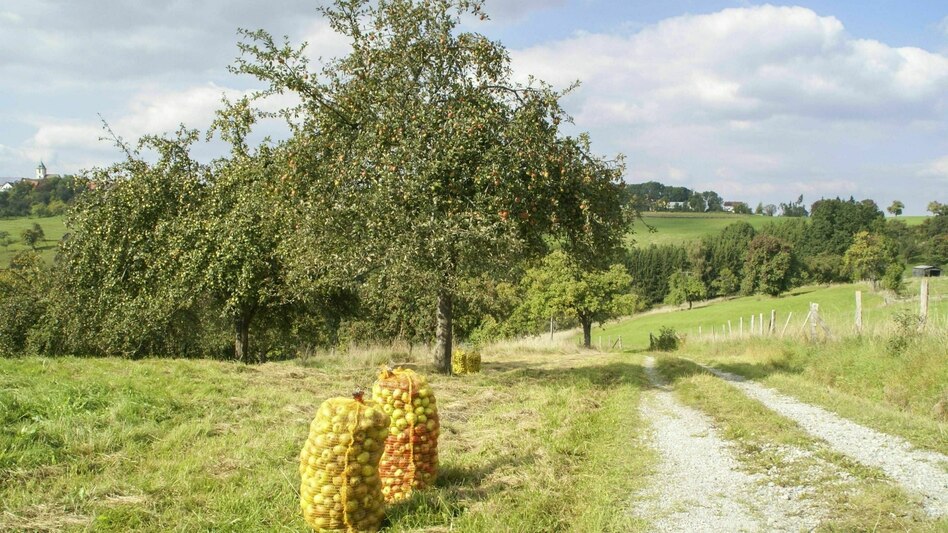
The bike ride to the Aasrücken on the Hohenstaufen mountain in the Göppingen district is sweaty, and not just in August. A winding road winds its way up to the 687 meter high Kaiserberg. Squads of motorcyclists cut the curves, older men in convertibles accelerate there. Here in the south of Germany, in Baden-Württemberg, people love cars.
Orchards, forest, hedges, poor grassland, rocks and agricultural areas are located close together. They shape this small-scale cultural landscape beneath the ruins of the Hohenstaufen ancestral castle. The orchards, a valuable biotope and cultural asset, are part of the traditional landscape here. They are an extensively cultivated cultural landscape with tall fruit trees; the meadows are mown and – rarely – grazed. It is a varied habitat with little owls, green woodpeckers, bats, wild bees and numerous insects in small caves in the old trees.
Baden-Württemberg's orchard landscape like here at Hohenstaufen is considered one of the most important contiguous orchard landscapes in Europe. Since 2021, orchards have been part of the intangible cultural heritage in Germany. Not every single meadow is therefore automatically protected as a UNESCO monument. The heritage lies in the traditional knowledge, the traditional care and management techniques, and the knowledge of the varieties.
Martin Rieger and Martin Weiler lead on the fruit nature trail on the Aasrücken. The nature trail was created to mark the 100th anniversary of the Hohenstaufen fruit and horticultural association. There are more than 60 signposted old apple and pear varieties over approximately one kilometer. Martin Rieger, who makes the must himself, offers a Jacob Fischer apple straight from the tree. It tastes sweet but floury. "The trees are productive this year, but the apples are small and not very juicy. That's bad for the producers of apple juice and cider products," says Rieger. The drought, the climate stress, is taking such a toll on the trees this year, and many trees are suffering from “sunburn”. He points to the discolored, cracked areas on the bark of a tree.
The association's statutes include, among other things, nature conservation and environmental protection, landscape and local preservation. And he imparts knowledge about fruit growing, offers tree pruning courses and lectures. “We contribute to ensuring that this landscape is managed and preserved,” says Martin Weiler.
And that is exactly what is crucial with orchards: they are a cultural landscape that was only created through regular human care and, without this care, loses its character in the long term. This is already the case in many places. “The orchards are deteriorating because their owners shy away from the effort,” complains Weiler. The orchard, the small paradise garden with apples, pears, quinces, cherries, plums and hazelnuts, is labor-intensive. “That doesn’t work if you go on vacation three times a year,” says Rieger.
Many orchards have already been cleared or fallen into disrepair. Also as a result of the mechanization and intensification of agriculture, through competition from low-stem plantation fruit growing, through the development of the landscape and through changing work and leisure behavior of people who prefer to look for paradise far away in summer. According to state estimates, there are currently 7 million trees in Baden-Württemberg, compared to around 11.4 million in 1990. The inventory has therefore fallen by around 40 percent.
But there is also a countermovement. Lisa Ziehe, managing director of the Swabian Orchard Paradise Association, is waiting on a bench on the edge of the municipal orchard in the town of Schorndorf im Remstal, not far from Hohenstaufen. Like many people in the region, the graduate geographer who grew up here has happy childhood memories of orchards, apple juice, cider and the life around it.
"There are a lot of initiatives, private individuals, but also municipalities and districts that do something for the orchard. And with us, many threads come together. We are the ones who spin the web in between." The regional association includes six districts: Göppingen, Esslingen, Tübingen, Reutlingen, Zollernalb and Böblingen. The association is financed through member contributions, public funding and foundations.
In Baden-Württemberg there has been special legal protection for orchards with a minimum area of 1,500 square meters since 2020. A conversion to another type of use is then generally subject to approval.
An important principle of the country is: “Protect through benefit”. In 2024, the state government decided on the 2030 orchard concept. It covers seven areas - including securing the existence of existing meadows, investing in research and also the marketing of orchards.
The club also works in this spirit. "An important focus that we have had for a long time is the educational topic, for example, orchard educators in schools. This is how children get to know their homeland. And we offer a relatively large number of courses with orchard-related topics, such as variety knowledge and production, as well as rope safety courses for fruit tree pruning," says Lisa Ziehe.
The club's trading platform is now a mainstay. This platform, similar to a cooperative, collects fruit from private individuals and sells it on: to markets such as Rewe or Edeka and other retailers, to bakeries and canteens. “The fresh Eastern baskets from the region are very well received in canteens,” says Ziehe. And the small-scale fruit farmers earn money from it: members get 25 euros per 20-kilogram box in the 2026 season, non-members get 20 euros. Whether it is economically worthwhile depends on the quantity, says Lisa Ziehe.
Another big issue is the offspring, or rather: their absence. "Society has changed a lot over the last few decades. We go on vacation during the summer holidays when the harvest is in full swing. And we all simply don't have the time. And we no longer live in large families. Managing a meadow orchard alone is a lot of work," says Ziehe.
Currently, many orchards are owned by older people, but the work is too much for them. Their heirs have moved away, they often don't know anything about the meadow, and in any case they usually have no connection to it. The Swabian orchard paradise is working to ensure that municipalities set up programs in which uncultivated meadows are offered for purchase, lease or simply for care, use and harvesting. Many municipalities, as well as private owners, usually lease out orchards in return for someone taking care of the trees.
A few places further, in the Remstal in Straßdorf near Schwäbisch Gmünd, Alexander Seiz managed to change generations after initial difficulties. His cider factory produces quince and apple sherry - slowly fermented with sherry yeast according to the Spanish model. An alcohol-free fruit secco called “Rosalinde” and elderberry must secco are also produced here.
“After my father died, I initially didn’t want to have anything to do with cider making,” he says in his small shop next to the production facility. "But then I felt sorry for it and set up a cider factory again. Today I would say that's my main hobby," says the full-time tourism consultant. “They are the smells and scents of my childhood.”
Even though cider has long since been replaced by beer as a drink at the regulars' table, Seiz sees growing potential for his refined products, which no longer have anything to do with a “reschen Moscht”, i.e. sour cider. Seiz supplies 14 restaurants in the region. "Our products are well received by customers. Regional products are very trendy," he reports happily.
“The orchard is a natural treasure,” enthuses August Kottman at the regular table in his “Hirsch” inn restaurant. "It used to serve as a pasture and orchard, with vegetables being planted under the trees in a two-story farm. Today, this valuable biotope can only be protected and preserved if we reach people through enjoyment."
He points to the shelves with bottles of home-made distilled spirits from his fine distillery: apple brandy, cherry liqueur, quince and apricot schnapps are on a serving table next to the counter. "The distillery is such a great, almost mystical institution where you can capture nature in its natural form, preserve it and keep it for a long time. As a clean, clear natural product," he describes the distilled fruit spirit.
August Kottmann is a farmer, cook, hotelier and co-founder of the Swabian ObstArche Fils-Alb interest group: an activist and orchard expert. The agile, almost 80-year-old is actively involved, for example in planting the compensation area along the newly created route of the Albautobahn A 8.
Here, employees of Autobahn GmbH met dedicated fruit variety rescuers from ObstArche Fils-Alb. Around 4.4 hectares of new orchards are now being planted on behalf of Autobahn AG as a compensation area with 1,000 fruit trees, including 750 historical varieties. 400 trees have already been planted, with 600 more to follow, says Kottmann. “This strengthens a unique ecological and cultural system that has shaped our region for centuries.”
An educational fruit trail leads along the Fils between Bad Ditzenbach and Gosbach. There you can get to know around 80 types of apples and 30 types of pears as well as various regional types of fruit. “There are many initiatives that are committed to preserving orchards,” says Kottmann. “We have a great network.” The activist emphasizes that he wants to preserve the cultural landscape, shape it with others and give them a future. “If I succeed in doing that, I will have lived a life that I can be satisfied with,” says Kottmann.
Read the full story at the source
Source: taz