
Germany taz
High Fens after the fire: The long regeneration
In the summer, a devastating fire raged for weeks in Europe's largest raised moor. Experts are now pushing for new ways to deal with natural fires. more...
Deutsch (original) ·Auto-translated to English
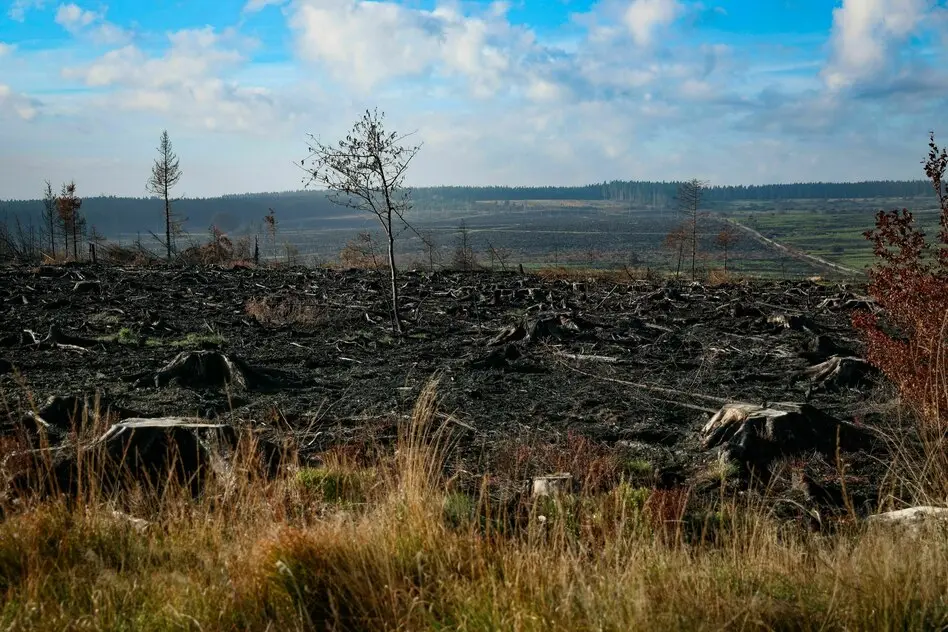
There was good news in the High Fens just in time for the autumn holidays. At the end of October, some peripheral areas of the area, which had been cordoned off since the huge fire in late summer, were reopened to visitors. Since then, hiking has been possible again around Signal de Botrange, the highest point in Belgium. However, most of it remains closed because the nature is still too badly damaged. The well-known wooden footbridges that lead through the raised moor have been largely destroyed.
Three months have passed since a huge area of the natural area on the Belgian-German border burned down. “2,629 hectares have burned,” reports Yves Pieper, head of the forestry department in Verviers. The official figures come from the European Forest Fire Information System (EFFIS). "We are still in the process of clearing the firewood. The damage is enormous, many protected habitats fell victim to the fire. Not just superficially, the soil also suffered extremely. It was a very long, slow fire that had time to take hold and was able to destroy the seeds."
The government of the Belgian region of Wallonia, to which the affected area belongs, is presenting a 20 million euro package to restore the High Fens. In addition to nature regeneration, it focuses on fire prevention, mapping habitats, species, soil and water before and after fire, and the area's infrastructure. Regeneration will not be possible “in a few months,” Anne-Catherine Dalcq, the Walloon nature minister, told public broadcaster VRT.
The broad approach is also evident on site: working groups with actors from different areas have been formed around the Verviers Forestry Office, which also functions as a nature conservation authority. There is plenty to do: "Regenerate habitats, improve the path infrastructure so that tankers can arrive in the event of a fire, create buffer zones for rescue workers and fire breaks or widen existing ones, regulate water drainage. In places where the vegetation has completely burned down, rain can no longer be absorbed and flows unchecked towards the valley," explains Pieper.
Reforestation is about planting trees that are less vulnerable to climate change, such as linden trees, chestnuts or maples. In addition, mixed forest is used, which increases resistance. The head of the forestry department calls this approach “mosaics,” which has been pursued for a good 30 years. "After the severe storms of the 80s and 90s, we began to convert the forest. Before that, large areas of one tree species were often lined up next to each other," says Pieper. Last but not least, he is hoping for financial support for this course from the political side.
Jan Baetens can attest to how complicated this often turns out to be in practice. The professor at the Faculty of Bioengineering at Ghent University is a forest fire expert and part of the Belgian Wildfire Network, founded in 2025. The 75 members of the network come from the universities in Ghent and Liège as well as state authorities. However, there is a problem: “Belgium is administratively fragmented and the responsibilities are therefore spread over numerous levels,” says Baetens. This is a major challenge for fighting and preventing fires. “For example, we don’t have a uniform index card for natural fire risks.”
In March the Belgian Wildfire Network published a white paper. This cites fragmentation as a risk factor that makes the country vulnerable to the increasing risk of natural fires. Others include a lack of public awareness, limited expertise and the proximity of natural to populated areas. There is therefore a case for an integral “fire management”, starting with data collection on fires, a monitoring system of the effects, models of fire spread through to public education and fire education.
While the network emerged before the fire and warned of the increasing danger, the University of Liège's multidisciplinary task force is a direct result. The Walloon metropolis is around 50 kilometers from the High Fens. Around two weeks after the fire broke out, the 50 scientists involved went public for the first time. Their goal: to examine the damage and develop long-term protective measures for the region.
It is coordinated by the economist Sybille Mertens, who complained to the regional newspaper L'Avenir when it was founded that, despite warnings, "an area that is very close to our hearts has gone up in flames." They now meet weekly to develop approaches through independent scientific exchange and to keep the topic on the political agenda. “Of course there are other important questions that make people forget about the High Fens – until the next fire,” says the researcher. “So it’s our job as scientists to think about it and promote public debate.”