
Germany · taz · · 2h
Historian on traveling by train: “It’s best to talk about what bothers you”
Deutsch (original) · Auto-translated to English
taz: Mr. Weber, do you take the train a lot?
Niklas Weber: Not that much right now. But I wrote large parts of the work in Eutin. I had a scholarship there and I spent a lot of time commuting back and forth between Berlin and Eutin on the regional train.
taz: These days people really like to complain about their experiences on the train. In your doctoral thesis you are also concerned with annoyances and unreasonable demands that can arise when traveling by train.
Weber: There are many connections. When Twitter was a normal medium, people were constantly sharing their train experiences. This is essentially a discursive tradition of the 19th century. Back then, the train brought all parts of society together in one place, and accordingly you can tell something about society in general by describing train experiences. And of course you prefer to talk about what bothers you about it.
scientific trainee at the Leibniz Center for Contemporary Historical Research Potsdam, received his doctorate at the Humboldt University Berlin in 2024. His dissertation was published by Campus under the title "Passengers. Class, Gender and 'Race' on the Railway Journey of the 19th Century" (378 pages, 45 euros; e-book 44.99 euros)
taz: Now you could assume: What happens on the train will, in principle, be what happens on this side of the train station, in other public spaces, including in private. Isn't that true at all?
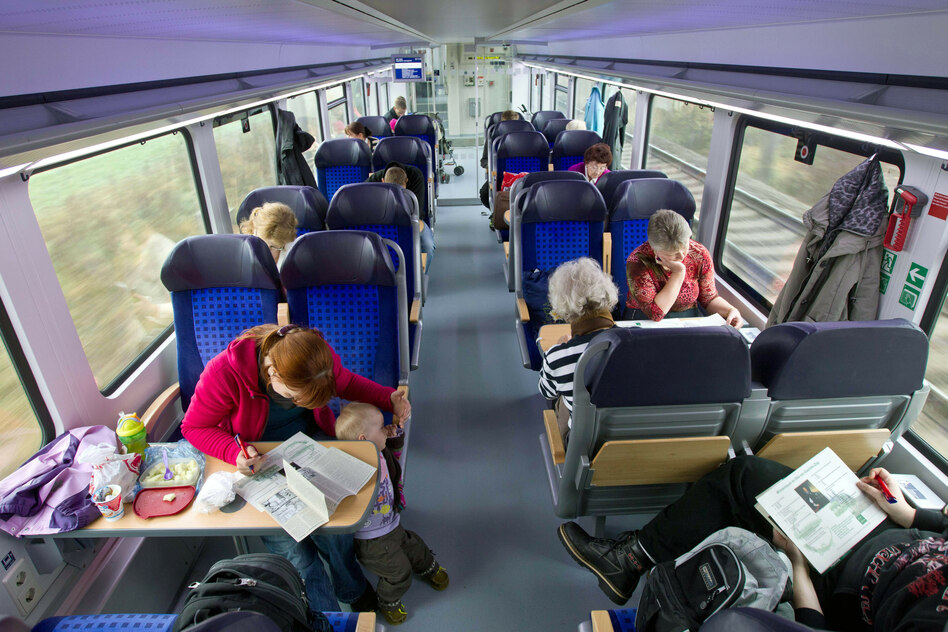
Weber: It's a very specific situation. The train is a place where you can meet strangers for a longer period of time. In the 19th century, the compartment was the standard form, but we don't have that anymore today, we actually all travel in open-plan cars. The vis-à-vis, on the other hand, invites conversation. The railway area is strictly sorted by class, and you can't actually just change class - that would be too expensive. But it is at least conceivable. The train is one of very few places where it is conceivable to meet across classes. At the same time, it is also a place where men and women can meet alone. Accordingly, there are also a large number of romantic, erotic, pornographic stories and images relating to the encounter between men and women in the railway compartment.
taz: People didn't just tell stories of catastrophe or impertinence?
Weber: I think the most popular outrageous story of the 19th century is that of the railway murder. There are a lot of examples. Ultimately, this is also a fantasy that is about the meeting of classes: train murders, the real ones, but also the fictional ones, are usually committed by people who actually belong in the fourth class, but sneak into the first... On the other hand, you can imagine the advantages of the railway from a first-class perspective in that you can then also descend into the fourth class in order to "get fresh contact with the people", as they said back then. In the sense of a hobby ethnological study - but also in the sense of erotic adventure.
with Niklas Weber: Mon, October 5th, 6:30 p.m., Hamburg, University and State Library/Ossietzky Forum. Information and registration: https://roter-salon-hamburg.de/
taz: Did the railway really level out differences - or really reveal them?
Weber: That's hard to say. Fundamentally, the railway was a fascinating social experiment that brought all parts of society together in one place. Transport in the 19th century, i.e. from the introduction of the railway, was basically more egalitarian than today. This goes hand in hand with the fact that the railway is imagined as a democratic machine from the start. One that makes the differences disappear. But there is also this class system that became more and more differentiated over the course of the 19th century. In 1914 there were four classes of cars throughout Germany. Added to this is the racist segregation in the colonies, which is incredibly rigid and is intended to create differences that do not even exist.
taz: So should the railway ultimately just be a kind of mirror – of everything else?
Weber: There has always been the idea that the railway not only reproduces social structures, but also produces them. Tony Judt, one of the best-known British historians, saw a connection between the invention of social classes and car classes. The car class sorts people according to money, which already corresponds to the concept of social class. It's no longer about privilege, about birth, but about how much you have. It is also interesting that the term “class” was a fairly neutral classification term until the 1840s. The charging comes primarily with Marx, but in terms of timing there is a coincidence with the introduction of the car classes.
taz: Of course, we still know such phenomena today: that a technical innovation brings with it new terms that then appear to us to be so powerful in explanation, as illuminating the present so much, that they migrate into other areas: the bubble, the interface...
Weber: You shouldn't overuse the connection. But you can, for example, talk about how the idea of living in a class society relies on narratives to be plausible. And the railway produced so many stories about “class” back then that it became a kind of evidence. Even if a car class and a social class are of course not the same thing.
Weber: ... would simply be misguided. But that doesn't mean that it hasn't been done again and again, including in political agitation, especially by the SPD: protesting against the misery of the fourth class, the so-called "cattle class", was an easily understandable way of talking about class society and agitating against it.
Read the full story at the source
Source: taz