
Germany · taz · · 3h
Helsinki's traffic transition: The cycle path of least resistance
Deutsch (original) · Auto-translated to English
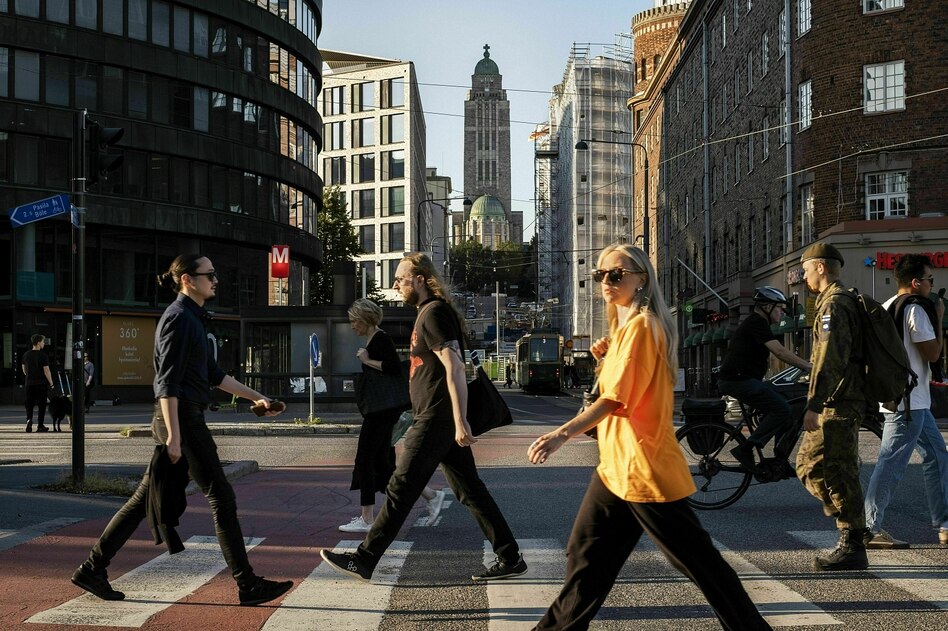
Children kick balls across the street in Kallio, an alternative district of Helsinki. Where cars would otherwise be parked, people are now sitting between flower pots and drinking drinks they brought with them, and table tennis is being played on part of the road. This is called summer street in Finland.
From May to September, the Helsinki city government closes certain sections of the street to cars and makes others one-way. This creates space for temporary benches, swings and a small stage. When it gets dark and cold again in autumn, the cars get their space back.
This compromise - car-free streets, but only in summer - pretty much sums up Helsinki's approach to the transport transition. The city is considered a role model for sustainable mobility and has spent billions on new cycle paths, buses and trains in recent years. In contrast to other model cities for the transport transition, such as Paris or Utrecht, politicians in Helsinki are refraining from making any tough cuts.
Instead of pushing back the car, the city is trying to find consensus solutions. Transport transition without a culture war, without conflicts. Can this work?
Reetta Putkonen is one of those who has to manage this balancing act. As head of Helsinki's road and traffic planning, she puts the transport transition into practice. From the planning of entire streets to the details of sidewalks and zebra crossings, everything comes together in her department. “Space in the city is the scarcest resource we have,” says the transport planner.
You are reading a text from our future department. If you're interested in more positive perspectives, subscribe to TEAM FUTURE, the constructive newsletter on climate, knowledge, utopias. Every Thursday you will receive an email from us with strong thoughts for you and the planet.
🐾 Sign up now for the TEAM FUTURE newsletter – free of charge
In her work, she therefore has to weigh up and prioritize between lanes and cycle paths, parking spaces and city trees. This is always associated with compromises, because mobility in Helsinki has to work for everyone: “Not just for the fit forty-year-old who rides his bike in any weather, but for the working mother who has to take her children to kindergarten and then quickly get to a meeting.”
The guiding principle for Reetta Putkonen's work is the Helsinki city strategy. After every local election, this strategy paper is negotiated and approved jointly by all members of the city council. There are also long-term plans for the development of the city and the region around Helsinki, which set the course for decades. For example, it was agreed to further improve public transport, build thousands of new apartments around important transport hubs and at the same time preserve biodiversity and urban nature.
It is a policy that is less focused on party profiling from election campaign to election campaign, but rather on broad consensus and long-term perspective. This should enable a reliable timetable for large social projects – such as the transport transition. But Reetta Putkonen still sees a division in city politics on this issue.
Half of the MPs want a quick transport turnaround with priority for pedestrians and environmentally friendly transport, the other half are in favor of a conservative mobility policy that wants to change as little as possible to the status quo. The current Helsinki strategy can be seen as a compromise between the two camps. A lot of money for cycle paths and public transport, but at the same time little cuts in cars.
The consensus in city politics includes ambitious climate goals that Helsinki has been working on for years. The city is renovating buildings, electrifying heating and shutting down fossil power plants. As a result, it has already significantly reduced its emissions.
Things are not going so well with traffic because, similar to Germany, emissions in this area are only falling very slowly. The Finnish capital has invested billions in sustainable mobility. In recent years, Helsinki has built a network of cycle highways, opened a new light rail system and extended the metro to the neighboring city of Espoo. But despite all the efforts, people in Helsinki are only hesitantly switching to buses, trains and bicycles.
“Helsinki’s transport policy wants to please everyone,” says mobility expert Carlos Lamuela Orta, who researched the transport transition at the university there. There are no driving bans or a city center toll. Instead, the city is building ever larger infrastructure projects – bicycle highways, tunnels and bridges.
While Carlos Lamuela Orta explains this, he stands in front of the latest of these projects: The Kruunuvuorensilta, the highest and longest bridge in Finland, spans the Baltic Sea at 1,200 meters. Since spring 2026, this bridge has directly connected the inner districts of Helsinki with the island of Laajasalo in the east of the city. The island, where oil tankers were once unloaded, now offers living space for many thousands of people.
The residents of Laajasalo can now get to the city center much more quickly via the new bridge than before. Provided that you are traveling by bike or tram. Despite its gigantic size, the new bridge has no lanes for cars. This makes it a symbol of the post-fossil metropolis that Helsinki wants to be.
However, this does not seem to have reached the people of Helsinki yet. Although the city had planned to double the proportion of bicycle traffic, this has stagnated for several years. Despite all the investments, only a tenth of all journeys are made by bicycle - significantly less than in Berlin or Hamburg, for example.
The example of Paris shows that a rapid turnaround in transport is certainly possible. There, the left-wing mayor Anne Hidalgo was able to multiply the proportion of bicycles in city traffic during her two terms in office. Car traffic fell significantly - also due to radical measures such as traffic bans and the removal of lanes.
The importance of cars is also decreasing in Helsinki, but only slowly. The Finnish capital would also have good conditions for a rapid turnaround in transport. According to Reetta Putkonen, Helsinki is a 15-minute city in which most journeys can be easily made on foot or by bike: “In Helsinki you can use a car - but in everyday life, for shopping or going to kindergarten, you don't need it.”
However, that doesn't mean that Helsinki residents have to give up their cars. In contrast to Paris, motorized traffic in Helsinki still flows largely unchecked, even through the middle of the city center. Despite all the big words about the transport revolution, the dominance of the car is hardly being affected, says Carlos Lamuela Orta. Even those in politics and administration who want a quicker turnaround shy away from radical steps.
Is the omnipresent consensus taking away the momentum from bold visions? Various innovative mobility projects that also received international attention have not been pursued further in recent years. The conversion of city highways into traffic-calmed boulevards was still part of official city planning in 2016 - today, in 2026, it seems unthinkable.
Finland is a car country. Many Finns rely on their cars because outside of big cities the distances are long and rail connections are rare. And many people in the Finnish capital also own a car, because without their own vehicle they can neither reach their summer cottage by the lake nor their friends and relatives in the country.
Compared to Germany, the car seems less suitable for the culture war. As a matter of course, speed limits of 100 to 120 km/h apply on Finnish motorways, often less in winter. On around 60 percent of the streets in Helsinki the maximum speed limit is 30, and on most other streets the speed limit is 40. Not everyone likes that, but the public debate about speed limits is limited.
Even if the compromise policy does not yet lead to a reduction in emissions for mobility, it has achieved another goal: traffic in Helsinki is already safer than in almost any other major European city. The number of serious traffic accidents has fallen sharply.
Transport planner Reetta Putkonen believes that the path to climate-friendly transport is only a matter of time. According to the Copenhagenize Index, Helsinki is already one of the most bike-friendly cities in the world. It took many years to get political support for the necessary investments and many more years to build cycle highways, bridges and tunnels, says Putkonen.
Now you just need a little patience until the mobility culture changes. Thinking in long lines is ultimately the principle of politics here.
Read the full story at the source
Source: taz