
Germany · taz · · 2h
“Homeless” in the Jewish Museum Vienna: The Austrians who were no longer allowed to be Austrians
Deutsch (original) · Auto-translated to English
At the beginning there is a graphic representation in an oversized size, it hangs in a small room. You can see labeled boxes and lines that point forward but also show side paths. The many round and square boxes have abbreviations on them. Some are colored blue, others pink. The giant graphic illustrates the bureaucratic process of expelling more than one hundred thousand people from their homeland.
The long line with a few curves does not mark the path of the Viennese Jews to their country of exile. Rather, he describes the necessary steps that the persecuted had to take before they could begin a journey to a safe foreign country - an endless chain of bureaucratic humiliation, combined with the complete plundering of those affected of their property. At the very end there are boxes labeled “Police De-registration”, “Customs Clearance” and finally “Passport and Baggage Check”. Not all people have come this far. More than 60,000 Viennese Jews were murdered.
At the opening of the “Homeless” exhibition, the director of the Jewish Museum Vienna, Barbara Staudinger, recalled the many well-intentioned references to the successes of the former Austrian Jews in exile, and to all the outstanding achievements that no longer benefited the old homeland. In truth, however, the exile was anything but a career opportunity, she said. Exile meant, first and foremost, loss – of language, orientation, home. Curator Caitlin Gura said she was dedicating the exhibition to “the Austrians who were no longer allowed to be Austrians.”
"Homeless. Viennese Jews in exile". Jewish Museum Vienna, until April 4, 2027. Catalog (Czernin Verlag): 32.90 euros.
The huge graphic mentioned at the beginning was created in 1941 on behalf of the “Central Office for Jewish Emigration”. This was an institution of the SD secret service within the SS and the invention of Adolf Eichmann. He worked in Vienna after the annexation of Austria in March 1938. The ambitious Eichmann noticed that by collecting all the permits from many different offices, too much time was lost to allow all the Jews to emigrate, as the Nazis initially demanded. With the “central office,” the SS man created an authority that bundled and thereby accelerated this process.
At the same time, he unleashed a wave of terror on the Viennese Jews. The Nazis dissolved the religious community and then forced the leaders, who had previously been imprisoned in the concentration camp, to support the emigration of their members. Jews were arbitrarily arrested and locked up in concentration camps, Jewish property was expropriated in a very short time, companies were “Aryanized,” and people were robbed of their existence.
On the walls of the room with the giant graphic hang the paper evidence of such terror: a court termination of the city-owned apartment on August 1, 1938, the “ban on representation” that prohibited the lawyer Julie Riesenfeld from any further activity in her profession. Or a clumsy letter with which the “Aryans” offered their customers additional services: “We are honored to politely inform you that we have taken over the company Paffenstätter mech. Weberei Julius Lenk and will be pleased to continue to count you among our customers.”
Eichmann boasted of his success and his career accelerated. By mid-1939, more than half of all Viennese Jews, 110,000, had already left their homeland. His regime of terror was so successful that the system of “central offices for Jewish emigration” was transferred to Berlin, Prague and Amsterdam.
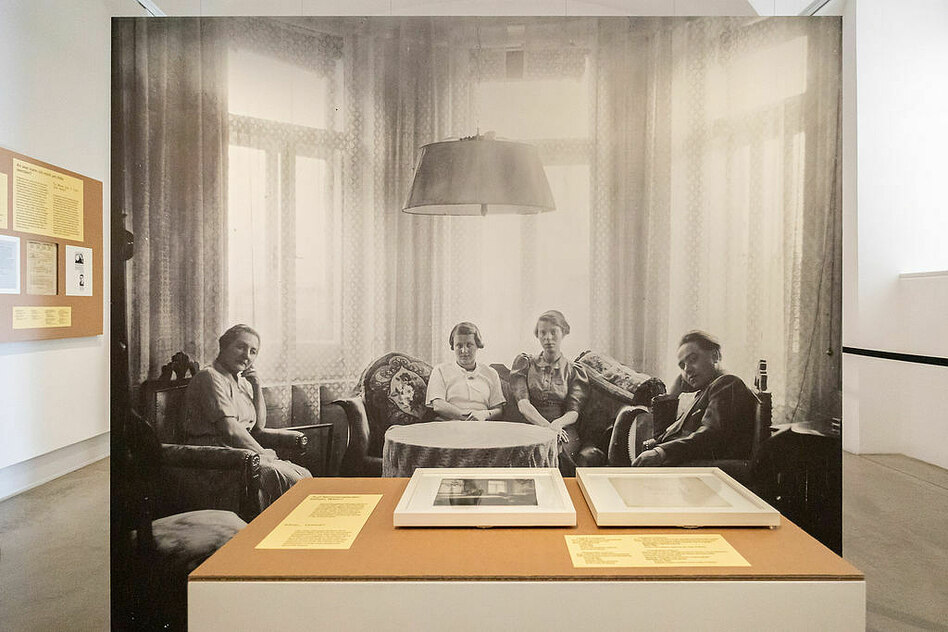
On the back of the giant graphic of the “central office” there is a large photo hanging in the room. It shows Gertrud (1906–1987) and Erich Zeisl (1905–1959) as well as two acquaintances sitting around a round table, apparently in their living room. It is the last picture that shows the Viennese Zeisl couple before their departure for the USA. All four people look skeptically into the camera.
Now it was not as if the persecuted Jews had been warmly welcomed abroad, on the contrary. Most countries closed their borders to unwanted refugees. Those who were very lucky managed to emigrate to America. Many of the ships set off in this direction from politically neutral Lisbon, the waiting room of Europe. The Klagsbrunn family from Vienna-Floridsdorf was stuck there for seven months. The son Kurt (1918–2005) captured the time in his photos. We see people waving on the quay of a ship leaving the ship, the family baking, an empty street and finally four people on board a ship heading to Brazil. They had escaped the Nazis two years before the Nazi regime banned emigration and decided to murder all Jews.
In the next exhibition room, older pieces of furniture are arranged together in the middle, with the memories of exiled Viennese on them. The furniture once belonged to the Glück family, who managed to emigrate to the USA. However, many people were not allowed to take their belongings abroad. Many began their new lives completely penniless. What remained were often photo albums from home, reflecting a happy life. Mimi Grossberg (1905–1997) in New York titled one of the pages on which she pasted the photos of her past: “O, you my Austria.” But most of the pictures have disappeared.
The lost homeland was not only remembered with old photos. Fanny Kallir (1899–1992) created a colorful picture book with scenes from Austria in New York. Arthur Hellmer (1880–1961) played German-language theater in London. Ilona Jellinek (1884–1971) wrote a cookbook with Sachertorte recipes in Los Angeles.
And then there are the memorabilia. The Nazis stole jewelry and books from the widow Elsa Klarwill (1877–1945) before she emigrated to Kenya, but she was allowed to take other things with her, including a pair of her late husband's lederhosen and her dirndl. After her death, her son Victor (1902–1985) took the clothes with him, first to South Africa, then to England, and finally, after Victor's death, they came to Canada with his daughter. Now the dirndl and lederhosen have returned to Vienna, only temporarily, of course, and as a sign of an exile that could not become Elsa Klarwill's home. She therefore represents many who no longer felt at home in a foreign country, but who nevertheless never set foot in Vienna again.
Or could no longer bet. Many of the exiles fell apart far from Vienna. A man, one of the most famous Viennese, left lines in his notebook that he wrote down in Great Britain in 1940: "I was born in 1881 in a large and powerful country that can no longer be found on any map today, in the thousand-year-old Austria [sic!]. I was educated and grew up in the imperial residence city of Vienna and had to leave it before it was demoted to a German provincial city."
The sentence can be found slightly revised on page 2 in the book “The World of Yesterday”, which was first published in October 1942 in exile in Sweden. It was written by Stefan Zweig, who committed suicide in Brazil on February 23, 1942.
Read the full story at the source
Source: taz