
Germany · taz · · 1d
Han Kang at the Thalia Theater in Hamburg: Metamorphoses and restless dreams
Deutsch (original) · Auto-translated to English
She hardly gets a word in edgewise. Neither in the novel nor on this evening at the theater at Hamburg's Thalia Theater on Gaußstrasse. It is the others who talk about her and about her: her husband, her brother-in-law and her sister. She, that is Yeong-hye, the “vegetarian”. In the novel of the same name by South Korean author Han Kang, who won the Nobel Prize in Literature in 2024, Yeong-hye decides one morning - after restless, bloody dreams - not to eat meat anymore. Those around you are shocked. But “the vegetarian” sticks with it: she wants – in protest against the violence and sexism in her life – to keep control of her own body and transform herself into a plant.
Metamorphoses and restless dreams always find their way onto the stage. Tell us about silent resistance that demands surreal visual and therefore theatrical worlds. That may also have been the motivation for director Lilja Rupprecht. In three parts, as in the original novel, it tells of the slow, willful disappearance of its protagonist. Tell this from those three perspectives.
At first, Yeong-hye is left with a blank space, an empty plastic chair behind a transparent film that covers the stage. Before that, actor Patrick Bimazubute appears as her husband. He raves about his “average woman” in an elongated, happy and sufficiently sexist manner: docile and easy-care, not a challenge. The topic of the evening is that this will soon change.
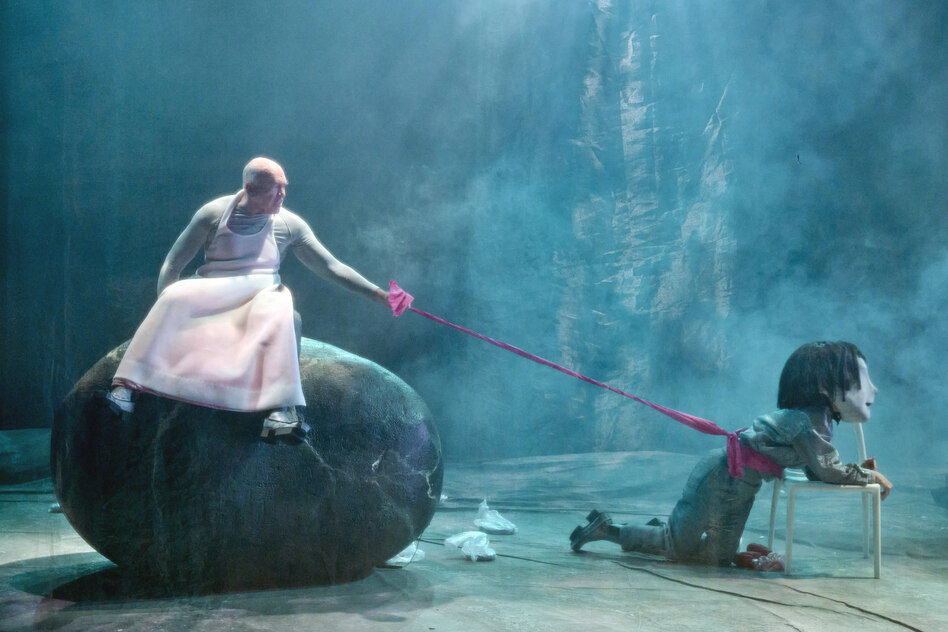
On stage, the actor Bernd Grawert has now put on an oversized mask: a pot cut with short black bangs and a hint of a rather doll-like, Asian-looking face (stage & costumes: Korbinian Schmidt). The four players (also: Caroline Junghanns and Jannik Hinsch) will take turns putting on this mask and performing the mostly silent Yeong-hye. She then moves like a dream walker behind the film, shielded in her own world. Every now and then the other players approach her and try violently to persuade her to eat. Sometimes mother, sometimes father, sometimes brother-in-law, sometimes sister. And soon too – in white coats! – Doctors.
Rupprecht repeatedly creates surreal scenes. A long red cloth then becomes a symbol of choking flesh. A rather pitiful chopstick choreography by Rônni Maciel represents the social pressure that a family celebration is supposed to convey, and even more pitiful doctor's coat choreographies represent the dominance in the psychiatric clinic to which Yeong-hye is ultimately admitted. Often the doll-like figure of Yeong-hye simply lies languidly for minutes over a huge gray stone that dominates the stage. That looks interesting, but it doesn't tell you anything.
Later in the evening the room opens up, but is then immediately taken over by a huge slide, which in turn is filled with seemingly endless projections (video: Rebecca Riedel). Flowers and naked, shadowy bodies then dance over the air-filled, rearing mountains of foil. In between, actors appear every now and then, trying to play art and seduction. After all, it is Yeong-hye's brother-in-law and artist (Jannik Hinsch) who, in this scene and with increasing excitement, wants to paint her emaciated body with flowers and conjure up a large film installation out of it.
The elaborate stage effect only lasts briefly. Soon the players seem to be literally drowning in it and their laborious handling of the seemingly endless slides soon obscures any remaining content. Where was the microphone again? And what's the idea of this scene again? Someone is still speaking a bit of text from somewhere. But the deeper the actors delve into this foil landscape and into the struggle with it, the more you exit as a viewer.
With three monologues, Caroline Junghanns takes on the perspective of sister In-hye towards the end, and with many, many, many means (sound, music and smoke that have not yet been mentioned) Rupprecht tries with all his might to create a very special world for “The Vegetarian”. She only very rarely succeeds. And it seems almost irrelevant to her at what price. But it is high. Falling by the wayside: empathy for the characters, the story and therefore their relevance.
Read the full story at the source
Source: taz