
Politics · taz · · 3h
Greens in Mecklenburg-Western Pomerania: Holding hands for re-entry
Deutsch (original) · Auto-translated to English
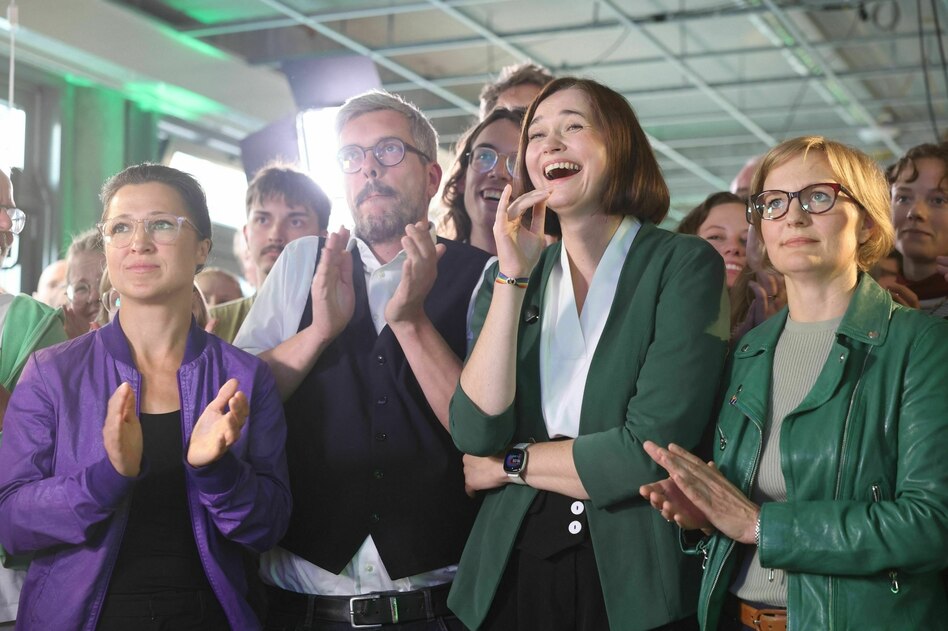
In the last seconds before the 6 p.m. forecast, Franziska Brantner and Claudia Müller stand side by side at the Green election party in Schwerin. The federal chairwoman and the top candidate hold hands. Mutual support with maximum tension: In the polls, your party was at 5 percent, it's about getting back into the state parliament - or leaving.
One minute after 6 p.m., Brantner and Müller are still holding hands. The forecast is 5.5 percent. Trend positive, but far too close to breathe a sigh of relief early in the evening.
It takes another two hours until the top candidate finally takes the stage. In a new Infratest projection, the Greens have just climbed by a tenth of a percentage point to 5.6. That's enough for her. “I don’t tend to declare victory prematurely,” says Müller. "And it's not a victory today. But I'm sure now: we're in the state parliament!"
Having to tremble on election days is not a new experience for the Greens in Mecklenburg-Western Pomerania: since 1990, the regional association had only made it into parliament twice before Sunday. The Greens traditionally lack the support in the east and, in Mecklenburg-Western Pomerania, the urban electorate that supports them elsewhere: Rostock is the only major city in the state.
This time, however, the Greens made a particularly big effort: after losing elections in Brandenburg and Thuringia in 2024, the federal party changed course and increased its presence in the eastern German states. The small regional association in Mecklenburg-Western Pomerania received additional funds and know-how, and members from other federal states traveled as campaign helpers. The good Green result in Saxony-Anhalt two weeks ago gave hope for additional tailwind.
"After the three state elections in Berlin, Mecklenburg-Western Pomerania and Saxony-Anhalt, many questions arise that go beyond state politics. Is something currently shifting in the German party landscape? We'll discuss this live and in the stream in the Bundestalk in the taz canteen in Berlin tomorrow evening. You can register here.
However, the general conditions were more difficult here in the north. In Saxony-Anhalt, the ruling CDU was unable to beat the AfD during the election campaign. It was unlikely that potential Green voters would switch to the Union in order to prevent the right-wing extremists from becoming the strongest force. In Mecklenburg-Western Pomerania, on the other hand, there is a popular Prime Minister in the person of Manuela Schwesig. In the polls she brought her SPD on a par with the AfD in the last few meters and on posters she advertised with the slogan: The woman against blue.
She paid little attention to the needs of the parties close to the 5 percent hurdle - in addition to the Greens and the CDU. Both took offense at Schwesig even before election night. In fact, in the end, the Greens lost primarily to the SPD; about the same number of voters from the CDU migrated to the AfD as to the SPD.
As in Saxony-Anhalt, the Greens countered this with a tactical argument during the election campaign: here, too, there would be a threat of a right-wing extremist government or at least an incredibly complex majority situation. The organization Campact started a support campaign for the Greens with the same reasoning. This in turn put the Left in a bad mood, which was stable at over 5 percent in surveys and now feared losses to the Greens - but according to an initial voter migration analysis, this did not happen.
The bottom line is that it was still enough for the Greens, also because of slight gains from former FDP voters and non-voters. “We have managed to retain votes in this polarization,” says Müller at the election party. “This is a success, but it also shows that we will have a responsibility.” It is important that the democratic forces do not engage in a “blame game”.
Forming a government could actually be difficult enough. When Müller is on stage, the exact majority in the state parliament is still unclear. But even in the clearest of all conceivable constellations – a secure red-red-green majority – the injuries of the election campaign would first have to be overcome. After all: Claudia Müller has experience with more difficult coalitions. At the federal level, she was State Secretary under Cem Özdemir in the Ministry of Agriculture. If the Greens co-govern Mecklenburg-Western Pomerania, they should sit in the cabinet.
And the federal party? If the result in Mecklenburg-Western Pomerania holds, she can look back on a decent election year. There is still room for improvement, not only in view of the mixed performance in Berlin, and the Greens have not yet found a effective remedy against the success of the AfD. Debates can therefore be expected in the next few weeks – about strategy, but also about personnel. The federal executive board will be re-elected in December. The two chairmen Banaszak and Brantner are not wobbling, but changes can be expected in the seats behind them.
Read the full story at the source
Source: taz