
Germany taz
New graphic novel releases: About painting geniuses, power-hungry wolves and finiteness
Luc Jacamon talks about the villain in the Kremlin, Catherine Meurisse with Dumas about Delacroix. And Melanie Carolin Wigger about friendship and dementia. more...
Deutsch (original) ·Auto-translated to English
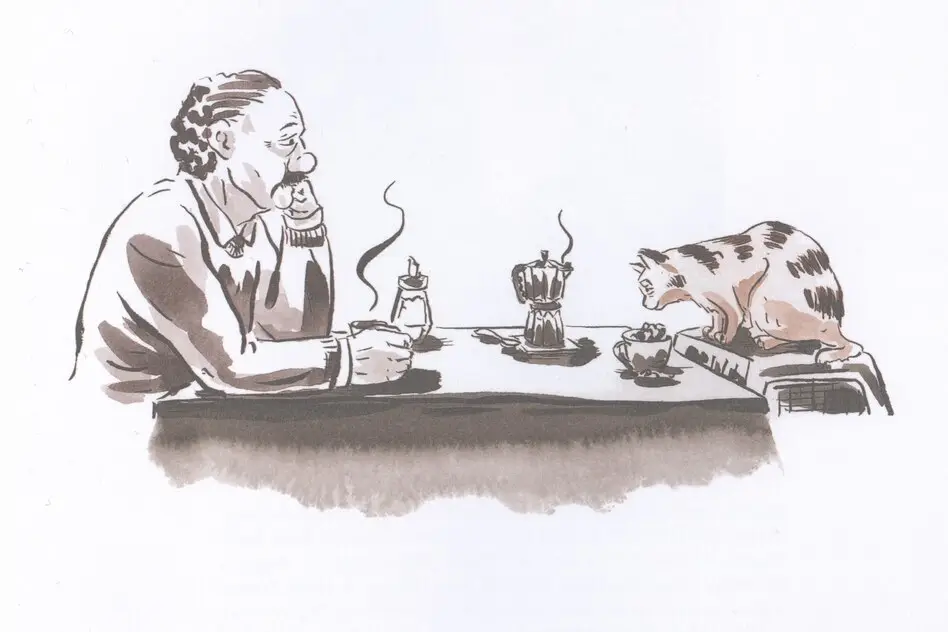
It started with Vincent no longer coming to the regulars' table at the Pinte. Robert and Vincent are of retirement age and have been friends since they were at school. So Robert gets into the habit of just picking up his friend at home. But soon Vincent can neither manage to dress appropriately for the weather nor remember how to ride a bike. Robert is confronted with the fact that his friend has to move into a dementia home.
The 34-year-old Swiss illustrator Melanie Carolin Wigger, who lives in Bern, works in a variety of ways - as an illustrator, animator and games designer. In her graphic novel debut “Vincent,” recently published by Berlin-based Avant-Verlag, she focuses on the topic of dementia. Inspired by her grandfather, who told her that a good friend had it, she became interested in it and worked for a few months in a facility for people with dementia.
Your book reflects this research. Wigger calmly talks about a strong friendship that has entered a difficult phase. Robert has to understand what is happening to his friend and reacts at first with surprise and then with increasing empathy to the changes in Vincent's nature. The illustrator also tries to capture his perspective when she draws full-page panels that lead into the whirlpool of his brain - memories, experiences and everyday life in the home are mixed up. Wigger finds appropriate images for the constant confusion in Vincent's mind.
Luc Jacamon: “The Magician in the Kremlin”. Translated from French by Resel Rebiersch. Writers and Readers, Hamburg 2026. 144 pages, hardcover, 29.80 euros
Melanie Carolin Wigger: “Vincent – A story about friendship and dementia”. Avant Verlag, Berlin 2026. 240 pages, hardcover, 26 euros
Catherine Meurisse: “Alexandre Dumas tells the story of Delacroix”. Translated from French by Lilian Pithan. Carlsen Verlag, Hamburg 2026. 140 pages, hardcover. The first edition includes a colored art print. 32 euros
The author concentrates entirely on her characters in her drawings, which are made with ink and selected watercolors (shades of gray for the present, shades of ocher for the past). She also portrays secondary characters in a lively and pointed manner. A successful debut on a topic that is becoming increasingly relevant to society.
At the latest with the start of the Russian war of aggression against Ukraine in 2022, Putin's Russia has visibly dropped its mask for many. But how did a low-ranking KGB official rise to become the most important man in the Kremlin? The French illustrator Luc Jacamon, known for the action series “The Killer” (text: Matz), dares to tackle an explosive and timeless topic with the comic adaptation of the bestselling novel “The Magician from the Kremlin” by Giuliano da Empoli (2022, published in German in 2023 by C.H. Beck).
The comic of the same name, published by the Hamburg publisher Schreiber & Leser, is about Wadim Baranow, a fictional advisor to Vladimir Putin who decisively accompanies his path to power. Supported by his oligarch friend Boris Berezovsky, the entrepreneur, who comes from the theater and media milieu, finds himself in the inner circle around Putin, who is groomed to become the new presidential candidate and later has his first problems as president when the nuclear submarine “Kursk” runs aground.
While the drawings are very atmospheric (especially in nature scenes), Jacamon's adaptation is unfortunately too superficial. The protagonist, a beau without any distinctive character traits, remains - like Putin himself - pale; it remains unclear what predestines him to be a "magician" and which ideas are crucial to creating the new "tsar" (as the president is almost universally called).
Vadim's "tragic" love story with the oh-so-erotic oligarch's lover Xenja is hard to beat in terms of cliché. Likewise, the whispering tone of the monological dialogues and the recurring allegorization of the portrayed milieu with (cruel, lonely) wolves or (strong, Russian) bears. Perhaps this graphic novel is a suitable introduction to the topic of “neo-Russian imperialism,” but it is difficult to find deeper insights.
The illustrator Catherine Meurisse, born in France in 1980, was a long-time member of the editorial team of the satirical magazine Charlie Hebdo and, like her colleague Luz, was only able to escape the Islamist attack on January 7, 2015 by a lucky coincidence. As a result, she worked on her own book projects, some of which dealt with autobiographical experiences such as coming to terms with the terrorist attack (“The Lightness”), but also often with French cultural history.
“Olympia in Love” from 2014 (Reprodukt Verlag, Berlin 2018) is one such book in which she used Edouard Manet’s painting “Olympia” from 1863 as a hook for a crazy comic story. While the average educated French readership immediately understands such fireworks of allusions, it requires German recipients to have a certain interest in French culture.
With the current book “Alexandre Dumas tells the story of Delacroix” (Carlsen Verlag, Hamburg), such concerns quickly disappear. Meurisse's light-hearted narrative style finds an equal partner here. The text comes from Alexandre Dumas (“the elder”, 1802–1870).
He was a bestselling author in the 19th century, created classics like “The Three Musketeers” and ran a writing factory with countless ghostwriters who wrote hundreds of feature novels under his name. The art lover knew almost the entire Parisian artistic scene personally.
He was friends with the painter Eugène Delacroix (1798–1863). A year after his death, in 1864, he wrote a speech about his companion at a comprehensive exhibition of his paintings in Paris. In this “chat about Delacroix and his works” he reviewed his career and incorporated his insider knowledge of the Paris art salons in countless anecdotes. The text of this speech, published shortly afterwards, is the basis for Meurisse's book.
As early as 2004, she illustrated it for her (award-winning) university thesis, supplemented by comic images in which the corpulent Alexandre Dumas appears in front of his audience and begins to talk about Delacroix.
The speech itself is hand-lettered by the artist, so that the illustrations and text appear as if they were made from a single piece (the German lettering by Olav Kohrt is based on Meurisse's font). Comic scenes are repeatedly interspersed, depicting Dumas' often satirically pointed anecdotes in a biting manner and supplementing them with his own ideas.
Meurisse's skill is shown when she uses wonderfully strange figures to satirize the Parisian art world of the time and the bourgeoisie. She often quotes historical cartoons. The battle between the conservative painting school around Ingres (1780–1867), which emphasizes lines and contours, and Delacroix's freer style of painting is vividly demonstrated.
In 2019, Meurisse went back to this early work, colored it and expanded it with watercolors that filled the pages. She interprets famous paintings by Delacroix, exploring the effect of colors while central figures remain shadowy. In her own pictures she works with the narrator Dumas, who enjoys emphasizing how Delacroix's masterful use of color duped and revolutionized the art world - and laid the foundation for Impressionism, which conquered the salons a few years later.
Of course, Delacroix’s most famous painting is also mentioned. “Freedom Leads the People” (1830), a depiction of the Paris July Revolution of 1830, with Madeleine in the center as the barricade leader. Dumas reports that the iconic work was immediately purchased by the state, but was not allowed to be exhibited publicly for decades because of its explosive political content.
With her congenially satirical comic scenes, her loose lines and enchanting watercolors, Catherine Meurisse has given the 160-year-old, highly amusing and educational “chat” back its freshness and, in turn, created a total work of art.
With the successful translation by Lilian Pithan, Dumas’ brilliant portrait of his artist friend is available in German for the first time.